Saturday, January 12, 2008
Lighting up your writing
The switch should have been relatively smooth: Carrara has intuitive controls, a great deal many more features, and a lot more sophistication and realism than Bryce. However, there was a problem that I couldn't quite put my finger on. I was able to create images with content in forms I'd only ever dreamed of before, and it was indeed quite intuitive to do... but at the same time, something was missing in the finished products. The scenes often felt flat, dull, and less interesting than the ones I had been doing in Bryce.
This was a mystery to me for several months -- all the parts were seemingly there, so I couldn't see why everything didn't gel. I should point out at this point that I'm not a professional artist, and most of my technique is self-taught. To a professional artist, or even just someone trained in mid-level photography, the problem with my Carrara work should have been obvious: light. If you have any passing interest in art or photography, the link above is one of the best reads you may find.
Take a look at the two images below. The one on the left was rendered before I read that article, and the right-hand one was rendered after.
Pretty dramatic difference, right? The only thing changed between them is the lighting. The mountains, their "shaders," the clouds and mist -- none of that was changed one iota. Yet it looks like much of that is different, doesn't it? The mist is much more prominent in the second image, because it is caught in the path of a strong light from the left of the scene. The clouds look different (thicker and more brooding) because the sun is now positioned high in the sky, shedding a redder, more diffuse light as a counterpoint to the harsh white light from scene left. Even the mountains look different, as the deep contrast of light and shadow makes each crook and crag that much more prominent.
In every sense, light is art. Monet certainly knew this. Light is vision, after all -- at the most fundamental level, the only thing our eyes ever see is reflected light. From that perspective, of course changing the lighting of a scene will have a dramatic effect on the way that scene is viewed. Lighting effects everything from clarity to mood.
Here's where I tie this into writing -- perhaps you see the connection already. Light is to (visual) art as words are to writing, right? The wording of what we write is what separates the great writers from the merely good, and the merely good from the truly terrible. Cliches, passive voice, unneeded word repetition, awkward construction, and just plain unclear wording can kill any work -- fiction or nonfiction. It doesn't matter how brilliant or revolutionary your idea/plot/characterization is, unless you can transmit those concepts -- through your words -- to your readers.
This, of course, is old news. I presume I'm preaching to the choir, here, to pick an apt cliche. What may not be so obvious is this: poor wording problems can be remedied with editing. This is the part of the craft that has to be learned by most writers. Clear, original thinking and content -- that's the part that can't be taught. I'm not an art historian, but from what little I have read on the subject it seems that most famous artists attended some sort of art school, or studied under another artist in their time period. This was how they learned what they needed about technique, including everything that was known and relevant about light itself.
Even though these artists had presumably been walking around and "looking at stuff" their whole lives. Maybe even admiring the great art that came before them. My first point is this: a serious writer will take the time to learn the underlying craft it takes to become a true wordsmith. Practice makes perfect, but not unless you know what to practice.
But that's really my ancillary point. The true purpose of this post was that I realized something rather important with those two images of mine: in order to fix my "bland, dull" images, I just needed to put some vigor into the lighting. I have a good sense of form and composition, anyway, so that part was already pretty much set. It's the same with writing. If you have a good sense of plot and character, and have a good understanding of the basics of grammar, that's a pretty decent foundation to work from. It's like my first mountains -- deceptively empty if you're lacking the crucial elements of voice and style, but still quite recoverable. As long as you take the time to learn something about voice and style, as I finally did with regard to light.
Don't get me wrong, there are plenty of terrible writers with "great ideas" that aren't really great. That's not what I'm talking about. I'm talking about those writers with legitimately new concepts, with solid foundations, who nevertheless get rejected time and again because their work lacks pizazz, or agents just don't fall in love with it, or one of the many other euphemisms for "poor lighting." If you're one of those people, don't just keep beating your head on the wall -- practice probably won't help significantly, for the same reason that I'd have never figured out the underlying mechanisms behind lighting my mountain scene. Instead, go pick up some good writing books (I've mentioned On Writing and Don't Murder Your Mystery recently), and learn a few things you don't already know. Then come back and practice, practice, practice -- and I bet you'll see some progress.
I'll let you know if that worked for me once I find out.
Friday, January 11, 2008
Prewriting is Writing
Thursday, January 10, 2008
Progress
I probably could have written more today, but I hit the end of what I had prepared, and so decided to stop. No sense burning myself out. I'll figure out the rest of this scene by the time I start writing tomorrow, and get it written then. The important thing is to be making meaningful , reasonably consistent progress.
At any rate, there is still a bit more old content that I need to do a wholesale replacement of, and then I'll be reaching the best of my old content -- that part should go extremely quickly, by comparison. Then I'll finally be done with my long "revising and expanding" phase, and can press on and write the last third of the book.
The stats as of today:
-49,000 estimated words.
-57,549 actual words.
-Ten and a portion fully-revised-and-expanded chapters (167 pages total).
-196 pages in all.
-Song(s) listened to while writing: Soundtrack to Final Fantasy VII: Advent Children
Wednesday, January 9, 2008
Chapter 10 is done
Of course, some self-editing must necessarily sneak in. When I first started chapter ten tonight, I wrote 3/4 of a page before stopping. This is all telling, I realized. I made myself go back and rewrite that content through showing instead of telling, and the result was about two pages of dialogue/exposition mix instead -- and it was vastly stronger. I may not be an expert yet, but I'm catching on!
Now, if only I can keep up a relatively fast pace and get through the dreaded first draft sometime in the next month or two, I can move on to the fun business of revisions. I believe this is the opposite attitude of most writers, who seem to prefer the first draft to revisions, but that's how it goes. Oddly, my backhand is much stronger than my forehand in tennis, too, which is also backwards.
Now that was a non sequitur.
The stats as of today:
-48,750 estimated words.
-57,356 actual words.
-Ten and a portion fully-revised-and-expanded chapters (163 pages total).
-195 pages in all.
-Song(s) listened to while writing: Soundtracks to all three Lord of the Rings movies, Meet The Robinsons, K-PAX, and the Bourne Supremacy.
Speeding up FireFox
Nerd Type?
| What Be Your Nerd Type? Your Result: Gamer/Computer Nerd - You enjoy the visual stimulants of a video game, chatting on AIM, or reading online comics. Most of these types of nerds are considered dirty who lack hygeine, of course they always end up being the ones who make a crapload of money. And don't worry, that's just a stereotype; I'm not calling you dirty. ^_~ | |
| Literature Nerd | - |
| Social Nerd | - |
| Science/Math Nerd | - |
| Artistic Nerd | - |
| Anime Nerd | - |
| Musician | - |
| Drama Nerd | - |
| What Be Your Nerd Type? Quizzes for MySpace | |
These things are only so accurate, of course, but I found it interesting that Computer/Gamer beat out Literature. In reality, I'd say those are about neck-and-neck for me. I should blame someone for this digression (as everyone does), but I'm a little wary of blaming an agent who doesn't represent me (and whom I plan to query in the future, you know).
Tuesday, January 8, 2008
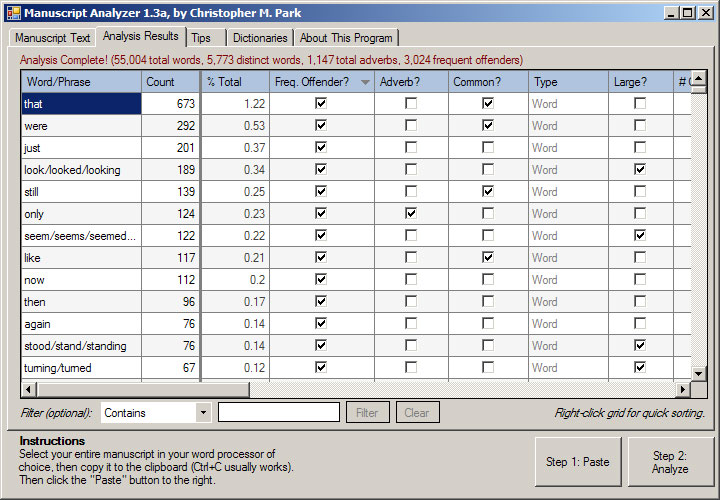
Manuscript Analyzer 1.3
- The dictionaries of Frequent Offenders and Phrases have been updated. Due to the self-updating nature of the dictionaries, a new release of the software was not actually required for this feature, but it bears mentioning.
- All dictionaries now support grouping of "like words" into single entries. For instance, "look/looked/looking" are all now shown as a single entry, rather than three separate entries. This gives a much more accurate view of the frequency with which frequent offenders are used.
- A filter feature has been added. This allows you to quickly filter out any entries that don't meet criteria of your choosing. At present, you can require that words contain/start with/end with a set of characters, or you can insist that a word or phrase "Equals" a specific value (for example, bring back only the word "and," without including other results like "andy," which the "Contains" filter would include).
I've recently added some screen shots to my tools page. You can also see them here:
UPDATE: 1.3a is now the current version online, as that fixes a minor issue with sorting that was introduced in 1.3.
Monday, January 7, 2008
Forward Motion
So that's what I did over the holiday break, in those few spare moments -- I worked over my first chapter again, and also worked on a couple of specific spots that came later on in. Tonight I realized what was happening, however, and decided to put those revisions on hold. If I keep revising as much as I have been so far, I'll never finish my first draft at all. So instead of revising Chapter 2, I jumped ahead to chapters 9 and 10, and revised both of them. This is in preparation for tomorrow, when I'll actually write new scenes for chapter 10 (I always have to do some revision of the preceding scene if there's been a gap of more than a few days in my writing, just so that I get back into the flow/mindset of that last scene I wrote).
In all, through this time I've managed to lose about 200 actual words, and no pages (so no estimated words, either). Still, I'm really pleased with those edits that I have made -- and also that there were so many things that were already "right," or at least close to it, that I didn't have to change.
The stats as of today:
-47,250 estimated words.
-55,302 actual words.
-Nine and a portion fully-revised-and-expanded chapters (155 pages total).
-189 pages in all.
-Song(s) listened to while writing: Meet the Robinsons soundtrack
Andrew Olmsted
Friday, January 4, 2008
Holiday Roundup
First off, thanks to a post by literary agent Jonathan Lyons, I read this very interesting piece by Dave Eggers. The part that is particularly interesting is his bit on selling out, which is a longish addendum to his response to the initial email. I've never had much concern over how avant garde anything was, but it was very interesting to read the rant of someone who once did, but no longer cares. I agree with Eggers' conclusion that tracking "sellouts" is just another form of fashion, and that might very well explain why I've never had any interest in it.
I saw an interesting post called Respecting Romance over at the BookEnds Literary Agency. This post was all about why some romance writers are embarrassed by their chosen genre, and why they shouldn't be. I don't read very much romance, and I definitely don't write it, but it recalled to mind the stigma that surrounds sci-fi and fantasy. I think most genres have some sort of stigma, actually, but here again -- it's all fashion. Write because you want to, and because your topic interests you. "Great art" can be formed in any genre -- any medium at all, in fact, as many artists have demonstrated.
Next I want to point out a post called Critters Vs. Betas (and the Dreaded Spouse Question) over at Dwight's Writing Manifesto -- and not just because he mentions me in the post. I recently posted some of my thinking on the topic, but Dwight has a new way of looking at it that I hadn't quite thought of before.
Literary agent Kristen Nelson recently made a post about the new Top Dealmaker feature at Publisher's Marketplace. I thought it was really useful information, and quite insightful (she usually is). It's good to have an agent's take on this sort of thing.
On an off-topic note, Stephen Parrish recently posted about Dinner For One, "a British one-act play [that] is a New Year's Eve tradition in Germany." Shortly after he mentioned this play (first time I'd ever heard of it), a German friend of my uncle brought it up. Go figure. Interestingly, the Wikipedia entry on the play notes that "although the sketch is most popular in non-English speaking countries, it is typically shown in the original English without dubbing or subtitles. Curiously, the film remains practically unknown to the English speaking world (except for Australia)." How very curious, indeed! Can you imagine a work of yours becoming a yearly tradition in some other country, but being utterly uncared-about in your native land?
I re-watched Terry Gilliam's cult classic Brazil the other day. It's a dystopian movie that made a big impression on me in high school, and which I've since counted as one of my top favorite movies even though I hadn't seen it for over eight years. My wife got it for me on DVD as a Christmas present, which was a really pleasant surprise. I was a little worried it might not seem as good now that I've grown up a lot more, but actually it was better than before. This movie is dense with symbolism, dark humor, and pointed social commentary. If you haven't seen this one, it's definitely worth a look -- the ending is probably my favorite movie ending of all time.
Have you ever heard of the (in)famous lexicographical term Mountweazel? I'm confident you'll find that trivia article both edifying and humorous.
Over the holiday break I read Stephen King's much-touted On Writing, and found it to be quite good. Most of you have probably read it already, but if not, it's definitely worth a read.
Another book that I'm finding even more helpful at present is Chris Roerden's Don't Murder Your Mystery. This is a very nuts-and-bolts book on writing, specifically aimed at Mystery writers. Don't let that fool you -- this gem is extremely applicable to all genres. The author has been a professional editor for over forty years, and she (yes, she's a female "Chris") really knows her stuff. For me, this book came at just the right time. I hope it finds you the same way.
And, I think that was about it!
Thursday, January 3, 2008
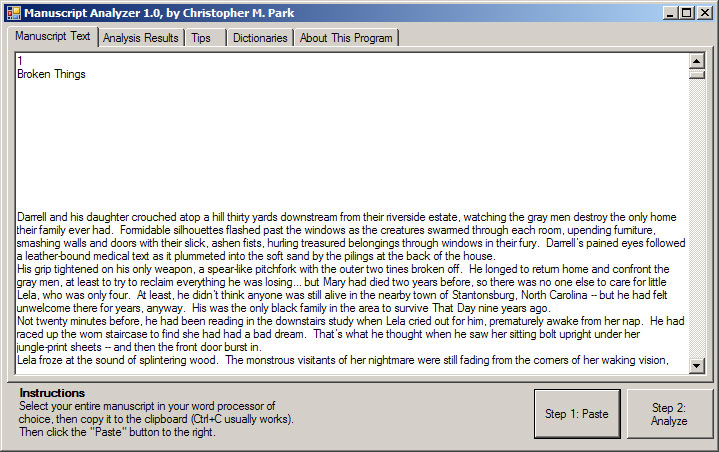
Manuscript Analyzer 1.0
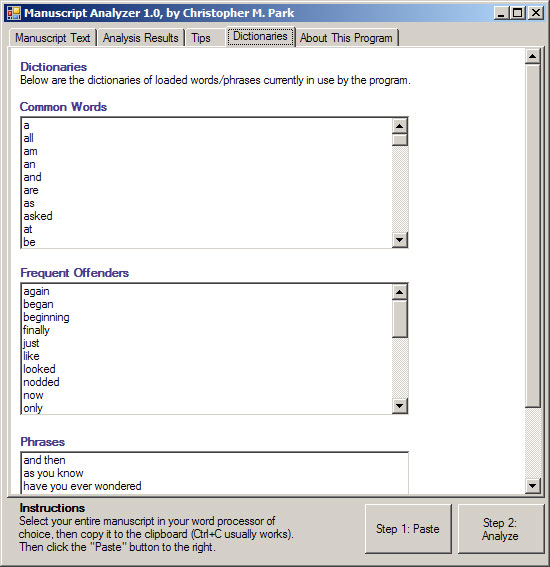
As part of this new page, I'm also releasing the very first version of a new tool that I've created for writers . It's called Manuscript Analyzer, and is a pretty unique tool for aiding writers in doing some forms of analysis of their manuscripts. There are a number of programs that let you count the frequency of words in a document, but this takes it a step further and helps you identify junk phrases, "frequent offender" word patterns, and adverbs. It also lets you ignore common words that clutter up the high ranks of other word-counting programs, and allows you to focus on words by size.
Best of all, the dictionaries for all of the above can be extended by users via simple text files. This program auto-updates its dictionaries. As is noted in the "About" tab of the program itself, I'm very interested in ideas for how to extend this program even further. This is actually something that I just started coding this evening (seriously), so I'm sure there is a lot more that could be added. But I think that you'll find what's there to be quite robust and useful as it is.
Saturday, December 29, 2007
An Unusual Litmus Test
...
Now that you have returned, let me first note I certainly agree that Anne's logic applies to almost every situation. However, most people tend to believe there are exceptions to every rule, and of course they tend to believe they fall into the minority that is the exception. Especially when it comes to issues like this.
Interestingly, I've read several published authors who noted their spouses were their first reader/editor. Stephen King, Orson Scott Card, and Bill Watterson (who wrote/drew the comic strip Calvin and Hobbes, and thus wasn't truly in this industry) all come to mind. I'm sure you could come up with many other examples.
There are two points I'd like to make on this score. First, readers would do well to remember that what a person says when publicly thanking his/her beloved is not necessarily the full truth. Secondly, most of these writers noted looking for general reaction from their spouse, usually on a chapter-by-chapter or realism basis, rather than on a line-by-line basis. But I'm sure it varies. At any rate, aspiring writers would do well to not just blandly take such comments of published writers at face value.
That said, I do believe my wife is an incredibly valuable first reader/editor to me, even on a line-by-line basis (and I believe I have a good litmus test for objectively determining she is -- more on that below). First of all, she has a degree in comparative literature, and is a voracious reader of the same genres I write in -- she's much wider read than me in general, actually. Secondly, she's done enough writing to know what she's doing. She hasn't written as much fiction as I have, but it's not a race.
All of that just gets her into the ball field of being a potential first reader, except for the pesky issue that she's my spouse -- and here's where my litmus test comes in. Ask yourself this: would you or your spouse be offended/upset/surprised/displeased by trading constructive critiques post-coitus? As in, “that wasn’t very good for me?” If you’re uncomfortable answering that to yourself (don’t tell me -- I really don’t want or need to know) then your spouse probably can’t be your editor regardless of his/her other qualifications.
But if you’re so uninhibited around each other that giving direct, un-couched feedback on your most intimate acts is a normal and accepted practice between the two of you (after all, the comments are only designed to help), then you can probably be reasonably certain they aren’t couching things when discussing your novel. Although, even then, be on guard at first -- it’s far too easy for your beloved to want to be supportive at the expense of not being constructively critical at first. Here’s a good law of editing (in the mathematical sense) I’d like to propose: if all your feedback from your first reader is unequivocally positive, it wasn’t helpful. Even if the person loves your book to death, he or she should find about ten thousand things wrong with it, and tell you just why each one is wrong (or say it just doesn’t rub them right if they can’t tell).
So that’s why I think my wife and I are one of the very few exceptions to this particular rule -- yet even then, she is my first reader, but certainly not my last before querying. I think my litmus test holds water, but I’m not aware of many people who seem likely to pass it (of course, it isn’t exactly a topic I ever discuss with anyone), so for most aspiring writers this is probably a moot point in the first place. When in doubt, follow the advice Anne has already laid out in her posts on this subject.
Friday, December 21, 2007
Overusing "That"
Thursday, December 20, 2007
Prewriting
It's not that I haven't had motivation (though I haven't had much time). It's that things just haven't been feeling quite right. Things have seemed harder than they should, than they have in the past, and I haven't been able to shake the feeling that I just am not close enough to my characters. Hence tonight's earlier musings, as well as this character prewriting work. I don't think I'm fully there yet, but I am getting closer to the point at which the full weight of my momentum should hit, and I should be able to blaze through at least another substantial portion of this book.
Also, I did manage to revise my content from last time, and I actually wrote another two pages of new content. It came very easily tonight, after all my prewriting. All right! But that doesn't necessarily mean I have my momentum back. We'll see what the upcoming holidays do to that.
The stats as of today:
-47,250 estimated words.
-55,491 actual words.
-Nine and a portion fully-revised-and-expanded chapters (155 pages total).
-189 pages in all.
-Song(s) listened to while writing: Sick Cycle Carousel and Somebody Else's Song, both by Lifehouse
Thoughts on Writing
One of the critical things about writing well is to do the unexpected. This means if the next scene seems obvious, or little more than a bridge to the scene after that, you probably shouldn’t be writing the scene in question. This means that your characters have to be unique, and have enough interesting attributes to keep the reader following them. In my case, this also means there has to be enough to keep the reader sympathetic to the main character(s). If there isn’t something admirable or unique about the character, they just seem like another everyman, or a prop in a play.
One key aspect of this is that the character must be strong enough to make his or her own decisions, despite where you (the author) think the story is going. This might mean that some smaller scenes won’t work or can’t play, or even that some whole scenes might have to go -- a romantic scene with Ender would have been disastrous, and would have completely killed parts of his character.
This means that certain conversations, which the author might wish to have proceed in a certain fashion in order to disseminate information in the most efficient manner, will instead go in an entirely other direction. This is how depth and complexity is created. I have a tendency to feel frustrated or flustered in such cases, because I feel like I’m not writing tightly enough in terms of plot -- but in reality, not every scene is going to advance the plot by light years. The best books have plot and character development interwoven in every scene, but in many cases the plot development is so slow as to be almost unnoticeable. The novel is book-length because the main plot is doled out in little bits, after all.
One big issue with my own writing is that scenes which are just filler, or scenes in which the protagonist is passive, tend to crop up too much in early drafts. Identifying those sooner than later and killing them is a good idea. I’ve gotten a lot better about the filler issue, but the passivity issue is a big problem. After all, I tend to model the characters after myself, and my general strategy in life is to accumulate knowledge/power until I have an assured positioning for victory, and then to strike the finishing blow all at once. This strategy is actually very effective in practice, but it doesn’t exactly make for the most riveting writing, as the build-up period is comparatively dull.
This means I will always be slightly out of my element when writing, if I want to remain interesting to my readers. I will always have to use the strategy of taking smaller actions early and often, still with an eye to that big finish, but without the painful comfort of doing little in the meantime. This is something that I’ve been forcing myself to do with my last two works, but it still isn’t something that is entirely comfortable to me.
Interestingly, my older works were often much less cautious, but also much less practiced. I’ve changed since then. I’ve learned patience and caution, at times at a rather steep price to myself. What I have to learn is that these virtues are not necessarily virtuous when it comes to the body of my writing itself -- but they are certainly helpful in weathering the creation process itself.
Tuesday, December 18, 2007
Black Hole Blasts Neighboring Galaxy
Yet another thing for people to fear: intergalactic radiation that suddenly wipes out Earth's atmosphere and magnetic field. Apparently the researchers that saw this think that the same thing could actually happen to the Milky Way in about a billion years, when it starts merging with the Andromeda galaxy. Well, look on the bright side: maybe our sun will have imploded by then, anyway.
I have to say, this sort of thing really strikes me as interesting partial-premises for sci-fi novels. I know that a lot of the far-future dying-sun stories have already been done, but I still hunger to someday do something of the sort. There are just too many interesting ideas to write them all!
Friday, December 14, 2007
I Am Legend
Well. I think that "too little gore" is easily answered: it's just not that kind of movie. And frankly, I think the opposite advice can be given to most modern horrors, so it's obvious that I'm just not on the same wavelength with those reviewers. We'll chalk that up to taste.
Secondly, my wife and I both felt the movie was immensely suspenseful. The key word here is suspense -- this was more in the tradition of M. Night Shyamalan or Alfred Hitchcock (both of whose work I love), rather than George Romero. To note: I did enjoy the original Night of the Living Dead and Dawn of the Dead, but I was less than thrilled with Day of the Dead, and haven't wanted to see any of the more recent entries or remakes from that line. I also enjoyed 28 Days Later, though I felt it was overly bloody, and I quite enjoy Stephen King novels (the most obvious comparison being THE STAND, of course, which I believe must have been at least partly inspired by the original novella of I AM LEGEND -- King has noted that he is a fan of Richard Matheson).
So, given all of that, I must say that I thought that this was one of the most suspenseful movies I've seen in recent years. The use of silence, and of light and darkness, was masterful. The CG creatures weren't quite what I expected, but they didn't seem out of place at all to me. The largely solo acting by Smith was his best work, in my opinion -- he displays a fairly wide emotional range here, and does so subtly and convincingly. Those who complained of "wooden" acting, especially referring to the scene in which he recites from the movie Shrek, are simply missing the point. This is a moderately subtle movie that trusts the viewer to catch the emotional cues without the aid of music or extended dialogue. It's all about Smith's expressions, body language, tone -- and that's why I feel like it's his best work.
As for inept storytelling... there are flashbacks, as there are in the novel, and I think that was the main complaint. I thought those were well done, and provided some interesting contrast to the "present" events of the story. I suppose this is a matter of taste once again. Don't get the wrong impression, by the way. It isn't that the movie has done particularly bad with the critics -- it's middling on rotten tomatoes. I just felt that it should have done much better than middling.
The chief complaint that I could lodge against this movie is that it will probably make diehard fans of the book unhappy. The core twist is changed -- and thus the very meaning of the title is altered rather dramatically, actually -- and this will upset those who simply wanted to see the big-screen version of the Matheson novella. However, for those fans who understand what this movie is -- both a modernization and a retelling of the classic tale, with a weaker ending but a much more likable protagonist -- there's a lot to love here.
Changing The Spacing Of Your Manuscript
Hours of tedious work? Not hardly! Using nothing more sophisticated than the "Find and Replace" function in MS Word, here's how to reformat your manuscript to add two spaces instead of one. Just follow these steps in order, and you should be good to go. It also works on manuscripts that are half and half -- part of it formatted with the correct two spaces, part of it formatted with only one.
Of course, as with any large-scale change you make to your manuscript, make sure and save a copy first! If something should go awry for whatever reason, you don't want it to happen to your only recent copy.
Now, on to the steps:
1.) Open "Find and Replace" in MS Word by hitting Ctrl+H in windows, or by looking under the Edit menu and choosing "Replace" (the menu location may vary slightly by Office version, especially in the 2007 edition, which moved the location of a lot of things -- I'm using Office 2003).
1.a.) Step two and below will use the character "_" to represent a literal space (since you otherwise couldn't see it), and square brackets [] to indicate the boundaries of the text you should be finding and replacing. When entering these values into your textboxes, omit the square brackets, and use a literal space where I show the underscore.
2.) Search for [._] and replace it with the value [.__]
3.) Search for [."_] and replace it with the value [."__]
4.) Search for [?_] and replace it with the value [?__]
5.) Search for [?"_] and replace it with the value [?"__]
6.) Search for [!_] and replace it with the value [!__]
7.) Search for [!"_] and replace it with the value [!"__]
8.) Search for [:_] and replace it with the value [:__]
9.) Search for [._._.] and replace it with the value [...]
10.) Search for [...__] and replace it with the value [..._]
11.) Search for [___] (three spaces) and replace it with the value [__] (two spaces)
Unless you have strange formatting or other interesting punctuation, that's it! And I'm sure that you can see how you can apply these general principles to other types of punctuation, or strange types of speech-delineation, like the carrots (<>) that are used to identify thought-speech in Orson Scott Card's SPEAKER FOR THE DEAD.
The key is to run all your replaces that are like 2-8 first, so that you have at least the correct number of spaces after each sentence; then run numbers 9-11 to collapse any inappropriate extra spaces back down. If you're worried that things have gotten very out of whack, you can even run numbers 10 and 11 repeatedly, until they find nothing more to replace (that's actually not a bad idea to do, anyway, just to be sure).
I used this logic to successfully reformat my own manuscript several months ago, and I haven't found any problems with it in the interim. But I'm not the biggest expert on the rules of two spaces versus one, so if you see a hole in my logic, or if there's something I'm omitting, please let me know and I'll update the post. Happy formatting!
UPDATE 1: Someone pointed out on Anne's blog that this sort of logic incorrectly adds too many spaces after abbreviations. Since I didn't use any of those in my WIP, I didn't have that problem. But adding lines to search and replace things like [Mr.__] with [Mr._] would work, presuming you know, or can at least guess, all the abbreviations you used.
UPDATE 2: The list has been simplified a bit regarding quotes, thanks to a comment to this post.
UPDATE 3: Actually, that simplification was invalid, as another comment pointed out. In order to avoid adding extra spaces in cases like [what I think,"_said Tom.], the full steps above are necessary.
Wednesday, December 12, 2007
A winner is me!
The stats as of today:
-46,750 estimated words.
-54,902 actual words.
-Nine and a portion fully-revised-and-expanded chapters (153 pages total).
-187 pages in all.
Thursday, December 6, 2007
Another Scene Down
Today's scene was very brief, but I think that's a nice counterpoint to the longer ones I usually write. I also think it was a fitting length for this particular scene, which ends suddenly and surprisingly. I had been a little unsure how to write this one, but it turns out that I was thinking I was going to write it from one perspective, but really needed to write it from another character's pov. What would have been expected and relatively uninteresting the first way became something surprising and unexpected this way. And brief! Let's me move on to the next scene, which is more important anyway, which is good.
Now I just need to figure out exactly how I want to write that one. Sometimes having the right plan is well over half the battle. I don't expect to get much done on that tomorrow, though, since that's my birthday and I'll likely be otherwise occupied. The big twenty-five! I'm not sure if it seems stranger that I've lived a quarter of a century, or that I've only lived a quarter of a century.
The stats as of today:
-45,500 estimated words.
-53,639 actual words.
-Nine and a portion fully-revised-and-expanded chapters (149 pages total).
-182 pages in all.
Monday, December 3, 2007
More on Chapter Ten
The stats as of today:
-45,250 estimated words.
-53,263 actual words.
-Nine and a portion fully-revised-and-expanded chapters (147.5 pages total).
-181 pages in all.
Attributes That Identify Your Writing
So that got me thinking: what aspects of my writing are distinctly "me," and present in all of my works? To date, I've written two Science-Fantasies (that's a real book category, not something I made up), and I'm working on one Dark Fantasy that's set in the future of our modern world, so in some senses is a bit like science fiction (just with magic). So here's what I came up with:
1. All my works have both magic and technology in them, to some greater or lesser degree.
2. All my works have characters with modern outlooks. Either my story is set in modern times, in the future, or in an alternate universe.
3. All of my books have a dark streak to them. Main characters are not safe from death, though I'm not cavalier about that.
4. Multiple cultures are always present in my works, and often multiple languages are present, as well.
5. I usually make use of some non-European mythology or folklore as the underpinnings of parts of my story or world.
6. There is usually a blend of locales in my stories that includes industrial/commercial locations as well as deep wilderness locations.
7. There is almost always some sort of Eastern influence in my works, usually Japanese, Korean, or Chinese (or all three).
8. Entropy is a theme (or at least a strong element) in every last work I write.
There are probably other things, too, but that's what I could come up with off the top of my head. In my biased, non-expert opinion, I think that this is enough to tie together a readership and build a fan base that can enjoy all my works. I don't plan to write any thrillers or horror or romance, though those elements may creep into my various works to greater or lesser degrees. But the core sci-fi / fantasy mix, and other elements that I mention above, are always part of my works, and should make a story recognizably mine once people have read a couple of my pieces. The main question is the ratio of sci-fi to fantasy, and that's something that varies work-to-work for me.
What about you? What attributes permeate every work that you write? Everyone has something, even if it's only one or two things. For instance, Orson Scott Card, who writes in something like four genres, is well known for always including interesting ethical dilemmas in every one of his works. Even if it's something as broad as that, or the fact that you always have strong female leads, or always write in a certain notable voice, you probably have something consistent in each of your works. So what is it?
Saturday, December 1, 2007
A good way to start the month.
I also had a pretty striking realization today: I really don't need to write things in sequence. I've always tried to do that, because when I wrote the endings to books long before I finished them, it never felt right by the time I actually got there. The characters and story had matured in different directions than I had originally expected.
However, part of what makes me feel like programming is easier than writing is that I can break even the most complicated programming down into discrete parts, and I can attack each piece individually, in whatever order I choose, and then I can put it all together and polish it up and it's done.
Well, today I realized that I can do that same sort of thing on a smaller scale with my writing, too. I was having ideas for dialogue farther into today's scene, which I was trying to hold in my head while I figured out the start of the scene. After twenty minutes of this, I realized I should just write down the later stuff so that I could free up those resources in my brain. That turned out to be about a page of material, all told. Then there was another section that came shortly after the first that popped into my head, and I wrote that down.
The funny thing is, that made it much easier to write the opening of the scene, too. I knew where the scene started, and where it quickly needed to get to, so I just wrote the appropriate (brief and interesting) bridge. Sometimes having too many options can be paralyzing, as we all know, and by writing something that I was certain about that came just a bit in the future, I reduced my options for the earlier bridge paragraph so that I could more easily make the right decision and just be happy with it.
Funny how that works! I'm definitely going to have to keep this technique in mind over the coming weeks, and see if that makes things easier. I suspect it really will. With programming, often there is a piece that I just don't want to do, because it seems too big and unpleasant. So instead I just do lots of other little pieces that contribute partly to the big piece, or even that are unrelated, and when those are done I just have the big piece left and it doesn't seem so bad. I'm a much faster programmer than I am a writer, and I bet that has something to do with it.
The stats as of today:
-44,500 estimated words.
-52,536 actual words.
-Nine fully-revised-and-expanded chapters (145 pages total).
-178 pages in all.
Friday, November 30, 2007
A good way to end the month.
The stats as of today:
-43,750 estimated words.
-51,516 actual words.
-Eight and a half fully-revised-and-expanded chapters (141.5 pages total).
-175 pages in all.
Let's try this hook thing again...
Nine years have passed since the Dead ended civilization, leaving only tiny splinter societies behind. Darrell Williams, a black doctor in a rural white town, is one of the few survivors in a countryside of roving monsters and encroaching wilderness. When his house is stormed by his undead neighbors, he escapes with his daughter, Lela, to find asylum with refugees in an abandoned electronics factory.
Yet something about the post-civilization world is changing. The uneasy equilibrium between the survivors and their supernatural tormentors is suddenly lost. The Dead are becoming erratic and aggressive, and seem to have a particular interest in Darrell’s family. Four-year-old Lela discovers clues to the twisted logic that drives them -- but then she disappears. Darrell is left to search for answers and his daughter with only the help of strangers in a hostile, ruined world.
Nothing is simple with hooks, is it?
One More Hook
Nine years have passed since the Dead ended civilization. Darrell Williams was once a respected black doctor in a rural white town, but now he is one of the few survivors in a countryside of roving monsters and encroaching wilderness. When his house is stormed by his undead neighbors, he escapes with his daughter, Lela, to find asylum with refugees in an electronics factory many miles downriver.
Yet something about the world has changed. The normally-predictable Dead are suddenly erratic and aggressive, and seem to have an unusual interest in Darrell’s family. Four-year-old Lela discovers clues to the twisted logic that drives them -- but then she disappears. Darrell is left to search for answers and his daughter with only the help of strangers in a hostile, ruined world.
Thursday, November 29, 2007
Hooking Again...
Nine years have passed since the Dead ended civilization. The few remaining survivors huddle in isolated towns that have been refit to repel the nightmare creatures prowling the countryside. Darrell Williams was once a respected black doctor in a rural white town, but now he is haunted by the memory of his wife, Mary, slumped against the furniture store window where she was inexplicably murdered by transients. He will never forget how the undead rage transformed her as she rose to kill the family she had cherished only moments before.
One quiet morning his house is stormed by his neighbors, all of whom apparently perished during the night in a fire that his four-year-old daughter, Lela, glimpsed in her dreams. The two find asylum with refugees in an electronics factory many miles downriver, but the Dead are escalating out of control there, too. As the creatures become unusually erratic and aggressive, little Lela discovers clues to the twisted logic that drives them -- but then she disappears. Darrell is left to search for answers and his daughter with only the help of strangers in a hostile, ruined world.
Wednesday, November 28, 2007
Progress Update
In other news, the holidays take up a lot of time. Actual events are only part of it -- then there's the shopping, planning, etc. And trying to get all my day-job work done before the end of the year, to make sure everyone is happy before I take off a week and a half around Christmas.
Oh, and I came up with a new title for ALDEN RIDGE. I've been searching for a more evocative one for months, struggling with many dimensions of the story/themes, etc. No luck. Then, after yesterday's post at Pub Rants about titles, I finally had the idea to look through proverbs and idioms from various other cultures to see if that sparked anything. Turns out I found a Chinese one that sparked a great title! But right now I'm sitting on it, waiting a few days (or possibly weeks or longer) to make sure this title sticks with me before I go announcing it to the world. So for now, in public, the book is still ALDEN RIDGE. But I'm very excited about the new title (now I've probably hyped it to the point that you'll be disappointed when I do "unveil" it).
Thursday, November 22, 2007
Thanksgiving Trivia
Happy Holidays, everyone!
Tuesday, November 20, 2007
More on Chapter 9
Also, I passed 50K actual words today. All right!
The stats as of today:
-42,750 estimated words.
-50,394 actual words.
-Eight and a half fully-revised-and-expanded chapters (138 pages total).
-171 pages in all.
Monday, November 19, 2007
Plotting, Revising, and Progress
The latter half of the novel is becoming increasingly concrete in my mind, which really helps to alleviate my worries of getting lost after my current solid plot threads run out. I'm really starting to get a full sense of this entire book, to the point that I think I won't ever completely run out of material before I reach the end. If that happens, that will be a first for me.
The stats as of today:
-42,000 estimated words.
-49,334 actual words.
-Eight and a portion fully-revised-and-expanded chapters (134 pages total).
-168pages in all.
Why some readers don't read.
However, I do have a less depressing theory about why at least some of the people in the 17-22 age bracket are reading less. I'm 24 myself, and I can tell you that I probably almost fit into those poor statistics (when it came to pleasure reading) during the 17-22 age bracket -- as did most of the other book lovers that my wife and I knew.
Now, all of us were certainly reading plenty of textbooks, newspaper/journal articles, and nonfiction works related to our careers (programming/computer work, in my case), but pleasure reading was a rare thing.
This is because the pressure on juniors and seniors in high school is higher now than it ever was, and most of us were taking 5 or 6 college-level classes that kept us busy. Plus all the various extracurriculars -- sports, music, clubs, etc -- that the modern teenager is involved in. College is also a very busy time for most, either because of all the intense socializing and such that many subscribe to, or (in my and my wife's case) all the extracurriculars. We both were working through college, not because we had to in order to make ends meet, but because we didn't want to erode all our savings while in college, and because we each had opportunities to jump-start our careers in a major way during that time period. The year after college is also very busy, often even traumatic, for most students as their social life disappears (if they were that sort) and they start job-hunting (in a very tight market at this point -- competition isn't just fierce in the publishing industry).
What my wife and I are now seeing, with all our friends having been out of college for a year or two, is that everyone is reading a lot more again. We recommend books to our friends and vice-versa, we talk about what we like, and some of our friends even formed an impromptu monthly book club as way to keep in touch.
If you look at what all of our reading habits are now, we're probably in the top to upper-middle percentages (depending on what else the individual has going on in a given month), whereas we were all in the lower percentages just a few years before. And these are all people who grew up reading in the top percentages, all of whom participated in "Battle of the Books" competitions and other reading programs as a kid, and most of whom write short stories, poetry, or novels.
I don't pretend to know what everyone in the world is doing, and certainly the lack of literacy in many people I know is a little bit shocking. However, statistics can be misleading, and I think the notion that the current generations won't have any/many readers is a false one. I think certain societal conditions make reading difficult even for those who love reading during the late teens and early twenties -- but before long, those who love it will resurface on the other side.
I suppose we'll see if I'm right in about 10 years, when we see the statistics for the late-twenties crowd. At worst, I would be willing to bet serious money that many people rediscover their love of reading when they have kids, and start reading to them. Hopefully that then leads to other kinds of reading for the adults themselves.
What advice would you have wanted at the start of your career?
I finished my very first novel back in 2001, when the market was a bit different and there was a LOT less information available on the Internet for aspiring writers. I subscribed to Writer's Digest, but even that didn't help much at the time, for whatever reason. At any rate, I decided that I didn't want to be paying somebody else 15% of my income for the rest of my life, so I tried sending my novel directly to publishers -- one at a time, since they didn't accept simultaneous submissions. At any rate, I didn't hear back from the first one for fourteen months, so I sent out the next submission to a second publisher. I never heard back from them, either, and I assumed that was just it.
I wish that I had known to submit to agents, back then! I also wish I had realized all the many services provided by agents. I think that a lot of truly-green aspiring authors just don't get that agents are actually a valuable asset to their career, rather than the imagined money drain that some seem to think they are (or even just an extra step -- why go through two steps when I can just approach the publisher?).
I finished my second book in 2006 (I took four years off after my first silent failure, largely because I was going through school, starting my day-job career, getting married, etc, at the time). This time there was loads more information on the Internet, but I still jumped the gun on my first query. I found a big-name agent who represented a crazy number of authors I love, and I decided to send him, and only him, a query to start. Worst of all, his agency had a policy of not responding to queries (e-queries only there) if not interested.
So after a month I had nothing back from him, and that was a bit demoralizing. Fortunately I had spent that time doing more research, and I built up a better list to query. I also learned just how bad that first query letter was -- I included something like four or five flags that said I was a newbie. I've blogged at length about the whole process I went through before, so I won't repeat all that here, but suffice it to say there is a lot to learn, and it's hard to learn who to believe on the Internet without a LOT of reading. And even those sources that are reputable give seemingly conflicting advice at times -- sometimes it's not clear when they are speaking for themselves, or "the industry as a whole" (which is hard to do).
I wish that somebody had told me about all that complexity, so that I would have had the proper expectation of doing the research necessary to make myself comfortable with the whole process -- and so that I wouldn't have shot myself in the foot quite so many times. Plus, I wish I had known more of the expectations of pacing, etc, for a modern debut -- something I learned a whole lot about from Anne's blog, actually. Though several agents remarked on the ingenuity of my premise for my second book, those that did respond in a personal manner felt the pacing was too slow. I presume that all those that sent back form letters, or didn't respond at all, probably agreed.
Because, you see, I was sending sample pages (30 at first, and later 10 once I wised up) with every query. That meant that I never got a single request for partial, not that I'm certain I would have otherwise. Not having sent so many pages with each query also would have meant I might have saved $100+ in postage, incidentally.
I wish I had known how to format a manuscript properly (just double-spaced isn't enough), and that I had known how to do a proper title page. It would have been such a big help if I had been a lot better at writing query letters, since so much is riding on that. Writing effectively in a condensed format was not a skill I had at all until fairly recently (this speaks to the source of the overwriting in my second book).
All of this, plus the various issues of novelcraft that I learned or still am learning, is all what I would have liked to have known. If you read writing books from the early or mid 90's, the authors tend to make light of the whole process, and that makes the modern commonality of bland rejection hurt that much more. I think that, previously, new authors started with a smaller audience and worked their way up (or petered out). It seems like most now-famous writers of a certain longevity in the industry have a number of obscure titles under their belt from the start of their career. Not so much anymore, eh? Now it's sink or swim from the get-go, and all the "on the job" training that writers used to receive is now self-study homework that must be learned from trade magazines, conferences, and (reliable) Internet sources.
None of that ever would have occurred to me when I was just starting out. There's no way to tell everything to someone with no concept of the industry in just one sitting, so the best thing would be just to get the general idea of what the issues are, and how much work is involved. Back when I was starting, my ego was overlarge and had not yet been trampled down to a respectable size by the process, so I probably wouldn't have believed someone who told me.
What's the solution? I'm not really sure. But this industry sure is a lot more Darwinian than ever before, I notice. That's kind of demoralizing in some senses, but in another sense I'll be that much more proud when I DO make it -- because it's never been harder.
Thursday, November 15, 2007
I'm on fire
The stats as of today:
-41,750 estimated words.
-48,855 actual words.
-Eight and a portion fully-revised-and-expanded chapters (133 pages total).
-167 pages in all.
Wednesday, November 14, 2007
Progress on Chapter 9
The stats as of today:
-40,250 estimated words.
-47,067 actual words.
-Eight and a portion fully-revised-and-expanded chapters (127 pages total).
-161 pages in all.
Tuesday, November 13, 2007
The Great Swampy Middle
Many thanks to Dwight's Writing Manifesto for mentioning this post in passing (that's another pretty cool blog on writing you should check out, by the way).
Finishing Chapter 8
The stats as of today:
-39,500 estimated words.
-46,097 actual words.
-Eight fully-revised-and-expanded chapters (124 pages total).
-158 pages in all.
Monday, November 12, 2007
Paul Potts
I saw this post about Paul Potts over at Pub Rants, of all places. I mean, you don't generally expect to read about an operatic singer on a literary agent's blog. It's a bit surprising that I'd link to this, because I'm not a fan of American Idol (at all), and this is basically a clip from the British version. But it's a pretty cool story how this guy got his start.
3 out of 4 people reading isn't so bad
Progress, Again, And Some Resolutions
Man. Makes me worry about how productive this holiday season can possibly be for my writing. Seems like there is always something new coming up these days. If writing was a full-time job, it would be no problem, but with so much of my time already obligated elsewhere, it does create pressure. At least I don't have kids yet -- I am in awe of those writers who somehow become published while working and raising kids.
At any rate, to increase my odds of coming even remotely close to my writing goals, I've made several resolutions. First, I'm cutting out television time. I'm not sure how this happened, but somehow in the last year I started watching a lot of TV. For about seven years in recent history I didn't watch any at all, so I don't know what happened there. I don't really even enjoy most TV shows that much, but it seemed like such a nice, mindless retreat after a hard day of designing software and programming and such. It became my habit to treat TV like some sort of recharging device, to let my mind idle and rest between getting off work and sitting down to write.
The thing is, after two hours of TV in the early evening (yes, sad, I know) I was usually just as tired as I was before I started, and frankly TV isn't very inspirational when it comes to writing (ahem). Plus if there was anything else I wanted/needed to do that evening, like household chores, errands, exercise, pleasure reading, or just spending time with my wife, that was going to cut into my writing time. Ick! It was making me feel like I was under very great pressure to do writing in all my spare time, but like I had very little spare time at all.
Somehow it didn't occur to me to just cut out the TV time until this weekend. Instead of TV, I did all those other things I wanted to do. If I was too tired to do any of that, well, I'd just let myself fall asleep for a brief nap, and wake up feeling really recharged. It's amazing what even just fifteen or thirty minutes of sleep can do for your body. So far so good on this approach, even though I haven't been using it for long -- I certainly don't miss the TV, anyway, and I doubt that will become an issue again. It's like when I became addicted to morning caffeine (like so many Americans) without realizing it: after about four years I saw what had happened, and I was able to quickly cut out the caffeine and haven't looked back (though now that I'm thoroughly detoxed I'm once again able to enjoy an occasional sweet tea or mocha latte). Sometimes these bad habits, many of which current society frankly encourages, just sneak up on you.
My hope is that, even with all the extra personal time commitments I'm going to have during the coming holiday season, I'll be able to maintain a good writing pace (and my sanity) by having cut out the "dead weight" of my daily schedule. Hopefully there should be plenty of time for merrymaking, relaxing/recharging, as well as writing during this schedule. And maybe I'll be able to accomplish some other things, like some art that I have in mind, and some new code for my uncle's robot, without cutting into that writing time.
You know, becoming a novelist really requires a level of commitment like no other career I can think of. Although, becoming an editor or an agent is close.
The stats as of today:
-38,750 estimated words.
-45,025 actual words.
-Seven and a portion fully-revised-and-expanded chapters (120 pages total).
-155 pages in all.
Sunday, November 11, 2007
The Art of the Finish: How to go from Busy to Accomplished
Friday, November 9, 2007
Wizard of Earthsea Miniseries Woes
Cosmic Rays on the Tennis Court
Each of the cosmic rays studied had energy in excess of 57 billion billion electron volts, about the energy of a nicely hit tennis ball. By comparison, the Large Hadron Collider at the European Organization for Nuclear Research, or CERN, near Geneva, will accelerate protons to a mere 7 trillion electron bolts [sic] when it turns on next summer.
“Such energies are so extreme that they could arise in only the most violent places in the universe,” the authors of the report wrote.
Okay, so a "nicely hit tennis ball" has 57 billion billion electron volts of energy in it, but the world's largest particle accelerator only produces 7 trillion electron volts? Apparently the energy found in cosmic rays can only originate from black holes or the tennis court -- "the most violent places in the universe."
Thursday, November 8, 2007
Digital Dreams
Since this has been an ongoing minor issue, I've finally bit the bullet and set up an online store from which people can order prints of my work. Certainly you're still free to look at my art in my online gallery, which has pretty high-res images (compared to what most artists would put up if they hoped to sell their work), and that's not something I plan to change -- I'm not going to lower the quality of my online offering in hopes of making a few bucks on prints.
If you enjoy my work and want to make a contribution to my computer art software fund (haha), feel free to stop by the store. Or if you just really like a piece and want a print for your home, office, or a friend, you'll be hard-pressed to do as high a quality printing as these.
But no pressure! I'm really not out to get rich off these. If you want to use my art on your website or something like that (non-commercially), I'm still generally happy to grant rights to those who ask.
PS - If there's a piece that you really want that isn't in the store, let me know and I'll see what I can do. I just have too many pieces to be able to put them all online.
Monday, November 5, 2007
Actual Progress
Amazingly, though, it's been about three weeks since I've actively worked on new content. I've got things well planned out for the next four or five chapters, however, so I'm hoping to make up for lost time this month. It would be nice if I can actually exceed my goal of reaching 172 pages (which seems reasonable), but I suppose that remains to be seen. There are plenty of real-life events that could still get in the way, but I'll try to keep that from happening.
The stats as of today:
-37,750 estimated words.
-43,926 actual words.
-Seven fully-revised-and-expanded chapters (116.5 pages total).
-Eleven completed chapters in all (151 pages).
Friday, November 2, 2007
More Revisions, More Cuts
The stats as of today:
-36,750 estimated words.
-43,059 actual words.
-Six-and-three-quarters fully-revised-and-expanded chapters (112 pages total).
-Eleven completed chapters in all (147 pages).
On Becoming a Published Writer
No, it's more than that. I'm learning how to recognize good writing, and how to tell when I'm not creating it versus when I am. I'm learning how to let go of the little passages that I love, but which just don't fit; how to maintain pacing to keep the reader's interest without sacrificing characterization; how to weave scenery description effortlessly into the action; how to reveal emotion and character by truly showing, rather than telling. I'm learning how to be a professional author.
It's funny, because a lot of that was stuff I already did intuitively. But when you work based on your intuition alone, your craft controls you, rather than the other way around. So when things aren't working (which inevitably will happen to every writer many times in every book), the purely-intuitive writer is going to be at a loss as to how to fix things. Not to say that this writer won't eventually figure it out through experimentation, reflection, or the help of mentors or peers -- just to say that it will either take more time and frustration than it should, or take that outside influence.
And that's a big thing for the aspiring writer -- outside influence. Those of us who are trying to become published (and who don't simply subscribe to ars artis gratia) are all looking for positive reinforcement. We want our friends, family, critique partners, and other first readers to love it. We want every agent we approach to offer to sign us, and for all the publishers to get into an intense bidding war and lavish a huge marketing budget on us. We want Hollywood to have such strong interest that we can dictate the terms to the point that we retain some level of artistic oversight, and we want to be on the NYT bestseller list and to get as many awards as Cormac McCarthy. While we're still aspiring, we can imagine that it will all happen for us on our first try.
When the first really hard rejection hits, it can be difficult not to feel like hanging it up. The really hardheaded among us, the career writers, don't feel like those dreams are gone after a rejection, just like we've been temporarily set back. The thought of quitting is there in our darkest moments, however, and it's tempting in many ways, but not really an option. Sure, maybe we could say that we quit for a few years -- maybe we could even think we had quit during that time. But sooner or later, we know we'll come back to it.
So we sit back down and write some more, but now it's with significantly less confidence, with significantly more hesitation. If we've gotten professional feedback from someone in the industry, we treat it as gospel -- to the point of harm at times. If we're told we're too wordy, our next book is severely underwritten. If we're told our pacing is too slow, our next book is a bit too fast. But these knee-jerk reactions are the sort of thing that can be fixed with careful editing and revision, fortunately, so the careful writer (who has thoughtful, competent, patient critique partners) might go on to good success with that second book. But at the same time, it becomes a lot easier to see why the average writer completes three manuscripts that don't sell before they come up with one that finally does.
Somewhere in this whole process, we have to start to learn to stand on our own. We have to start realizing that the recognition of the industry, or the reactions of our critique partners, or what anyone else thinks, is less important than what we know. We finally have some feeling for what is good and what isn't, and the comments of others only augment that knowledge, rather than always superseding it. This isn't to say that we become arrogant, or that we no longer listen, just that we become a semi-experienced member of the industry in our own right, and no longer feel the newbie's constant need to do whatever someone with a few credentials says. We become discerning, and listen to some people in the industry, and not to others. We form our own informed opinions. And when we do sign with an agent, and then with a publisher, hopefully we're in a position to act like a real novelist should: like an informed, courteous, open-minded professional with a spine.
Of course, there are those who shortcut this whole process, and find success more easily than most of us. But I wonder who is better off: the writer who suffers in ignominy for years, building discipline and knowledge before joining the ranks of the published author; or the writer who produces a publishable work on talent alone, and who goes into the industry without knowledge, experience, or a real appreciation for how valuable their new profession should be to them?
I'm not speaking of anyone in particular here. I actually don't know any writers who fit the second description. Everyone I've heard of had to work their way into the industry over many years, and essentially took the first path. Even novelists with famous parents, like Joe Hill (Stephen King's son). Yet this second path is the goal of so many aspiring writers, and so many of us seem to feel a little bit like failures when it doesn't happen. Not being an overnight success doesn't make you a failure: it might just make you more likely to be a sustainable success when you do make it.
When you're still on the upward slope, however, sometimes that's hard to believe. That's all a part of learning to stand on your own, without needing the overt support of someone in authority. I'm not completely there yet, but I'm a lot closer than I once was. Here's wishing the best in this regard for the rest of you, too. Here's hoping that we all have the endurance that this profession requires.
Misheard Lyrics
This one actually was something my sister first showed me a couple of years ago, but I didn't have a blog back then. Maybe you've seen it, but I still find it hilarious:
Great haystacks my destiny...
Thursday, November 1, 2007
Negative Progress is Good?
The stats as of today:
-37,750 estimated words.
-44,782 actual words.
-Six-and-a-half fully-revised-and-expanded chapters (112 pages total).
-Eleven completed chapters in all (151 pages).