Showing posts with label Publishing. Show all posts

Friday, March 6, 2009

Questions about Manuscript Analyzer

This morning I received some excellent questions about my tool Manuscript Analyzer, so I thought I'd take the time to address those here. Here were the questions:

What are the definitions of the items you point out, such as frequent offender, common, etc,? Why are these items important? Are they good or bad styles? Who decided that these particular items should be pointed out?
So, without further ado, the answers:

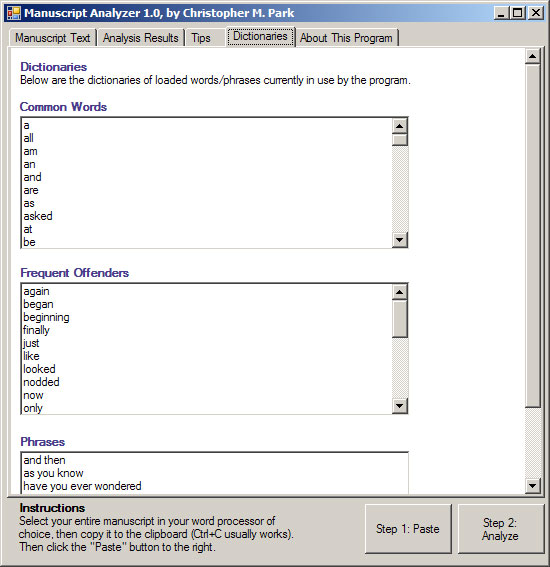
If you look down under usage tips on this page (http://www.christophermpark.com/manalyzer.php), it shows you the basic definitions. Frequent offenders are simply words that are commonly overused in manuscripts. The source for those are ones that I've noticed, as well as ones noted from such books as Don't Sabotage Your Submission, and various agent blogs (Nathan Bransford is an excellent one).

Common words are just small words like "a," "the," etc. Repetition of these is usually not an issue, which is why the tool lets you ignore them.

Phrases are cliches, mostly, but also redundancies ("and then", etc) which various agents have blogged about bothering them. All of the decisions about what to include were my own, however -- I wanted a tool like this to help me analyze my own manuscripts (making it available to others was a secondary occurrence).

These are all to be used as guidelines only, but if you are using any of the phrases, your wording is probably not as original as it could be. If you have a high repetition of any word that's not in the dictionary, you're probably overusing it. There's an early chapter in Don't Sabotage Your Submission that talks a lot about word repetition, but this tool helps you to automatically do the counting on a manuscript-wide basis.

Remember -- this tool doesn't do the analysis for you, it just flags common things for you and helps you do your own full analysis. Sometimes the words/phrases that a writer overuses are unique to a given manuscript; an editor pointed out that I had vastly overused the phrase "one-tined" in a recent ms of my own, and I doubt that has been a problem phrase for anyone else, ever. So the tool is meant to help you find things like that, too.

Thursday, February 28, 2008

Oddest Book Titles

Reuters recently had an interesting short article on this year's finalists for the oddest book title. I can't decide whether I think "Are Women Human? And Other International Dialogues" or "Cheese Problems Solved" is funnier. Of course, "I was Tortured by the Pygmy Love Queen" is pretty good, too.

As the article points out, it's really nice to see that the publishing industry isn't homogenizing too much. There are still plenty of quirky oddities making it into print.

Sunday, February 3, 2008

Manuscript Analyzer Online

The Windows version of Manuscript Analyzer has been getting some pretty good comments and use around the Internet, but one undercurrent that I've been encountering is that there are more writers who are Mac users than I had anticipated. To provide a solution for those users who can't use the Windows version, I've created Manuscript Analyzer Online.

This program is written entirely in JavaScript, and so works with Internet Explorer, Safari, Netscape, and FireFox without the need to install any software at all. The online edition contains all the features of the Windows edition, and is only very slightly slower to run.

The big concern that everyone is likely to have with this program, however, is its online nature. Is it stealing their manuscript, or transmitting it across the Internet where passing hackers might take advantage of it? The answer, of course, is no. Otherwise I wouldn't have put it up.

The program itself is about 24kb, and gets downloaded as a web page via your browser (like any other web page). Once it is downloaded, that's all that is transmitted: using JavaScript, the program analyzes the manuscript on your own computer, without any more interaction with my web server. This means that it also will work just as fast for dialup users as it does for users on cable or T1 (after that initial download), and that you don't have to keep an Internet connection open to use it.

Hopefully that alleviates any concerns that anyone has, but if there are other questions please do let me know and I'll be more than happy to address them. Also, I'm still quite interested in ideas for improvements/extensions to the program, so feel free to email me with those.

Exciting News

Well, this is certainly the most exciting news I've been able to post in a while. Remember how I've been admonishing you to read DON'T MURDER YOUR MYSTERY, the nonfiction book on writing by mystery editor Chris Roerden? Well, I promise you that my recommendations have not been skewed by the following news, which is a very recent development:

It turns out that the first line from my current WIP will be included in the next edition, DON'T SABOTAGE YOUR SUBMISSIONS. DSYS will be the expanded, cross-genre edition of the 2005 original, which won a 2007 Agatha award among many other honors. DSYS will be released later this year (I'll post a reminder as the time approaches).

This is very exciting for me not just because it's a great publication credit (hooray, query letters), but because I so wholeheartedly support this book. Amongst all the various writing books I own, this one has far and away been the most helpful on a practical, nuts-and-bolts level. It's really an honor to have my writing included with the many other examples of good writing that Roerden uses.

Tuesday, January 15, 2008

The effect of expectations on percieved quality.

Here's an interesting article from Reuters about how higher wine prices boost drinking pleasure. Essentially, adults were given the same wine over and over, but told that each one cost different amounts. The adults preferred the higher priced versions, even though there was no difference. Anyone who has taken marketing knows that this effect exists -- it's the basis of all "luxury" items.

What was interesting to me in the article, however, was that they documented a physiological response in the brain. Since the people believed they were getting something better, their brain responded as if it was. Their subjective experience was very much a slave to their expectations.

This is very interesting, perhaps alarming. It might mean that the same manuscript, packaged differently, will seem better or worse to agents and editors. One version that smells of stale smoke, another that is printed on too-cheap paper, one in the wrong format, another with crazy fonts or styling or with home-made cover art included... the agent or editor is already thinking they are dealing with someone unprofessional. Your actual writing and story would have to be pretty amazing to surpass those sorts of hurdles. Especially since they are looking at your work as part of the larger slush pile, which they expect to reject almost all of, anyway.

Just something to think about next time someone like Anne Mini is talking about reasons for having your work in standard format. It's also a good reason to exercise restraint and patience when you approach the submissions process itself. Take the time to do your homework, to proofread carefully, and to do everything else in your power to make your submission perfect. Each error makes your work seem like a cheaper wine.

Of course, we all rush to submit our very first works, don't we? That's probably why most (but not all) people don't get published until their third or fourth completed novels. I think that's just a part of the learning curve, something you have to go through that no one can talk you out of. Still, once that lesson is learned, hopefully we're all a lot more thorough the second time around.

I imagine that I have at least one reader who thinks this post is aimed at them -- it's not! This is more about general wisdom; every situation is certainly different, and sometimes people do get their first works published. Joe Haldeman did. It just doesn't happen very often, is all. Most of the other greats got lots of rejections, and not because they were any less of writers than Haldeman. Sometimes the stars align, and sometimes they don't. So it's probably good that we throw ourselves out there on our first try, perhaps a bit recklessly. Then we have a frame of reference for how to do things the next time around (presuming the stars didn't happen to align).

Tuesday, January 8, 2008

Manuscript Analyzer 1.3

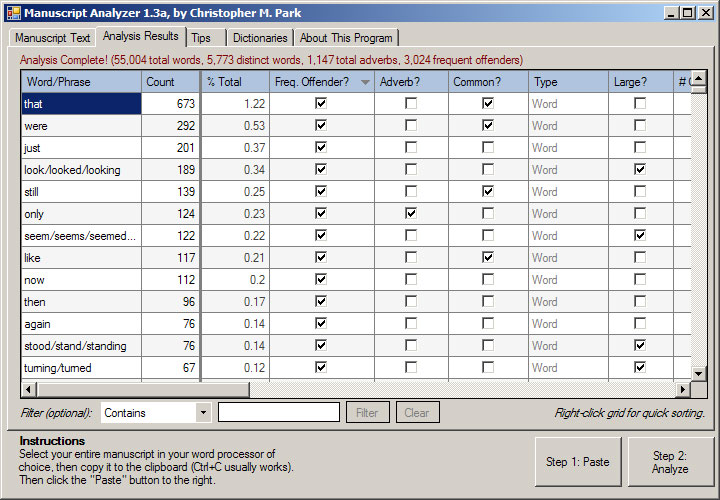
A new version of Manuscript Analyzer is now available for download. This new version adds the following features:

- The dictionaries of Frequent Offenders and Phrases have been updated. Due to the self-updating nature of the dictionaries, a new release of the software was not actually required for this feature, but it bears mentioning.

- All dictionaries now support grouping of "like words" into single entries. For instance, "look/looked/looking" are all now shown as a single entry, rather than three separate entries. This gives a much more accurate view of the frequency with which frequent offenders are used.

- A filter feature has been added. This allows you to quickly filter out any entries that don't meet criteria of your choosing. At present, you can require that words contain/start with/end with a set of characters, or you can insist that a word or phrase "Equals" a specific value (for example, bring back only the word "and," without including other results like "andy," which the "Contains" filter would include).

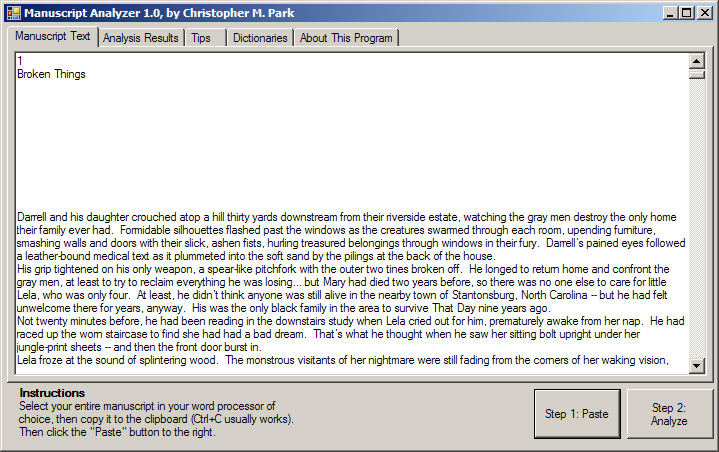
I've recently added some screen shots to my tools page. You can also see them here:


UPDATE: 1.3a is now the current version online, as that fixes a minor issue with sorting that was introduced in 1.3.

Friday, January 4, 2008

Holiday Roundup

I've been quiet lately, thanks to the holidays and then my return to work a couple of days ago. So this post is going to be a bit of catch-up for a lot of the things I've wanted to comment on in the last few weeks.

First off, thanks to a post by literary agent Jonathan Lyons, I read this very interesting piece by Dave Eggers. The part that is particularly interesting is his bit on selling out, which is a longish addendum to his response to the initial email. I've never had much concern over how avant garde anything was, but it was very interesting to read the rant of someone who once did, but no longer cares. I agree with Eggers' conclusion that tracking "sellouts" is just another form of fashion, and that might very well explain why I've never had any interest in it.

I saw an interesting post called Respecting Romance over at the BookEnds Literary Agency. This post was all about why some romance writers are embarrassed by their chosen genre, and why they shouldn't be. I don't read very much romance, and I definitely don't write it, but it recalled to mind the stigma that surrounds sci-fi and fantasy. I think most genres have some sort of stigma, actually, but here again -- it's all fashion. Write because you want to, and because your topic interests you. "Great art" can be formed in any genre -- any medium at all, in fact, as many artists have demonstrated.

Next I want to point out a post called Critters Vs. Betas (and the Dreaded Spouse Question) over at Dwight's Writing Manifesto -- and not just because he mentions me in the post. I recently posted some of my thinking on the topic, but Dwight has a new way of looking at it that I hadn't quite thought of before.

Literary agent Kristen Nelson recently made a post about the new Top Dealmaker feature at Publisher's Marketplace. I thought it was really useful information, and quite insightful (she usually is). It's good to have an agent's take on this sort of thing.

On an off-topic note, Stephen Parrish recently posted about Dinner For One, "a British one-act play [that] is a New Year's Eve tradition in Germany." Shortly after he mentioned this play (first time I'd ever heard of it), a German friend of my uncle brought it up. Go figure. Interestingly, the Wikipedia entry on the play notes that "although the sketch is most popular in non-English speaking countries, it is typically shown in the original English without dubbing or subtitles. Curiously, the film remains practically unknown to the English speaking world (except for Australia)." How very curious, indeed! Can you imagine a work of yours becoming a yearly tradition in some other country, but being utterly uncared-about in your native land?

I re-watched Terry Gilliam's cult classic Brazil the other day. It's a dystopian movie that made a big impression on me in high school, and which I've since counted as one of my top favorite movies even though I hadn't seen it for over eight years. My wife got it for me on DVD as a Christmas present, which was a really pleasant surprise. I was a little worried it might not seem as good now that I've grown up a lot more, but actually it was better than before. This movie is dense with symbolism, dark humor, and pointed social commentary. If you haven't seen this one, it's definitely worth a look -- the ending is probably my favorite movie ending of all time.

Have you ever heard of the (in)famous lexicographical term Mountweazel? I'm confident you'll find that trivia article both edifying and humorous.

Over the holiday break I read Stephen King's much-touted On Writing, and found it to be quite good. Most of you have probably read it already, but if not, it's definitely worth a read.

Another book that I'm finding even more helpful at present is Chris Roerden's Don't Murder Your Mystery. This is a very nuts-and-bolts book on writing, specifically aimed at Mystery writers. Don't let that fool you -- this gem is extremely applicable to all genres. The author has been a professional editor for over forty years, and she (yes, she's a female "Chris") really knows her stuff. For me, this book came at just the right time. I hope it finds you the same way.

And, I think that was about it!

Thursday, January 3, 2008

Manuscript Analyzer 1.0

Happy New Year, everyone! I had a very restful and recharging holiday season, and I hope you all had the same. To kick off the new year, I've finally gotten around to creating a Tools section on my website. This is a page for various little freeware programs that I create and want to publicly release, which I've been meaning to put up for ages.

As part of this new page, I'm also releasing the very first version of a new tool that I've created for writers . It's called Manuscript Analyzer, and is a pretty unique tool for aiding writers in doing some forms of analysis of their manuscripts. There are a number of programs that let you count the frequency of words in a document, but this takes it a step further and helps you identify junk phrases, "frequent offender" word patterns, and adverbs. It also lets you ignore common words that clutter up the high ranks of other word-counting programs, and allows you to focus on words by size.

Best of all, the dictionaries for all of the above can be extended by users via simple text files. This program auto-updates its dictionaries. As is noted in the "About" tab of the program itself, I'm very interested in ideas for how to extend this program even further. This is actually something that I just started coding this evening (seriously), so I'm sure there is a lot more that could be added. But I think that you'll find what's there to be quite robust and useful as it is.

Saturday, December 29, 2007

An Unusual Litmus Test

Anne Mini has recently been talking about who should and shouldn't be a valued feedback-giver to the aspiring writer (parts I and II). If you haven't read her posts yet, I highly recommend you do so before continuing reading this post of mine. I can wait!

...

Now that you have returned, let me first note I certainly agree that Anne's logic applies to almost every situation. However, most people tend to believe there are exceptions to every rule, and of course they tend to believe they fall into the minority that is the exception. Especially when it comes to issues like this.

Interestingly, I've read several published authors who noted their spouses were their first reader/editor. Stephen King, Orson Scott Card, and Bill Watterson (who wrote/drew the comic strip Calvin and Hobbes, and thus wasn't truly in this industry) all come to mind. I'm sure you could come up with many other examples.

There are two points I'd like to make on this score. First, readers would do well to remember that what a person says when publicly thanking his/her beloved is not necessarily the full truth. Secondly, most of these writers noted looking for general reaction from their spouse, usually on a chapter-by-chapter or realism basis, rather than on a line-by-line basis. But I'm sure it varies. At any rate, aspiring writers would do well to not just blandly take such comments of published writers at face value.

That said, I do believe my wife is an incredibly valuable first reader/editor to me, even on a line-by-line basis (and I believe I have a good litmus test for objectively determining she is -- more on that below). First of all, she has a degree in comparative literature, and is a voracious reader of the same genres I write in -- she's much wider read than me in general, actually. Secondly, she's done enough writing to know what she's doing. She hasn't written as much fiction as I have, but it's not a race.

All of that just gets her into the ball field of being a potential first reader, except for the pesky issue that she's my spouse -- and here's where my litmus test comes in. Ask yourself this: would you or your spouse be offended/upset/surprised/displeased by trading constructive critiques post-coitus? As in, “that wasn’t very good for me?” If you’re uncomfortable answering that to yourself (don’t tell me -- I really don’t want or need to know) then your spouse probably can’t be your editor regardless of his/her other qualifications.

But if you’re so uninhibited around each other that giving direct, un-couched feedback on your most intimate acts is a normal and accepted practice between the two of you (after all, the comments are only designed to help), then you can probably be reasonably certain they aren’t couching things when discussing your novel. Although, even then, be on guard at first -- it’s far too easy for your beloved to want to be supportive at the expense of not being constructively critical at first. Here’s a good law of editing (in the mathematical sense) I’d like to propose: if all your feedback from your first reader is unequivocally positive, it wasn’t helpful. Even if the person loves your book to death, he or she should find about ten thousand things wrong with it, and tell you just why each one is wrong (or say it just doesn’t rub them right if they can’t tell).

So that’s why I think my wife and I are one of the very few exceptions to this particular rule -- yet even then, she is my first reader, but certainly not my last before querying. I think my litmus test holds water, but I’m not aware of many people who seem likely to pass it (of course, it isn’t exactly a topic I ever discuss with anyone), so for most aspiring writers this is probably a moot point in the first place. When in doubt, follow the advice Anne has already laid out in her posts on this subject.

Friday, December 14, 2007

Changing The Spacing Of Your Manuscript

Anne Mini recently did a great post on why it's a good idea to have two spaces after each period. This was actually not a habit I ever picked up, as I don't believe my typing teachers ever advocated this (my wife learned this in her schools, but I didn't -- maybe I just missed the boat). At any rate, when I heard of this preference a few months ago, I decided to make the shift to using the two spaces, and in order to do that I had to reformat my entire WIP manuscript.

Hours of tedious work? Not hardly! Using nothing more sophisticated than the "Find and Replace" function in MS Word, here's how to reformat your manuscript to add two spaces instead of one. Just follow these steps in order, and you should be good to go. It also works on manuscripts that are half and half -- part of it formatted with the correct two spaces, part of it formatted with only one.

Of course, as with any large-scale change you make to your manuscript, make sure and save a copy first! If something should go awry for whatever reason, you don't want it to happen to your only recent copy.

Now, on to the steps:

1.) Open "Find and Replace" in MS Word by hitting Ctrl+H in windows, or by looking under the Edit menu and choosing "Replace" (the menu location may vary slightly by Office version, especially in the 2007 edition, which moved the location of a lot of things -- I'm using Office 2003).

1.a.) Step two and below will use the character "_" to represent a literal space (since you otherwise couldn't see it), and square brackets [] to indicate the boundaries of the text you should be finding and replacing. When entering these values into your textboxes, omit the square brackets, and use a literal space where I show the underscore.

2.) Search for [._] and replace it with the value [.__]

3.) Search for [."_] and replace it with the value [."__]

4.) Search for [?_] and replace it with the value [?__]

5.) Search for [?"_] and replace it with the value [?"__]

6.) Search for [!_] and replace it with the value [!__]

7.) Search for [!"_] and replace it with the value [!"__]

8.) Search for [:_] and replace it with the value [:__]

9.) Search for [._._.] and replace it with the value [...]

10.) Search for [...__] and replace it with the value [..._]

11.) Search for [___] (three spaces) and replace it with the value [__] (two spaces)


Unless you have strange formatting or other interesting punctuation, that's it! And I'm sure that you can see how you can apply these general principles to other types of punctuation, or strange types of speech-delineation, like the carrots (<>) that are used to identify thought-speech in Orson Scott Card's SPEAKER FOR THE DEAD.

The key is to run all your replaces that are like 2-8 first, so that you have at least the correct number of spaces after each sentence; then run numbers 9-11 to collapse any inappropriate extra spaces back down. If you're worried that things have gotten very out of whack, you can even run numbers 10 and 11 repeatedly, until they find nothing more to replace (that's actually not a bad idea to do, anyway, just to be sure).

I used this logic to successfully reformat my own manuscript several months ago, and I haven't found any problems with it in the interim. But I'm not the biggest expert on the rules of two spaces versus one, so if you see a hole in my logic, or if there's something I'm omitting, please let me know and I'll update the post. Happy formatting!


UPDATE 1: Someone pointed out on Anne's blog that this sort of logic incorrectly adds too many spaces after abbreviations. Since I didn't use any of those in my WIP, I didn't have that problem. But adding lines to search and replace things like [Mr.__] with [Mr._] would work, presuming you know, or can at least guess, all the abbreviations you used.

UPDATE 2: The list has been simplified a bit regarding quotes, thanks to a comment to this post.

UPDATE 3: Actually, that simplification was invalid, as another comment pointed out. In order to avoid adding extra spaces in cases like [what I think,"_said Tom.], the full steps above are necessary.

Monday, December 3, 2007

Attributes That Identify Your Writing

Nathan Bransford had an interesting post about cross-genre writing today. Essentially, he advocated that writers stick to one genre, in order to build their skills and their brand, until they are so famous that it no longer matters (think John Grisham). In response to questions in his comments, he further revealed that he felt that certain complementary genres, such as sci-fi and fantasy, or the various sub-genres of children's literature, were less of a problem. But in the case of the sci-fi / fantasy question, which was particularly relevant to me, he did mention that you still have to have some aspects to your writing that makes the stories obviously "you," and thus something that will have less risk of fragmenting your readership.

So that got me thinking: what aspects of my writing are distinctly "me," and present in all of my works? To date, I've written two Science-Fantasies (that's a real book category, not something I made up), and I'm working on one Dark Fantasy that's set in the future of our modern world, so in some senses is a bit like science fiction (just with magic). So here's what I came up with:

1. All my works have both magic and technology in them, to some greater or lesser degree.
2. All my works have characters with modern outlooks. Either my story is set in modern times, in the future, or in an alternate universe.
3. All of my books have a dark streak to them. Main characters are not safe from death, though I'm not cavalier about that.
4. Multiple cultures are always present in my works, and often multiple languages are present, as well.
5. I usually make use of some non-European mythology or folklore as the underpinnings of parts of my story or world.
6. There is usually a blend of locales in my stories that includes industrial/commercial locations as well as deep wilderness locations.
7. There is almost always some sort of Eastern influence in my works, usually Japanese, Korean, or Chinese (or all three).
8. Entropy is a theme (or at least a strong element) in every last work I write.

There are probably other things, too, but that's what I could come up with off the top of my head. In my biased, non-expert opinion, I think that this is enough to tie together a readership and build a fan base that can enjoy all my works. I don't plan to write any thrillers or horror or romance, though those elements may creep into my various works to greater or lesser degrees. But the core sci-fi / fantasy mix, and other elements that I mention above, are always part of my works, and should make a story recognizably mine once people have read a couple of my pieces. The main question is the ratio of sci-fi to fantasy, and that's something that varies work-to-work for me.

What about you? What attributes permeate every work that you write? Everyone has something, even if it's only one or two things. For instance, Orson Scott Card, who writes in something like four genres, is well known for always including interesting ethical dilemmas in every one of his works. Even if it's something as broad as that, or the fact that you always have strong female leads, or always write in a certain notable voice, you probably have something consistent in each of your works. So what is it?

Monday, November 19, 2007

Why some readers don't read.

Today, over at literary agent Jonathan Lyons' blog (an excellent read, by the way), there was an interesting post about a new National Endowment for the Arts report about how readership is continually falling. They particularly pointed out how the reading levels of late teens were falling, while the reading level of nine year-olds was up a little bit. It was all very doom-and-gloom with the apparent hope of shocking people out of their apathy about reading, and from that angle I support what they were saying. People do need to read more! We all do!

However, I do have a less depressing theory about why at least some of the people in the 17-22 age bracket are reading less. I'm 24 myself, and I can tell you that I probably almost fit into those poor statistics (when it came to pleasure reading) during the 17-22 age bracket -- as did most of the other book lovers that my wife and I knew.

Now, all of us were certainly reading plenty of textbooks, newspaper/journal articles, and nonfiction works related to our careers (programming/computer work, in my case), but pleasure reading was a rare thing.

This is because the pressure on juniors and seniors in high school is higher now than it ever was, and most of us were taking 5 or 6 college-level classes that kept us busy. Plus all the various extracurriculars -- sports, music, clubs, etc -- that the modern teenager is involved in. College is also a very busy time for most, either because of all the intense socializing and such that many subscribe to, or (in my and my wife's case) all the extracurriculars. We both were working through college, not because we had to in order to make ends meet, but because we didn't want to erode all our savings while in college, and because we each had opportunities to jump-start our careers in a major way during that time period. The year after college is also very busy, often even traumatic, for most students as their social life disappears (if they were that sort) and they start job-hunting (in a very tight market at this point -- competition isn't just fierce in the publishing industry).

What my wife and I are now seeing, with all our friends having been out of college for a year or two, is that everyone is reading a lot more again. We recommend books to our friends and vice-versa, we talk about what we like, and some of our friends even formed an impromptu monthly book club as way to keep in touch.

If you look at what all of our reading habits are now, we're probably in the top to upper-middle percentages (depending on what else the individual has going on in a given month), whereas we were all in the lower percentages just a few years before. And these are all people who grew up reading in the top percentages, all of whom participated in "Battle of the Books" competitions and other reading programs as a kid, and most of whom write short stories, poetry, or novels.

I don't pretend to know what everyone in the world is doing, and certainly the lack of literacy in many people I know is a little bit shocking. However, statistics can be misleading, and I think the notion that the current generations won't have any/many readers is a false one. I think certain societal conditions make reading difficult even for those who love reading during the late teens and early twenties -- but before long, those who love it will resurface on the other side.

I suppose we'll see if I'm right in about 10 years, when we see the statistics for the late-twenties crowd. At worst, I would be willing to bet serious money that many people rediscover their love of reading when they have kids, and start reading to them. Hopefully that then leads to other kinds of reading for the adults themselves.

Monday, November 12, 2007

3 out of 4 people reading isn't so bad

I saw this great post, Jim McCarthy is excited that 3 out of 4 people read a book last year, over at the Dystel & Goderich Literary Management blog today. He has a much more positive spin on the much-lamented poll from earlier this year than most other people have. I must say that I wholeheartedly agree with his points -- definitely worth a read if you've been feeling down about those statistics showing that readership is declining.

Friday, November 9, 2007

Wizard of Earthsea Miniseries Woes

Here's an interesting article by Ursula K. Le Guin regarding how the Sci-Fi channel deviated from her books' original vision when they made a miniseries out of them. I saw that miniseries, and sure wasn't impressed -- despite the inclusion of Danny Glover, who I always love to see. Aside from weak directing, the story was definitely mangled and didn't make much sense. Here's why.

Monday, October 8, 2007

Sunday, October 7, 2007

Restarting page numbering in word

This question gets asked a lot, so I thought I'd answer it here: "How do I omit the page number from my title page (plus however many other Table of Contents / Epigraph pages, or whatever else you've stuck in up at the start), and then have it start at page 1 at the start of my first chapter?"

1. Start out with no page numbering at all.

2. At the top of the page that you want to start numbering from, do the following: under the Insert menu in Microsoft Word, choose Break, and then choose one of the "section break" types.

2.a. If you've already got a page break properly in place, choose "Continuous" to not mess that up.

2.b. If you want to insert a page break with your new section, choose "Next Page" to do so.

3. Make sure your cursor is still on that same page that you want to start the numbering from, and then once again go to the Insert menu. Choose Page Numbers, use whatever settings you like, and then choose Format on the Page Numbers popup. Under the Formatting popup, change the "Continue from previous section" radio button to say "Start at 1" instead.

This divides your document into two "sections," each of which can have independent page numbering. You can actually use this same technique to divide your document as many times as you want, and have all sorts of different page numbering schemes (such as no page numbering at the very start, then roman numerals for an Introduction, then regular Arabic numerals for the main content, and then lettering for appendixes).

But, for manuscripts, remember that you'll just want to keep it simple and just have the Arabic numerals for the main content, starting in your first chapter.

Wednesday, September 12, 2007

Introverts

I've always known that I have introvert-like tendencies, but I've never thought I was a true introvert because I don't have any fear of public speaking. I'm not shy at all, in fact, and quite enjoy lecturing on technical topics in particular. I gave an hour-long presentation on Trends in Rich Client Development at a local council for technology executives just this Tuesday, in fact.

Therefore, it was with great surprise that I discovered this article from The Altantic, and this follow-up interview from several years after the article's original publication (thanks to Shrinking Violet Promotions). It turns out that I'm apparently an introvert after all, even though I have an affinity for the limelight much of the time, and am quite good at relating to people. Often I unconsciously make myself the center of gatherings (oops) by keeping up with everyone present and providing a lot of casual banter (as I've gotten older, this attention-grabbing habit has lessened steadily from its peak during my teenage years).

There are many different degrees of introverts, but I fit what are apparently the most salient factors in determining one's introvert/extrovert orientation: I don't seek out parties or the company of other people in most cases, I have no problem being alone for extended periods, and I tend to be drained, rather than energized, with extended social contact with others. Workplace contact is fine, and I've been known to run multi-day all-day meetings with large groups of clients, while retaining more stamina than any of the other attendees... but put me in a party with a group of non-family acquaintances for a couple of hours, and I'm bushed by the time I leave.

As the writer notes, this is largely because I have to consciously work to keep up the conversation when its not someone extremely familiar (family or my very best friends) or a topic with a very specific agenda (work, for the most part). I don't have to pause to think overly much when I'm talking about work things, but if you just want to chat with me about random inanities, I'm really going to have to work to hold up my own end unless we slip into anecdote-sharing mode. Then the storyteller in me takes over, and I'll be just fine until I run out of relevant anecdotes or the topic shifts again. And if it's a topic I don't have any real knowledge about, like professional sports, you're going to find me just smiling and nodding a lot (with the occasional grunts of agreement or commiseration).

Reading the interview, I was surprised to discover that my wife is not just an introvert, but also shy. I'm an introvert only, and one with an affinity for positive attention, so that's a pretty big difference in outlook. We've both always known this about ourselves and each other, but we never really had the words to put to it before. It's somehow reassuring to discover that there are a lot of others out there just like us. In college, all our friends thought we were crazy for never going to their parties. We thought they were a little crazy for being amused by the endless routine of empty socializing and drinking. Now that everyone is older, and more focused on careers and apartments/houses and serious relationships, it's a lot easier for us all to relate.

Still, it's nice to see it written in a major publication that we weren't the crazy ones. We were simply introverts, and we still are. Perhaps that's why I so very much look forward to (hopefully) someday going on book tour, even though I know how exhausting it will be for me. I imagine the majority of writers are introverts, and that those who aren't also shy probably know exactly what I'm talking about.

Tuesday, September 11, 2007

Estimated vs. Actual Word Count

This is something that I've been meaning to write about for the better part of a month now, but I've been putting it off because it seemed too difficult to explain. I think that this is partly what has been holding me up from posting more updates on how my writing/editing is going, also, since I need to make this post before I can properly inform you of my progress.

The issue is how word count is reported. I've always just been one to hit the "Word Count" option under the Tools menu in Word, and leave it at that. Seems simple enough, right? That's the actual word count.

Well, I've recently learned that most of the publishing industry still doesn't think in those terms -- they want to know the estimated word count, which is 250 words x number of pages in standard format (12 pt. Times New Roman, double spacing, 1" margins all around, et cetera). See Anne Mini's Word Count category for her detailed first-hand explanations of why that is, and how this works. Suffice it to say that, based on the acceptable word counts that many agents mention on websites and blog posts, and then the corresponding page counts that they mention on occasion, you'll see that Anne is right, and that there is still an overt expectation that you use estimated word count instead of actual.

This means that, when I initially queried THE GUARDIAN with 145,000 words, the agents were probably thinking the equivalent of what you would consider 162,000 "actual" words, when really I should have told them something closer to 118,900 words. When I shrunk my novel to 96,000 words, it was actually more like 84,000 words in their parlance. 80,000 words is what they would consider 320 pages, so that's right in the sweet spot of the range for most debut fiction (80,000-100,000 estimated words).

Please note that there is not absolute conversion factor between estimated and actual word count, even if your manuscript is already in perfect standard format (hence the conversion factor discrepancies between my numbers above). It's all about how many pages you wind up with, which can obviously vary a lot if most of your chapters happen to end with a page that only has one or two lines of text, versus if your chapters largely happen to end right at the bottom of each page. Depending on how many chapters you have, this could throw you off by several thousand words one way or the other.

Right now, however, my actual word count for ALDEN RIDGE is 31,287, and my estimated word count is 27,750. Previously my target was about 95,000 actual words. From now on, however, I'm going to ignore the actual word count, and just shoot for about 80,000-85,000 estimated words. That will probably work out to about the same thing.

At any rate, I figured this estimated-word-count expectation was a little-known fact in the aspiring author crowd. It's certainly not something I had ever encountered before Anne started talking about it on her blog. Hope this was useful!

Stupendously Ultimate First Line Challenge

If you're a writer and haven't yet seen Nathan Bransford's Stupendously Ultimate First Line Challenge, you should drop by and submit your first line(s), and then get ready to vote on your favorite from the finalists list later this week. There are lots of entries already, but I'm sure he'd love more. Contest closes tomorrow evening.

Wednesday, August 22, 2007

Author Bio Updated

Anne Mini recently did a series on how to construct proper author bios (Parts 1, 2, 3, 4, 5), and this inspired me to redo my own author bio. The old version was much longer, and in some senses more informative, but the problem with it was that it was just too long. There was just too much information that I was trying to convey at once, so the important points were lost in the shuffle. It was really styled more like an encyclopedia entry than a marketing tool, anyway, so I doubt it would have been very effective with professional readers.

As Anne points out, one of the primary purposes of the author bio is to make the author sound interesting. I think my new version does that a lot better (and more concisely) than the old version did. For those of you with websites and/or blogs -- do you have an author bio online, yet? It might be a good thing to do, both as a great thing to have on hand for when agents request it, and to have readily available online in case someone from the industry stops by (you never know, right?).

If you post one, drop me a comment and let me know; I always like finding out more about the people who stop by my blog!