I just today realized this. It goes without saying that there are major spoilers ahead for FFVI, so if you haven't played that game yet you should stop reading. And go play that game. Right now. To me, it's the best game ever made.
But I digress. I said it was an allegory. Usually when people say some story is allegorical, they mean it has some hidden political, religious, or parallel-to-current-events meaning. FFVI goes deeper than that -- it's an allegory for a key part of the human condition. That is, that the world changes around us, and things are irrevocably lost. Back to that in a second.
When I was a kid, I had a paper route from right before third grade until just after 10th grade. Eight years almost to the day, of delivering a free paper called the "Ad Pak" once a week to 152 houses in my neighborhood. I rarely missed a week (just one or two weeks per year when my family was out of town for vacation, and occasionally when I was sick on a Wednesday), so its fair to say that I made my deliveries about 400 times per house in all those years I was a paperboy.
The point is, when you visit any house -- or 152 houses -- so very many times, you come to know them extremely well. I probably knew the front yards and front stoops of those houses better than many people know the front yards of their grandparents' houses. And I knew many of the families that lived in those homes fairly well, and some of them very well. I doubt there is anyone else alive who knew those streets remotely so well, simply because I was the paperboy for so very long, and because I often stopped to chat when people were amiable and I had time.
It's been twelve years since I made my last deliveries. It was a job I was quite happy to be done with when I finished it. Now I miss my closeness to those houses, those streets, terribly. A lot has changed in the last 12 years. Many of the older people who lived on my route have died, and others have probably moved to nursing homes. All of the kids have grown and moved away. Some of the parents remain, but many of them are grandparents now and a lot of them have left, too. New families have moved in to close to half the houses, bringing with them lively new children and young families (which is great), but at the same time making huge changes to the properties in terms of home decor, landscaping, and so on.
Those decor and landscaping changes are actually also great, looking at this in an unbiased fashion, but it makes me feel that much more distant from the properties I once knew so well. Many of them bear little resemblance to the homes I could still sketch from memory. As I'm sure you can tell, as it practically drips from these last few paragraphs, this whole process makes me extremely nostalgic. Things have changed at those houses, almost entirely for the better, but since I know longer recognize the world I grew up in, it feels more like a tragedy to me. You can't go home again, and all that. This is perfectly familiar to anyone over a certain age.
And this is also what Final Fantasy VI is an allegory for. On the surface it's about saving the world (or what remains of it after failing to save it the first time). But underneath, what it does is make the player intimately familiar with the World of Balance -- and then utterly destroy that world. The World of Ruin is an almost entirely tragic place, of course, and this, coupled with everything from the music in the WOB to the colors to the characters and story elements, serves to make the player nostalgic.
The characters are often nostalgic as well, and much of the later side-quests involve surprisingly deep exploration of backstory. As a kid, I think that perhaps Locke's backstory resonated most highly with me. Now I think probably Cyan's does. It's these layers of depth, and the fact that the game manages to make the player go through echoes of the character's emotional turmoil, that make the game so bloody brilliant. A shallow, world-sweeping allegory is fairly simple and trite to set up -- but FFVI goes the extra mile by also making it a personal story for a dozen main characters and dozens of supporting cast members that we also care about.
Much like my paper route, the World of Ruin is littered with remnants from the past. Some whole towns, parts of others, and many people that you recognize from the WOB remain in the WOR. Some families still remain on my old route, and the very basic structure of all the houses and yards are achingly familiar. It's these discordant similarities mixed with the Unfamiliar that make the nostalgia factor so high. If nothing had changed, of course we wouldn't be nostalgic, but if everything had disappeared or changed completely it would also be hard to really comprehend what was lost in the same way.
Final Fantasy VI touches on a great many universal themes, a lot of underlying truths about humanity. It manages this despite the fact that its wording is spare and simple because of the limitations of the platform it was written for. The simplicity makes it almost poetic, really, which is a lesson a lot of more modern RPGs could learn from. But the attention to making the story recognizably human, at playing off so many deep-seated emotions that players can relate to in different ways at different stages of life, is the core of FFVI's brilliance.
My extreme fondness for the game is well established, but I've spent the last 16 years trying to figure out just what exactly it was that made that story so powerful for me and so many others. I still haven't figured it all out, but I think that this is one key piece of the puzzle. It kept the emotions real, human-sized, and understandable. And it had a killer hook for making the players really feel what the main characters were going through in a visceral way (the end of the World of Balance).
I don't want to duplicate what Final Fantasy VI did, but I do want to someday create a game narrative with the same sort of emotional impact and depth. Eventually I'll hopefully figure out enough to do so. It's an amazing achievement for the FFVI team that I feel almost as much nostalgia in connection with their game as I do regarding my lost youth delivering papers to families I no longer know. As amazing as Chrono Trigger or Silent Hill 2 are, for me they just can't touch that level of emotion.
Showing posts with label Thoughts on Writing. Show all posts
Showing posts with label Thoughts on Writing. Show all posts
Sunday, November 14, 2010

Tuesday, August 3, 2010
Why I'm Reluctant To Critique... Whatever You Created
How many here were raised under the rule from Bambi, "if you can't say anything nice, don't say anything at all?" I know I was. And hence an immediate conundrum when you're out to critique a game that someone else has created. It's especially challenging when an aspiring indie asks me to "take a look at their game and let me know what I think," or similar.
Let me back up for a moment. In his post about his Critter Code of Ethics (an important read for anyone thinking about giving or receiving criticism), my friend Stephen Parrish writes:
This is a fundamental truth that a lot of folks don't stop to consider. I know that I was personally in that second group for most of my younger life -- I'd ask for criticism, expect praise, and then sulk if I got actual criticism. This helped no one, least of all me, and wasted the time of the person who was giving me critiques.
Taking Criticism Effectively Is Hard
Even back in college, when my wife would give me perfectly valid (and quite insightful) commentary on my own fiction writing, I was known for having an overstrong emotional reaction. Part of the problem was this: when we were younger, and I was a worse writer, she pretty much just gave me praise, oohing and ahing over what was good and ignoring the rest. Then as we both grew older and wiser, she started actually trying to give me better feedback; she'd stayed in the field of literature, which I'd partly abandoned for computers, and she'd picked up a lot of stuff I had not. However, in that same span I had also grown as a writer as most people do with time, and so my experience was that I had gotten better and she was suddenly critical.
Of course, that wasn't what was happening at all. It was merely that she was more sure of herself and of me, and that I was far enough along the path of my abortive literary career that I should have been ready to hear her criticism. There was some undeserved static from me in the meantime, but eventually we worked through that, I managed to mostly put my emotional reactions on hold, and we both managed to learn a lot together from the process of editing my novels.
However, Taking Criticism Effectively Is Worthwhile
So, happy story, right? Put your emotions on hold, suck it up and delve into the criticism that will make your work better. It's certainly a big theme at Arcen, where everyone on the team tries to put their egos on hold as much as possible and there's a more-or-less free flow of constructive criticism between the members of the team. That's largely something we conduct in private for reasons of decorum, but what's quite public is the suggestions forum for AI War, which is one of the favorite sections of our forum system: it's seen over ten thousand posts in the last year, and we've completed more than 1,400 individual items during that time.
What makes this work? I would say that one major factor in both cases is the sense of trust. When AI War was new, and the player community was only partially formed, I had a much harder time emotionally dealing with all of the suggestions. It's like sticking your head into a fire hydrant of "you should have done this, why didn't you do that?" It can feel very negative, very draining, and like the people who are your supposed "fans" aren't actually liking your work much at all. Amongst staff members, it can feel like professional rivalry or worse.
That's when there is not a sense of trust. I think I did a pretty good job of swallowing my feelings despite myself in those early days of AI War, and I don't think I publicly let on overmuch how I was really feeling. But I was miserable, I was stressed, and I was worried that nobody really liked my game all that much. In short, I was having huge bouts of insecurity, which is natural for anyone who has taken great pains to create something, and then has thrust it out in front of the world for criticism.
And that's around the time when that magical missing ingredient showed up: trust. As last summer wore on, and the popularity of my game grew, the volume of suggestions grew high enough that I couldn't hope to address them all. That might make it sound like AI War isn't very good, but actually players are just bursting over with suggestions and ideas for pretty much every game ever created. In most cases they simply don't have an outlet for those suggestions, so they just gripe on forums. But in the case of AI War, they did have an outlet. And that's where the trust came from. There were too many suggestions for me to do them all, everyone could see that, but they could also see that I was listening, and trying. They could trust that they had a voice, and I'd do my best to make everyone happy.
Similarly, I began to see that these actually were fans of the game, as true of fans as you could possibly ask for. Not only did they enjoy the game, but they spent enough time thinking about the game and playing it that they were willing to write up ideas for me to consider. Once I could no longer keep up with the flood of ideas, I soon learned that it wasn't the actual implementation of any specific idea that would keep players happy, but rather that I'd at least consider all the ideas, and take them into account as I improved the game. Sure, everyone prefers it when their own actual idea is used, but people are pretty reasonable about the circumstances when there are thousands of them and one or two of us.
So, long story short, an environment of trust happened to form, and the feedback cycle of suggestions and improvements became a daily or weekly routine rather than an unexpected and emotional event. As more staff were added to Arcen, they came into this environment and that attitude of trust formed amongst our small team as we worked together, cautiously testing the waters with one another with constructive criticism, notes, and ideas outside our direct areas of expertise.
In short: there are a lot of benefits to having these sorts of sources of criticism, but the environment has to be suitably safe. And that doesn't happen overnight.
So Why Don't I Like Critiquing What Others Create?
Well, as anyone on my staff can tell you, I'm certainly full of critiques. If something is so much as one pixel off, I'll comment on it. Not in a mean way, but I value precision and correctness, and I think everyone else on the team agrees. They comment on things I've done quite a lot, too. This is a two-way street.
So when I say I don't like critiquing the work of others, I'm referring to people that I don't have that level of relationship with. My inclination is to absolutely pick apart whatever someone shows me, not to be mean, but to make it better. However, in almost all cases if the other party has not had that intensity of criticism before, they're going to get overwhelmed and probably will have a negative reaction to it. And I'll have wasted my time.
It happens to the best of us. Stephen Parrish, the author of the Critter Code of Ethics above, sent out an email asking for comments on an event-specific website he had created a while back. Knowing his views on literary criticism, and having a long history of web design, I really let loose on the site he was working on. I thought a lot of aspects were good, and overall I very much liked his site, but that didn't stop me from writing over five thousand words of criticism about a 7-page site. He and I have always been on great terms, but that particular endeavor of mine was a waste of several hours of my time, suffice it to say.
I had another critique partner years ago where the result wasn't as happy. We'd talked online for a few months and had similar outlooks on writing, and we decided to swap manuscripts. We'd both had some near misses with agents, and felt like we were on the verge of picking up representation (as it turned out, she was but I was not). I diligently critiqued the first 8 chapters of her manuscript, and by the end of that process I had written as many words in red as she had originally had in the chapters to begin with. This was very poorly received. She handed back my first chapter with notes that she felt the protagonist was arrogant and unlikeable, and little else. It was written in the first person, in my voice. Go figure. We didn't really speak much after that.
Suffice it to say, my track record is not overly great with individual critique partners. To me, it's a minor miracle that the Arcen staff and community works together so smoothly, and I'm not entirely certain how that came about. Call it blind luck, divine providence, or whatever, but I can't tell you how to recreate it. I guess it's just having the right mix of personalities.
Critiquing Versus Evaluating
I'm making up some terminology here, but I'm going to make a distinction between "critiquing" something and "evaluating" that same thing.
Personally, when I critique something, I rip it apart. The slightest flaws are mentioned and explored, possible alternatives are suggested for every last non-perfect facet, and red ink is thick on the ground. You can hand me my very favorite games ever, what I consider masterpieces, and the effect of this would be extraordinarily diminished but not erased. There is no game or literary work that is above all reproach.
Normal games, anything not at the absolute pinnacle of its genre, don't stand a chance under that kind of scrutiny. In all seriousness, my process for tearing apart games is very much the same as that in Zero Punctuation. I only discovered ZP in the last few months, but I've watched almost all the videos and I'd say I agree with about 70% of what he says.
Except what he's doing is evaluating a game, to use my newly-minted terminology. I presume that he, like most people, fires up a game and starts playing it, intending to enjoy it. Then every time something jumps out at him as being sub-par or wrong, he makes a mental note of it. In the games he likes, very little jumps out at him. In the games he rips into on his reviews, things were jumping out at him left and right.
In the case of a critique, there's a different process I go through: I'm not playing this to enjoy it. I don't even care if I enjoy it. I'm here to find every last flaw I can, to make the work stronger. I've worked with a couple of professional editors in the last decade or so, and their approach was much the same: they were here not to destroy, but to break down to help me to rebuild. As one put it (to paraphrase), "I quite enjoyed your book, but you'll notice that just about every page is covered in red. Take this for what it is: a mark of respect. In the book industry, editors only give so much feedback for authors whom they feel would actually benefit from that much effort. If I didn't think that all this feedback would help you in making this the best possible book you can make it, I wouldn't have spent the time."
That editor forever changed my perception of criticism. I wasn't being nit-picky all those years, I was just doing what she was doing. Which is, admittedly, picking nits. But assumedly you want a nit-free game or novel, which is why you asked someone to critique it... right?
All too often, the answer is no. Most of the time, people are just looking for validation of their work, and that's it. They approach professional authors with hopes of either getting some validation from someone who already made it into the business or even in hopes that the author will think the work is so amazing that he will recommend it immediately to his agent and editors.
That almost never happens, because generally manuscripts that are that amazing have already found an agent or editor without going to those lengths. Most manuscripts that haven't are in need of a good nit-picking before they're really ready, and the best you can hope for from a professional author is that they'll rip into your stuff. And that's generally devastating enough for you that it's a waste of their time.
Critiquing Is Critical Thinking
Why critique? It's because you want to make something better. If we never saw the flaws in anything, nothing would ever improve, right? And thankfully almost nothing in our world is perfect -- if there was too much perfection, there would be nothing left to do, no more room in which to grow, and that would be the most depressing thing I can think of. Fortunately, there's room for improvement all around us, in everything we have made and do. Fifty years from now, everything in your house will seem cheap and outdated, if current trends hold.
Part of critical thinking also involves recognizing what has been done right. Unlike Stephen Parrish, I also believe very strongly that it's important to tell people what they have done right. He thinks that's useless as a general rule, but I think the utility lies in the fact that often people just do things instinctively, and don't consciously know what others react to well, or why they react to it well. I get a lot of positive commentary on AI War as well, and quite a lot of it has also been instructive to me. And when it comes to the staff, I give out at least as much positive commentary as I do negative.
Simple, honest -- and hard to swallow, if you were just looking for effusive praise.
So, What Was "Evaluating" Again?
I never really explained that, did I? Critiquing is actively looking for flaws, whereas evaluating is not. Normally when I play games for recreation, I'm just in evaluation mode. I play to enjoy, and I note things that I particularly enjoy, or that particularly impede my enjoyment. Small flaws or things that I would do differently slip right under the radar, because I'm not actively trying to find them. Heck, I'm here to enjoy the game, after all!
But at the same time, any author should be evaluating every book they read, and any game designer should be doing the same with every game they play. And authors should read, just as game designers should play games. It's the only way to grow, as it's the only way to spark ideas that don't come solely from within yourself. Working in isolation is not a very conductive path to growth.
So anyway, most of the time I try to stay in evaluation mode just to see the forest instead of the trees, to use a different analogy. Then if I spot something specifically of note (for good or ill), I might delve into the critique mode for just a bit. When someone does something strikingly well or poorly, it can be very useful to think about it more actively to really understand why it worked as it did.
Conclusion
Hopefully my reasons are now clear for avoiding requests to critique the games of others. Personally, I've had very little luck with that, and often wind up spending a lot of well-intentioned effort crafting a critique that is of no use to the other party, demoralizes them, and gets them mad at me. Because all too often I misinterpret what the person was really asking for, and they don't understand quite what they'd be getting into with me.
And for the record, if you're looking to break into the business you're far better off going directly to the distributors and press with a suitably awesome game. Other indie developers that have already had some level of success are rarely in the position to open any doors into the industry for you.
Lest this post spark even more requests for critiques than I normally get, I should also note that time is particularly thin on the ground for me. I love answering questions and try to make blog posts to help out other indies with ways for them to improve their work or to help them break into the business, but there is rarely the time for me to do full critiques these days. I'm going to be a new dad within the next six weeks, and I'm already finding it really hard to balance all of the various jobs I have. I don't mean any offense to anyone, but I have to tend to my family first, then my own job, and at the moment there is very little left after those two things.
The best source for critiques isn't other developers or even reviewers, anyway. It's players. It's the would-be fans of the games you create who just couldn't get into it for whatever reason; the genre experts on the genres you wish to inhabit; and the actual fans of your game, who even so will have ideas on ways to make it better. If you want the best possible feedback for making your game everything you want it to be, seek out those people and get their opinions. Having a designer friend or two to toss ideas around with doesn't hurt, but it's the players that are collectively more expert than all of us in terms of knowing what they want and what they like and don't like. Just listen to them.
Let me back up for a moment. In his post about his Critter Code of Ethics (an important read for anyone thinking about giving or receiving criticism), my friend Stephen Parrish writes:
There are three kinds of writers: those who aren't interested in criticism; those who, when they ask for criticism, are really seeking validation; and those who incorporate criticism and improve their work.
This is a fundamental truth that a lot of folks don't stop to consider. I know that I was personally in that second group for most of my younger life -- I'd ask for criticism, expect praise, and then sulk if I got actual criticism. This helped no one, least of all me, and wasted the time of the person who was giving me critiques.
Taking Criticism Effectively Is Hard
Even back in college, when my wife would give me perfectly valid (and quite insightful) commentary on my own fiction writing, I was known for having an overstrong emotional reaction. Part of the problem was this: when we were younger, and I was a worse writer, she pretty much just gave me praise, oohing and ahing over what was good and ignoring the rest. Then as we both grew older and wiser, she started actually trying to give me better feedback; she'd stayed in the field of literature, which I'd partly abandoned for computers, and she'd picked up a lot of stuff I had not. However, in that same span I had also grown as a writer as most people do with time, and so my experience was that I had gotten better and she was suddenly critical.
Of course, that wasn't what was happening at all. It was merely that she was more sure of herself and of me, and that I was far enough along the path of my abortive literary career that I should have been ready to hear her criticism. There was some undeserved static from me in the meantime, but eventually we worked through that, I managed to mostly put my emotional reactions on hold, and we both managed to learn a lot together from the process of editing my novels.
However, Taking Criticism Effectively Is Worthwhile
So, happy story, right? Put your emotions on hold, suck it up and delve into the criticism that will make your work better. It's certainly a big theme at Arcen, where everyone on the team tries to put their egos on hold as much as possible and there's a more-or-less free flow of constructive criticism between the members of the team. That's largely something we conduct in private for reasons of decorum, but what's quite public is the suggestions forum for AI War, which is one of the favorite sections of our forum system: it's seen over ten thousand posts in the last year, and we've completed more than 1,400 individual items during that time.
What makes this work? I would say that one major factor in both cases is the sense of trust. When AI War was new, and the player community was only partially formed, I had a much harder time emotionally dealing with all of the suggestions. It's like sticking your head into a fire hydrant of "you should have done this, why didn't you do that?" It can feel very negative, very draining, and like the people who are your supposed "fans" aren't actually liking your work much at all. Amongst staff members, it can feel like professional rivalry or worse.
That's when there is not a sense of trust. I think I did a pretty good job of swallowing my feelings despite myself in those early days of AI War, and I don't think I publicly let on overmuch how I was really feeling. But I was miserable, I was stressed, and I was worried that nobody really liked my game all that much. In short, I was having huge bouts of insecurity, which is natural for anyone who has taken great pains to create something, and then has thrust it out in front of the world for criticism.
And that's around the time when that magical missing ingredient showed up: trust. As last summer wore on, and the popularity of my game grew, the volume of suggestions grew high enough that I couldn't hope to address them all. That might make it sound like AI War isn't very good, but actually players are just bursting over with suggestions and ideas for pretty much every game ever created. In most cases they simply don't have an outlet for those suggestions, so they just gripe on forums. But in the case of AI War, they did have an outlet. And that's where the trust came from. There were too many suggestions for me to do them all, everyone could see that, but they could also see that I was listening, and trying. They could trust that they had a voice, and I'd do my best to make everyone happy.
Similarly, I began to see that these actually were fans of the game, as true of fans as you could possibly ask for. Not only did they enjoy the game, but they spent enough time thinking about the game and playing it that they were willing to write up ideas for me to consider. Once I could no longer keep up with the flood of ideas, I soon learned that it wasn't the actual implementation of any specific idea that would keep players happy, but rather that I'd at least consider all the ideas, and take them into account as I improved the game. Sure, everyone prefers it when their own actual idea is used, but people are pretty reasonable about the circumstances when there are thousands of them and one or two of us.
So, long story short, an environment of trust happened to form, and the feedback cycle of suggestions and improvements became a daily or weekly routine rather than an unexpected and emotional event. As more staff were added to Arcen, they came into this environment and that attitude of trust formed amongst our small team as we worked together, cautiously testing the waters with one another with constructive criticism, notes, and ideas outside our direct areas of expertise.
In short: there are a lot of benefits to having these sorts of sources of criticism, but the environment has to be suitably safe. And that doesn't happen overnight.
So Why Don't I Like Critiquing What Others Create?
Well, as anyone on my staff can tell you, I'm certainly full of critiques. If something is so much as one pixel off, I'll comment on it. Not in a mean way, but I value precision and correctness, and I think everyone else on the team agrees. They comment on things I've done quite a lot, too. This is a two-way street.
So when I say I don't like critiquing the work of others, I'm referring to people that I don't have that level of relationship with. My inclination is to absolutely pick apart whatever someone shows me, not to be mean, but to make it better. However, in almost all cases if the other party has not had that intensity of criticism before, they're going to get overwhelmed and probably will have a negative reaction to it. And I'll have wasted my time.
It happens to the best of us. Stephen Parrish, the author of the Critter Code of Ethics above, sent out an email asking for comments on an event-specific website he had created a while back. Knowing his views on literary criticism, and having a long history of web design, I really let loose on the site he was working on. I thought a lot of aspects were good, and overall I very much liked his site, but that didn't stop me from writing over five thousand words of criticism about a 7-page site. He and I have always been on great terms, but that particular endeavor of mine was a waste of several hours of my time, suffice it to say.
I had another critique partner years ago where the result wasn't as happy. We'd talked online for a few months and had similar outlooks on writing, and we decided to swap manuscripts. We'd both had some near misses with agents, and felt like we were on the verge of picking up representation (as it turned out, she was but I was not). I diligently critiqued the first 8 chapters of her manuscript, and by the end of that process I had written as many words in red as she had originally had in the chapters to begin with. This was very poorly received. She handed back my first chapter with notes that she felt the protagonist was arrogant and unlikeable, and little else. It was written in the first person, in my voice. Go figure. We didn't really speak much after that.
Suffice it to say, my track record is not overly great with individual critique partners. To me, it's a minor miracle that the Arcen staff and community works together so smoothly, and I'm not entirely certain how that came about. Call it blind luck, divine providence, or whatever, but I can't tell you how to recreate it. I guess it's just having the right mix of personalities.
Critiquing Versus Evaluating
I'm making up some terminology here, but I'm going to make a distinction between "critiquing" something and "evaluating" that same thing.
Personally, when I critique something, I rip it apart. The slightest flaws are mentioned and explored, possible alternatives are suggested for every last non-perfect facet, and red ink is thick on the ground. You can hand me my very favorite games ever, what I consider masterpieces, and the effect of this would be extraordinarily diminished but not erased. There is no game or literary work that is above all reproach.
Normal games, anything not at the absolute pinnacle of its genre, don't stand a chance under that kind of scrutiny. In all seriousness, my process for tearing apart games is very much the same as that in Zero Punctuation. I only discovered ZP in the last few months, but I've watched almost all the videos and I'd say I agree with about 70% of what he says.
Except what he's doing is evaluating a game, to use my newly-minted terminology. I presume that he, like most people, fires up a game and starts playing it, intending to enjoy it. Then every time something jumps out at him as being sub-par or wrong, he makes a mental note of it. In the games he likes, very little jumps out at him. In the games he rips into on his reviews, things were jumping out at him left and right.
In the case of a critique, there's a different process I go through: I'm not playing this to enjoy it. I don't even care if I enjoy it. I'm here to find every last flaw I can, to make the work stronger. I've worked with a couple of professional editors in the last decade or so, and their approach was much the same: they were here not to destroy, but to break down to help me to rebuild. As one put it (to paraphrase), "I quite enjoyed your book, but you'll notice that just about every page is covered in red. Take this for what it is: a mark of respect. In the book industry, editors only give so much feedback for authors whom they feel would actually benefit from that much effort. If I didn't think that all this feedback would help you in making this the best possible book you can make it, I wouldn't have spent the time."
That editor forever changed my perception of criticism. I wasn't being nit-picky all those years, I was just doing what she was doing. Which is, admittedly, picking nits. But assumedly you want a nit-free game or novel, which is why you asked someone to critique it... right?
All too often, the answer is no. Most of the time, people are just looking for validation of their work, and that's it. They approach professional authors with hopes of either getting some validation from someone who already made it into the business or even in hopes that the author will think the work is so amazing that he will recommend it immediately to his agent and editors.
That almost never happens, because generally manuscripts that are that amazing have already found an agent or editor without going to those lengths. Most manuscripts that haven't are in need of a good nit-picking before they're really ready, and the best you can hope for from a professional author is that they'll rip into your stuff. And that's generally devastating enough for you that it's a waste of their time.
Critiquing Is Critical Thinking
Why critique? It's because you want to make something better. If we never saw the flaws in anything, nothing would ever improve, right? And thankfully almost nothing in our world is perfect -- if there was too much perfection, there would be nothing left to do, no more room in which to grow, and that would be the most depressing thing I can think of. Fortunately, there's room for improvement all around us, in everything we have made and do. Fifty years from now, everything in your house will seem cheap and outdated, if current trends hold.
Part of critical thinking also involves recognizing what has been done right. Unlike Stephen Parrish, I also believe very strongly that it's important to tell people what they have done right. He thinks that's useless as a general rule, but I think the utility lies in the fact that often people just do things instinctively, and don't consciously know what others react to well, or why they react to it well. I get a lot of positive commentary on AI War as well, and quite a lot of it has also been instructive to me. And when it comes to the staff, I give out at least as much positive commentary as I do negative.
Simple, honest -- and hard to swallow, if you were just looking for effusive praise.
So, What Was "Evaluating" Again?
I never really explained that, did I? Critiquing is actively looking for flaws, whereas evaluating is not. Normally when I play games for recreation, I'm just in evaluation mode. I play to enjoy, and I note things that I particularly enjoy, or that particularly impede my enjoyment. Small flaws or things that I would do differently slip right under the radar, because I'm not actively trying to find them. Heck, I'm here to enjoy the game, after all!
But at the same time, any author should be evaluating every book they read, and any game designer should be doing the same with every game they play. And authors should read, just as game designers should play games. It's the only way to grow, as it's the only way to spark ideas that don't come solely from within yourself. Working in isolation is not a very conductive path to growth.
So anyway, most of the time I try to stay in evaluation mode just to see the forest instead of the trees, to use a different analogy. Then if I spot something specifically of note (for good or ill), I might delve into the critique mode for just a bit. When someone does something strikingly well or poorly, it can be very useful to think about it more actively to really understand why it worked as it did.
Conclusion
Hopefully my reasons are now clear for avoiding requests to critique the games of others. Personally, I've had very little luck with that, and often wind up spending a lot of well-intentioned effort crafting a critique that is of no use to the other party, demoralizes them, and gets them mad at me. Because all too often I misinterpret what the person was really asking for, and they don't understand quite what they'd be getting into with me.
And for the record, if you're looking to break into the business you're far better off going directly to the distributors and press with a suitably awesome game. Other indie developers that have already had some level of success are rarely in the position to open any doors into the industry for you.
Lest this post spark even more requests for critiques than I normally get, I should also note that time is particularly thin on the ground for me. I love answering questions and try to make blog posts to help out other indies with ways for them to improve their work or to help them break into the business, but there is rarely the time for me to do full critiques these days. I'm going to be a new dad within the next six weeks, and I'm already finding it really hard to balance all of the various jobs I have. I don't mean any offense to anyone, but I have to tend to my family first, then my own job, and at the moment there is very little left after those two things.
The best source for critiques isn't other developers or even reviewers, anyway. It's players. It's the would-be fans of the games you create who just couldn't get into it for whatever reason; the genre experts on the genres you wish to inhabit; and the actual fans of your game, who even so will have ideas on ways to make it better. If you want the best possible feedback for making your game everything you want it to be, seek out those people and get their opinions. Having a designer friend or two to toss ideas around with doesn't hurt, but it's the players that are collectively more expert than all of us in terms of knowing what they want and what they like and don't like. Just listen to them.
On Writing: Frequent Offenders In The Manuscript Analyzer
I recently got the following note via email, which I thought asked a great question:
That's a really great question. Here's my response:
With any of the frequent offenders, bear in mind that you have to use your own discretion and judgment -- the tool tries to give you a good overall idea of areas you might need to check, but these are at best red flags, not definitive notices of error. In most cases, anyway -- in the case of some of the frequent offenders, you've got words that are always wrong, like irregardless.
In the specific case of were, it's not even that the word itself is too much of a problem, but that if it is too prevalent it can be indicative of sentence structure that isn't varied or creative enough.
For example: "They were eating lunch. The horses were in the pasture. They could see the clouds were passing by overhead." This is pretty unimaginative, and is something that tends to pop up in the first drafts of a lot of manuscripts.
Much better construction might be something like: "They ate lunch on the terrace. Horses grazed in the pasture below, with clouds drifting lazily by overhead."
Again, there's nothing wrong with saying "they were eating lunch." You'll find sentences like that in any manuscript, and peppered throughout published books. Sometimes that's the exact right thing to say, for reasons of pacing, tone, or simply because it sounds right.
On the other hand, you often read a lot of amateur manuscripts, or rough first drafts even of professionals, where the sentence construction reads almost like a monotone because of all those "was/were x-ing" constructions. It's always up to the individual writer or editor to make their own judgments, and certainly in a rough draft it's better to just get the thoughts down on paper without worrying about the flow of the language, but when it comes time for revision this is one of the areas where a lot of writers spend a ton of their time. I know I do!
I had recently discovered your Manuscript Analyzer program, which I've been using for a better understanding of the editing process. But, what I don't understand is why the word "were" is a frequent offender? When properly used with a verb, especially with one ending in -ing, the word "were" is perfectly acceptable. Would I have to use my own discretion, or is there another explanation?
That's a really great question. Here's my response:
With any of the frequent offenders, bear in mind that you have to use your own discretion and judgment -- the tool tries to give you a good overall idea of areas you might need to check, but these are at best red flags, not definitive notices of error. In most cases, anyway -- in the case of some of the frequent offenders, you've got words that are always wrong, like irregardless.
In the specific case of were, it's not even that the word itself is too much of a problem, but that if it is too prevalent it can be indicative of sentence structure that isn't varied or creative enough.
For example: "They were eating lunch. The horses were in the pasture. They could see the clouds were passing by overhead." This is pretty unimaginative, and is something that tends to pop up in the first drafts of a lot of manuscripts.
Much better construction might be something like: "They ate lunch on the terrace. Horses grazed in the pasture below, with clouds drifting lazily by overhead."
Again, there's nothing wrong with saying "they were eating lunch." You'll find sentences like that in any manuscript, and peppered throughout published books. Sometimes that's the exact right thing to say, for reasons of pacing, tone, or simply because it sounds right.
On the other hand, you often read a lot of amateur manuscripts, or rough first drafts even of professionals, where the sentence construction reads almost like a monotone because of all those "was/were x-ing" constructions. It's always up to the individual writer or editor to make their own judgments, and certainly in a rough draft it's better to just get the thoughts down on paper without worrying about the flow of the language, but when it comes time for revision this is one of the areas where a lot of writers spend a ton of their time. I know I do!
Wednesday, May 5, 2010
Interview with Novelist Stephen Parrish
With us today is my blogging buddy Stephen Parrish, whom I've known for a couple of years through writing circles. I first met him back when The Guardian was seemingly nearing picking up an agent, but then obviously all that fell through for me, and I've lost contact with the bulk of the writing friends that I made during that time.
But Steve and I have kept in touch, and I've been enjoying seeing him break into print -- I picked up his book, The Tavernier Stones, just yesterday from my local Borders, and will post about that sometime in the coming weeks once I have a chance to finish it. Steve is going 'round the blogosphere giving interviews, and so I took my chance to ask him a bunch of rude questions.
Q: Okay, so the obligatory "for those who don't know Steve" question -- can you tell us what your book is about? I bet you have an awesome elevator pitch by this point.
Stephen Parrish: It's based on the true story of seventeenth century journeyman and trader Jean-Baptiste Tavernier. He made six voyages to the Orient, chiefly India, and brought back to Europe many of the world's most famous diamonds, including one that would eventually be recut into the Hope. He mysteriously disappeared during his seventh and final voyage to India. My novel capitalizes on that mystery: it postulates that he arrived at his destination, amassed the largest cache of gemstones in history (including several actual stones that haven't been seen since his time), and was robbed during his return trip to Europe. The legend of the "Lost Tavernier Stones" swelled during the centuries following Tavernier's disappearance, until the day a body floated to the surface of a bog in northern Germany, with one of the stones clutched in its fist. That's where my story begins.
Okay, so it's a little long for an elevator pitch, but just imagine we're going up several floors.
Q: We've all heard the stories about famous books and authors whose work was rejected a bajillion times before they went on to be rich and famous. So how many rejections did The Tavernier Stones rack up? How many times did you rewrite it?
Steve: I kept a log, but I refuse to look at it. I also didn't keep any rejection letters, even from luminaries; I don't believe in saving mementos of failure. I wrote twelve structurally different versions of the novel and rewrote them probably thirty times. The book was turned down by over a hundred agents and editors combined, but I don't know the exact number. I'm baffled when I read about writers giving up after a dozen or two rejections. Agent Query lists over a thousand literary agents. Why stop at double digits?
Q: And this is your third book that you've written, but first to be published, right? Statistically, that would mean you're a bit ahead of the curve of most authors who actually get published. Do you feel ahead of the curve?
Steve: You know, I keep hearing such statistics, that most people have to write five or six or ten books before they break through, but that doesn't match my own anecdotal experience. Most of my friends published their first or second book. Maybe I just hang out with smart friends.
Q: What about unfinished books? How many of those would you estimate you have racked up over the years? And, for that matter, at what point in your life did you start writing?
Steve: I can't pinpoint a time I started writing, it kind of ramped up over the course of my life. Unfinished books? If you count a synopsis and a scene or two, a bunch. If you mean I got halfway through and petered out, a couple.
Q: All right, all right, I'll stop trying to make you look like a loser now. In all seriousness, though, I've read your blog for years and have always felt like you have a really effortless command of language, humor, and all the little techniques that make prose sparkle. Too often, I think that non-writers see a new author coming out and think of them as some sort of overnight success, where that is really almost never the case. A lot of mega-famous authors struggled enormously before they were published, and I think that's part of why their work is so solid. All that "diamonds out of coal and pressure" stuff, right? Do you feel like that's been the case for you?
Steve: My work is still coal. At any given point in my writing journey I've felt I'm better than ever before. No doubt a few years from now I'll look back at this stage and . . . well, I won't want to look back at this stage.
Q: So, realistically, now that you've made it into print, do you think you'd have wanted to short-circuit the process in the past? Speaking personally as someone who has not yet made it into print, but has had a very near miss, I definitely can say that I'm glad my earlier work never made it past the agents barrier, because I want my first published work to really represent me as well as possible. If you could play God and go back and get a magic "yes" from some agents that turned you down in the past, do you think you'd do it?
Steve: Hemingway's first published story was called "Up in Michigan." I'm hard pressed to say anything good about it. Of course, he went on to write great things. I think we should be putting our stuff out there, posting in on our blogs, sharing it with friends, submitting it, hoping it gets into print. Even if people are hard pressed to say anything good about it. Because doing so gives us practice in a way that working in isolation and storing things in trunks don't. If you can publish your "bad" stuff, more power to you; it'll be behind you then, and you can move on. If you wait until your bad stuff is good, you might have to wait a long time.
Q: We all know that you think that being a writer is the best job in the world, and that everyone should be doing it. But you've had a lot of different jobs -- unusually varied for any one person, actually. Can you tell us a bit about that? Was it restless youth, or what? Aside from writing, what was your favorite job?
Steve: Caddy, janitor, bartender, cook, newspaper deliver, factory worker, soldier, typist (clocked at over 120 wpm), teacher, jewelry salesman, cartographer, and a couple of others. Once I was even a paid lab rat: now anytime somebody says "Rosebud" I get hungry for a piece of cheese.
Restlessness probably sums it up. But I have a lot to draw from now, lots of places, experiences, and perspectives. When I run out of things to say I'll go back to cartography. I loved sharing a tradition with people like Eratosthenes, Ptolemy, and Mercatur.
Q: You've made references in the past to the fact that you draw on your past, and very varied, experiences for your writing. That seems like a killer idea. What would you therefore recommend to someone, say, who is just heading off to college to study creative writing or somesuch? Would you advise them to put their writing plans on hold for 10 or 20 years, go out and experience the world more, and then come back and write? Seems like a lot of writers are in their 30s or 40s at the earliest when they really make it into the business, so from my perspective that seems like valid advice, and is basically what I decided to do, myself. But I'm curious what your take is, having traveled that road -- do you feel like you missed out by not writing more instead of working all those other jobs?
Steve: I have mixed feelings. The writers who were already cranking out books in their teens just never seem to have enough depth for my tastes. I think it's most important to read, as much as possible, and to start reading very early in life. It will tune your writing style, for whenever you get around to actually playing some notes. You'll know when it's time; you won't be able to put it off any longer.
Q: Personally, one of my favorite things from reading your blog has always been the wry, often self-deprecating humor that tends to pervade it. Does that show up in your longer prose to the same degree? From the posted snippet of The Tavernier Stones, which I greatly enjoyed, I couldn't tell -- but that was pretty early in for the book.
Steve: Wait for the next one. That's when I stretch my voice.
Q: Most writers become known for writing a certain sort of book, or in a certain style. Stephen King is horror or magic with lots of character analysis, Stephanie Meyer always writes romance with reasonably young characters, Michael Crichton always had themes of the dangers of science left unchecked, etc. Statistically speaking, it's impossible for us to make valid conclusions from looking at your one book. So tell us: what aspects of The Tavernier Stones do you feel like are universal "Steven Parrish" attributes that you'll be known for? Are you planning to be a historical thriller writer in general, or is there some other focus?
Steve: It's always been my ambition to write what is generally considered "mainstream." Nobody seems to use the term anymore, though. I know the arguments in favor of genre labeling, nevertheless I'm opposed to it: labeling is disabling. A wonderful science fiction novel, for example, will be passed over by people who don't normally read science fiction. I don't care of your story has spaceships or cowboys or lovers or vampires; if it's good, I want to read it.
And I don't think that's just me being eclectic or something. I think everyone wants to read a good story; they're just afraid of stereotypical spaceships, stereotypical cowboys, etc.
Q: I have my own feelings on this, as I think every author does, but I'm curious on your take: in the age of movies, television, and video games, what do you think novels offer that the other mediums do not? For people who don't read much fiction (shame on them), what are the reasons they should give it a try?
Steve: My argument isn't going to change anyone's behavior, except maybe parents looking for ways to develop their children. Much as I love movies and games, and I do have a passion for both, they're passive. Stories, on the other hand, require work: the brain has to illustrate the scenes being described. Spielberg isn't there to do it for us. That effort, subtle though it may sound, is not only why reading is better training for the mind, it's also why literature can move us in ways no other medium can. Even without special effects and background music.
Art is the highest achievement of civilization, and literature is the highest form of art. That's my opinion and I'm sticking to it.
Q: Anything else you'd like to add?
Steve: When I was twelve or so (caddying) I asked a rich man for his secret. He said, "Work your ass off. And hand me the nine iron."
Not A Q: Thanks for joining us, Steve! And of course, best wishes for your success with this title and those to follow!
But Steve and I have kept in touch, and I've been enjoying seeing him break into print -- I picked up his book, The Tavernier Stones, just yesterday from my local Borders, and will post about that sometime in the coming weeks once I have a chance to finish it. Steve is going 'round the blogosphere giving interviews, and so I took my chance to ask him a bunch of rude questions.
Q: Okay, so the obligatory "for those who don't know Steve" question -- can you tell us what your book is about? I bet you have an awesome elevator pitch by this point.
Stephen Parrish: It's based on the true story of seventeenth century journeyman and trader Jean-Baptiste Tavernier. He made six voyages to the Orient, chiefly India, and brought back to Europe many of the world's most famous diamonds, including one that would eventually be recut into the Hope. He mysteriously disappeared during his seventh and final voyage to India. My novel capitalizes on that mystery: it postulates that he arrived at his destination, amassed the largest cache of gemstones in history (including several actual stones that haven't been seen since his time), and was robbed during his return trip to Europe. The legend of the "Lost Tavernier Stones" swelled during the centuries following Tavernier's disappearance, until the day a body floated to the surface of a bog in northern Germany, with one of the stones clutched in its fist. That's where my story begins.
Okay, so it's a little long for an elevator pitch, but just imagine we're going up several floors.
Q: We've all heard the stories about famous books and authors whose work was rejected a bajillion times before they went on to be rich and famous. So how many rejections did The Tavernier Stones rack up? How many times did you rewrite it?
Steve: I kept a log, but I refuse to look at it. I also didn't keep any rejection letters, even from luminaries; I don't believe in saving mementos of failure. I wrote twelve structurally different versions of the novel and rewrote them probably thirty times. The book was turned down by over a hundred agents and editors combined, but I don't know the exact number. I'm baffled when I read about writers giving up after a dozen or two rejections. Agent Query lists over a thousand literary agents. Why stop at double digits?
Q: And this is your third book that you've written, but first to be published, right? Statistically, that would mean you're a bit ahead of the curve of most authors who actually get published. Do you feel ahead of the curve?
Steve: You know, I keep hearing such statistics, that most people have to write five or six or ten books before they break through, but that doesn't match my own anecdotal experience. Most of my friends published their first or second book. Maybe I just hang out with smart friends.
Q: What about unfinished books? How many of those would you estimate you have racked up over the years? And, for that matter, at what point in your life did you start writing?
Steve: I can't pinpoint a time I started writing, it kind of ramped up over the course of my life. Unfinished books? If you count a synopsis and a scene or two, a bunch. If you mean I got halfway through and petered out, a couple.
Q: All right, all right, I'll stop trying to make you look like a loser now. In all seriousness, though, I've read your blog for years and have always felt like you have a really effortless command of language, humor, and all the little techniques that make prose sparkle. Too often, I think that non-writers see a new author coming out and think of them as some sort of overnight success, where that is really almost never the case. A lot of mega-famous authors struggled enormously before they were published, and I think that's part of why their work is so solid. All that "diamonds out of coal and pressure" stuff, right? Do you feel like that's been the case for you?
Steve: My work is still coal. At any given point in my writing journey I've felt I'm better than ever before. No doubt a few years from now I'll look back at this stage and . . . well, I won't want to look back at this stage.
Q: So, realistically, now that you've made it into print, do you think you'd have wanted to short-circuit the process in the past? Speaking personally as someone who has not yet made it into print, but has had a very near miss, I definitely can say that I'm glad my earlier work never made it past the agents barrier, because I want my first published work to really represent me as well as possible. If you could play God and go back and get a magic "yes" from some agents that turned you down in the past, do you think you'd do it?
Steve: Hemingway's first published story was called "Up in Michigan." I'm hard pressed to say anything good about it. Of course, he went on to write great things. I think we should be putting our stuff out there, posting in on our blogs, sharing it with friends, submitting it, hoping it gets into print. Even if people are hard pressed to say anything good about it. Because doing so gives us practice in a way that working in isolation and storing things in trunks don't. If you can publish your "bad" stuff, more power to you; it'll be behind you then, and you can move on. If you wait until your bad stuff is good, you might have to wait a long time.
Q: We all know that you think that being a writer is the best job in the world, and that everyone should be doing it. But you've had a lot of different jobs -- unusually varied for any one person, actually. Can you tell us a bit about that? Was it restless youth, or what? Aside from writing, what was your favorite job?
Steve: Caddy, janitor, bartender, cook, newspaper deliver, factory worker, soldier, typist (clocked at over 120 wpm), teacher, jewelry salesman, cartographer, and a couple of others. Once I was even a paid lab rat: now anytime somebody says "Rosebud" I get hungry for a piece of cheese.
Restlessness probably sums it up. But I have a lot to draw from now, lots of places, experiences, and perspectives. When I run out of things to say I'll go back to cartography. I loved sharing a tradition with people like Eratosthenes, Ptolemy, and Mercatur.
Q: You've made references in the past to the fact that you draw on your past, and very varied, experiences for your writing. That seems like a killer idea. What would you therefore recommend to someone, say, who is just heading off to college to study creative writing or somesuch? Would you advise them to put their writing plans on hold for 10 or 20 years, go out and experience the world more, and then come back and write? Seems like a lot of writers are in their 30s or 40s at the earliest when they really make it into the business, so from my perspective that seems like valid advice, and is basically what I decided to do, myself. But I'm curious what your take is, having traveled that road -- do you feel like you missed out by not writing more instead of working all those other jobs?
Steve: I have mixed feelings. The writers who were already cranking out books in their teens just never seem to have enough depth for my tastes. I think it's most important to read, as much as possible, and to start reading very early in life. It will tune your writing style, for whenever you get around to actually playing some notes. You'll know when it's time; you won't be able to put it off any longer.
Q: Personally, one of my favorite things from reading your blog has always been the wry, often self-deprecating humor that tends to pervade it. Does that show up in your longer prose to the same degree? From the posted snippet of The Tavernier Stones, which I greatly enjoyed, I couldn't tell -- but that was pretty early in for the book.
Steve: Wait for the next one. That's when I stretch my voice.
Q: Most writers become known for writing a certain sort of book, or in a certain style. Stephen King is horror or magic with lots of character analysis, Stephanie Meyer always writes romance with reasonably young characters, Michael Crichton always had themes of the dangers of science left unchecked, etc. Statistically speaking, it's impossible for us to make valid conclusions from looking at your one book. So tell us: what aspects of The Tavernier Stones do you feel like are universal "Steven Parrish" attributes that you'll be known for? Are you planning to be a historical thriller writer in general, or is there some other focus?
Steve: It's always been my ambition to write what is generally considered "mainstream." Nobody seems to use the term anymore, though. I know the arguments in favor of genre labeling, nevertheless I'm opposed to it: labeling is disabling. A wonderful science fiction novel, for example, will be passed over by people who don't normally read science fiction. I don't care of your story has spaceships or cowboys or lovers or vampires; if it's good, I want to read it.
And I don't think that's just me being eclectic or something. I think everyone wants to read a good story; they're just afraid of stereotypical spaceships, stereotypical cowboys, etc.
Q: I have my own feelings on this, as I think every author does, but I'm curious on your take: in the age of movies, television, and video games, what do you think novels offer that the other mediums do not? For people who don't read much fiction (shame on them), what are the reasons they should give it a try?
Steve: My argument isn't going to change anyone's behavior, except maybe parents looking for ways to develop their children. Much as I love movies and games, and I do have a passion for both, they're passive. Stories, on the other hand, require work: the brain has to illustrate the scenes being described. Spielberg isn't there to do it for us. That effort, subtle though it may sound, is not only why reading is better training for the mind, it's also why literature can move us in ways no other medium can. Even without special effects and background music.
Art is the highest achievement of civilization, and literature is the highest form of art. That's my opinion and I'm sticking to it.
Q: Anything else you'd like to add?
Steve: When I was twelve or so (caddying) I asked a rich man for his secret. He said, "Work your ass off. And hand me the nine iron."
Not A Q: Thanks for joining us, Steve! And of course, best wishes for your success with this title and those to follow!
Tuesday, April 20, 2010
Armchair Treasure Hunt at Stephen Parrish's
I am late on mentioning this, but a writer friend of mine, Stephen Parrish, is now running an armchair treasure hunt in support of his upcoming first novel, The Tavernier Stones. I have not read the book yet, but I've enjoyed the excerpt he posted quite a bit, and am really looking to getting my hands on it when it comes out in May.
If you're into ARGs, which are becoming all the rage these days, I think that something like this sort of armchair treasure hunt might be right up your alley. Armchair treasure hunts have been around for a while, and if this one is any indication they are as tricky as heck. As well they should be -- the clever winner gets a 1 carat diamond (no joke) as a reward. So be sure to stop by Stephen's site and check that out.
If you're into ARGs, which are becoming all the rage these days, I think that something like this sort of armchair treasure hunt might be right up your alley. Armchair treasure hunts have been around for a while, and if this one is any indication they are as tricky as heck. As well they should be -- the clever winner gets a 1 carat diamond (no joke) as a reward. So be sure to stop by Stephen's site and check that out.
Tuesday, September 8, 2009
Monday Depression In A Job You Love
I'm not a doctor, obviously, and I'm not an expert on the human mind or all the various chemical and psychological processes that are ongoing in our bodies and brains. However, like a lot of people, I've noticed that humans in general seem to be pretty cyclical in many of our moods. Obviously this is the most pronounced in manic depressive / bipolar disorder patients, but from observation it seems like they just have a (much) more extreme version of what every person goes through to some greater or lesser degree. I think that OCD patients are also just very heavily exaggerated symptoms of some of the underlying impulses that we all have.
Why am I bringing this up? Well, because it's the first day of the week, and I'm dealing with my usual bout of depression that brings. Today is Tuesday, but yesterday was a holiday in the US so I wasn't working. Usually the depression hits me on Mondays, but since I was off it is instead hitting me today. In the movie Office Space, one of my favorite films, they refer to this as "A case of the Mondays," and that seems about right to me. Certainly when I was working in a physical office, you could notice a distinct atmosphere difference on Monday mornings in all the staff, even those who intensely loved what they do.
So what gives? What on earth do I have to be depressed about right now, for instance? Things are going pretty well overall, I'm mostly doing what I want to be doing and seem to be moving in the right direction for being able to do it fulltime, and I've just had some really happy news in my personal life this morning. Plus, even just yesterday, I was excited about the work I would get to do today. Why on earth should I instead be feeling like things are so bad, and so much is wrong with the world?
Oh -- wait, are you waiting for me to give some big reveal as to why that is? Sorry to disappoint, I have no freaking clue. I'm sure a psychologist or a neurologist could give a better answer. All I know is that it happens, and I don't have clinical depression or anything (the rest of the week I'm generally fine, except when something happens that would make anyone a bit down for a few hours). So the question, for me, is not why this happens but what to do about it.
I had thought that if I was more into my work, that I would not have this trouble. But, clearly that's not the cure because I get this even when I'm working on game stuff right on Monday morning. I think it might have to do with the transition. Even if I'm looking forward to the work, getting back into the work can be a bit daunting. You start staring at that huge forest, rather than just the individual trees, and it can be depressing just how much there is to do.
It might have to do with having too many options and too many decisions to make, I don't know. Normally during the week, I have a short list of items that I am going to hit next. Sometimes new items get slotted into that list ahead of the original items, but that's no bother -- you just roll with it. But somehow at the start of the week it feels like there are more options.
Maybe that's what it is, I don't know. The solution, for me, is simply to start small. Just work on some little thing, important or not, that I can finish in 5-10 minutes. There are plenty of tweaks of that size in my queue. That usually gets me going, but if it doesn't then I just do a few more of those. Within an hour or so, I've completed several small tasks, am in the right mindset, and am ready to move on with the rest of my bigger tasks. The feeling of being slightly off then tends to persist for a few hours, sometimes the rest of the day, but after that initial ramp-up period I'm back in the saddle and at least not hampered by it. And the rest of the week, I'm perfectly fine.
This is perhaps a bit of an odd topic to touch on, especially considering my usual subject matter, but I think this is an important issue. At first this cyclical start-of-the-week depression had me worried that something was wrong, that maybe this was not the right profession for me after all (despite all of the evidence to the contrary). I don't know how many other game designers also have this problem. I think it's a common thing amongst people in general, but especially the "creative types." I'm convinced it doesn't mean anything, it's just some sort of biological problem such as needing sleep/food, or having low blood sugar or what have you. Do what you need to do to move past it as quickly as possible, so that it doesn't cost you a whole day of productivity (who can afford to lose 1/5 of their work week every week to this phenomenon?), and don't read too much into it.
The social tendency to not whine and talk about things like this (just "suck it up") is unfortunate, I think, because it tends to make people feel very alone when they have this sort of issue. But, anecdotally, it seems to be pretty universal to me. Most people just assume it is because there is actually something wrong, such as a job they don't love. That makes people who normally love their job worry even more about things like this. To that I say: let it go. There is some sort of process going on inside us that neither you nor I likely fully understand, but it doesn't mean anything. "Looks like someone has a case of the Mondays" is, for whatever reason, not limited to people who hate their jobs. Once you realize that, the phenomenon is not nearly so alarming.
Why am I bringing this up? Well, because it's the first day of the week, and I'm dealing with my usual bout of depression that brings. Today is Tuesday, but yesterday was a holiday in the US so I wasn't working. Usually the depression hits me on Mondays, but since I was off it is instead hitting me today. In the movie Office Space, one of my favorite films, they refer to this as "A case of the Mondays," and that seems about right to me. Certainly when I was working in a physical office, you could notice a distinct atmosphere difference on Monday mornings in all the staff, even those who intensely loved what they do.
So what gives? What on earth do I have to be depressed about right now, for instance? Things are going pretty well overall, I'm mostly doing what I want to be doing and seem to be moving in the right direction for being able to do it fulltime, and I've just had some really happy news in my personal life this morning. Plus, even just yesterday, I was excited about the work I would get to do today. Why on earth should I instead be feeling like things are so bad, and so much is wrong with the world?
Oh -- wait, are you waiting for me to give some big reveal as to why that is? Sorry to disappoint, I have no freaking clue. I'm sure a psychologist or a neurologist could give a better answer. All I know is that it happens, and I don't have clinical depression or anything (the rest of the week I'm generally fine, except when something happens that would make anyone a bit down for a few hours). So the question, for me, is not why this happens but what to do about it.
I had thought that if I was more into my work, that I would not have this trouble. But, clearly that's not the cure because I get this even when I'm working on game stuff right on Monday morning. I think it might have to do with the transition. Even if I'm looking forward to the work, getting back into the work can be a bit daunting. You start staring at that huge forest, rather than just the individual trees, and it can be depressing just how much there is to do.
It might have to do with having too many options and too many decisions to make, I don't know. Normally during the week, I have a short list of items that I am going to hit next. Sometimes new items get slotted into that list ahead of the original items, but that's no bother -- you just roll with it. But somehow at the start of the week it feels like there are more options.
Maybe that's what it is, I don't know. The solution, for me, is simply to start small. Just work on some little thing, important or not, that I can finish in 5-10 minutes. There are plenty of tweaks of that size in my queue. That usually gets me going, but if it doesn't then I just do a few more of those. Within an hour or so, I've completed several small tasks, am in the right mindset, and am ready to move on with the rest of my bigger tasks. The feeling of being slightly off then tends to persist for a few hours, sometimes the rest of the day, but after that initial ramp-up period I'm back in the saddle and at least not hampered by it. And the rest of the week, I'm perfectly fine.
This is perhaps a bit of an odd topic to touch on, especially considering my usual subject matter, but I think this is an important issue. At first this cyclical start-of-the-week depression had me worried that something was wrong, that maybe this was not the right profession for me after all (despite all of the evidence to the contrary). I don't know how many other game designers also have this problem. I think it's a common thing amongst people in general, but especially the "creative types." I'm convinced it doesn't mean anything, it's just some sort of biological problem such as needing sleep/food, or having low blood sugar or what have you. Do what you need to do to move past it as quickly as possible, so that it doesn't cost you a whole day of productivity (who can afford to lose 1/5 of their work week every week to this phenomenon?), and don't read too much into it.
The social tendency to not whine and talk about things like this (just "suck it up") is unfortunate, I think, because it tends to make people feel very alone when they have this sort of issue. But, anecdotally, it seems to be pretty universal to me. Most people just assume it is because there is actually something wrong, such as a job they don't love. That makes people who normally love their job worry even more about things like this. To that I say: let it go. There is some sort of process going on inside us that neither you nor I likely fully understand, but it doesn't mean anything. "Looks like someone has a case of the Mondays" is, for whatever reason, not limited to people who hate their jobs. Once you realize that, the phenomenon is not nearly so alarming.
Monday, September 22, 2008
Regarding Breaking Dawn
***SPOILER ALERT***
If you want to read this book and have not, don't read any further.
Okay, so you've already read the book, or you're that sure you'll never have even a passing interest in it. Fair enough either way. My wife and I have both enjoyed every book that Stephanie Meyer has published so far, and Breaking Dawn was no exception. I tend not to read criticism of books I like (there is rarely any point, as it boils down to taste), but in this case the criticism was inescapable.
I started reading this book the day it came out, and finished it within a day or two, so it's been a few months since I've read it. I'm a bit late to the party with posting my thoughts on the novel, but I've been busy. Mainly I want to respond to some of the criticisms that have been made against this book:
1. The book is fan-service.
Well... this is true. Seems like kind of a fitting way to end a series to me. The protagonist gets what she wants, and everybody goes away happy. It doesn't make for a groundbreaking, emotional knife-twisting, but it sure made me happy. The Time Traveler's Wife was both wonderful and haunting, and it left me miserable and depressed for days afterward. Quite the opposite with Breaking Dawn. Personally, I think there is room for both kind of books -- those that reaffirm life, and those that speak to the inevitability of death. I'd really hate to imagine a world with just one or the other. I tend to trend toward the bittersweet or dark endings in my own writing, so this is in no way a defense of something I might do. But I'm not opposed to the idea that something I'd personally never do is still a valid thing to do.
2. Bella is too perfect, creating a vehicle for the author to fantasize through.
Well... I can see that, too. But this is hardly new. Superman and a lot of other comic book heroes come to mind as falling into a similar mold. It's satisfying to read something like this every once and a while, though it would have been boring if the whole series had been this way. It is indeed more interesting when the main characters have flaws, but Bella has been so flawed for the rest of the series that it's quite an interesting change to see her as the active, powerful one for a change (she has been so passive in many ways in the other books, so it's a notable shift). I can see why this would turn some people off, but I don't think it's right to make a sweeping dismissal of the work for this reason.
Oh, and the complaint that all the guys fall over her even though she thinks she is ordinary? Well, this really happens. Whether or not it happened to Stephanie Meyer is irrelevant, this is the story she was telling and it is not as fantastical as some people seem to think. The same thing happened to my wife a lot in high school before we got engaged (and after, a bit). Of course, I know the truth is that my wife is far from ordinary, even if she never seemed to believe it!
3. The birth scene.
Squeamish, are we? My wife and I plan to have kids in a few years, and this scene did not change our views on it one iota. It's an interesting bit of science fiction. I guess maybe this was unexpected for some in a YA book, but Stephanie Meyer has noted that she never set out to write YA with this series.
4. Overuse of adjectives and descriptors like "dazzling."
This is definitely a glitch in Stephanie Meyer's writing, but it's hardly something worth condemning her for. If she were not so popular, people wouldn't complain about this. For a relatively new author, she's extraordinarily polished and professional in her presentation and wording. People complained about "saidisms" and other extra adjectives in J.K. Rowling's books, too, but I also felt that those complaints were a bit on the nitpicky side.
5. The book is angsty.
Well, so are a lot of teenagers. So are a lot of people in love. I think that part of the reason this series works, and the reason it resonates with people so much, is the fact that it is truthful in its emotions and its story arcs. If you're jaded and don't remember what it was like to be young and in love (or missed that boat entirely), I guess it would seem a little overmuch. But again, this boils down to a taste thing. I wouldn't want every book to be like this, but I wouldn't want every book to be like any single work. This book does an excellent job of honestly telling the story it is trying to tell.
6. Characterization blunders.
(Jacob and Edward's shift in views throughout the book, the easygoing nature of Charlie and the mother when it comes to Bella's wedding, etc.) Some people have complained that these parts of the story seemed out of character with past novels, but I didn't feel that way. I was surprised at how easy Charlie and the mother took it on Bella, but it wasn't grossly out of character -- his laid-back attitude and the mother's flighty nature had been long established. Given that, it wasn't much of a stretch to have their reactions be comparably tame so that the story could move along.
As for the changes with Jacob and Edward, there was support for their changes in past books, too. Edward has long made it clear that he would do whatever is best for Bella even at the expense of his happiness (hence his offer for her to have "puppies"), and Jacob has also been fairly prey to Bella's whims. The "imprinting" thing was also long established, and provided an interesting and funny plot arc.
7. Build Up To Nothing
So they do all this preparing for a battle that doesn't happen, right? I disagree. The battle very much happened, but it was more about positioning and maneuvering and discussion than just brawn-on-brawn. Surely you don't think the Cold War wasn't a real war just because we didn't have tanks and planes and nuclear weapons firing left and right?
Yes, there was not a battle in the traditional sense (as there was in Harry Potter), but I think this was one of the strengths of this work. The physical/magical battles in Harry Potter were long established through the series and so to not have one at the end would have been a letdown to be sure. But in the Twilight series, physical violence has been far overshadowed by the threat of violence along with emotional and mental conflict. Stephanie Meyer delivered on all these fronts without taking the story in a cliche direction just for the sake of having a "big battle" at the end. I thought it was the right decision, and it tied together nicely with everything else she had written so far.
8. Bella doesn't lose anything. There are no sacrifices.
Yep, this is a pretty "happy ending" type of book. In some respects, it is almost one long epilogue to the rest of the series. As I said before, that's not the sort of book I'm likely to write (I trend darker than that), but it doesn't offend me in the least that Stephanie Meyer chose this path. I found it interesting, and enjoyable, and a wonderful way to say farewell to the characters. In fact, if she wrote another book that was an "epilogue to the epilogue," so to speak, I'd read that one, too.
There are room for all kinds of stories, and not all of them have to center around suffering and loss. Bella and Edward (and Jacob) certainly suffer plenty during this novel, and there is conflict everywhere even when an overarching plot is not evident, and I felt like that was more than enough to keep the story interesting and meaningful. The fact that the suffering is passing and that everything works out is perhaps part of the uplifting theme of this book -- some genuinely dark and scary stuff happens (the birth in particular), but at the end of it things are better and life goes on. Surely this is a message worth writing about at least in some books?
There were other complaints in addition to these, of course, but most of them were so clearly rooted in taste that they aren't really debatable. To me, the most important thing is that Stephanie Meyer's work was original and interesting -- she didn't fall back on formulaic tropes, and she didn't bore her audience with self-indulgent tangents and explanations. Almost everything fit, the pace was reasonable, and she left at least this fan with a pleasant memory of her series at the end of it all. You can argue the artistic merits all day long, but I think there's value to be had in doing just what Stephanie did.
If you want to read this book and have not, don't read any further.
Okay, so you've already read the book, or you're that sure you'll never have even a passing interest in it. Fair enough either way. My wife and I have both enjoyed every book that Stephanie Meyer has published so far, and Breaking Dawn was no exception. I tend not to read criticism of books I like (there is rarely any point, as it boils down to taste), but in this case the criticism was inescapable.
I started reading this book the day it came out, and finished it within a day or two, so it's been a few months since I've read it. I'm a bit late to the party with posting my thoughts on the novel, but I've been busy. Mainly I want to respond to some of the criticisms that have been made against this book:
1. The book is fan-service.
Well... this is true. Seems like kind of a fitting way to end a series to me. The protagonist gets what she wants, and everybody goes away happy. It doesn't make for a groundbreaking, emotional knife-twisting, but it sure made me happy. The Time Traveler's Wife was both wonderful and haunting, and it left me miserable and depressed for days afterward. Quite the opposite with Breaking Dawn. Personally, I think there is room for both kind of books -- those that reaffirm life, and those that speak to the inevitability of death. I'd really hate to imagine a world with just one or the other. I tend to trend toward the bittersweet or dark endings in my own writing, so this is in no way a defense of something I might do. But I'm not opposed to the idea that something I'd personally never do is still a valid thing to do.
2. Bella is too perfect, creating a vehicle for the author to fantasize through.
Well... I can see that, too. But this is hardly new. Superman and a lot of other comic book heroes come to mind as falling into a similar mold. It's satisfying to read something like this every once and a while, though it would have been boring if the whole series had been this way. It is indeed more interesting when the main characters have flaws, but Bella has been so flawed for the rest of the series that it's quite an interesting change to see her as the active, powerful one for a change (she has been so passive in many ways in the other books, so it's a notable shift). I can see why this would turn some people off, but I don't think it's right to make a sweeping dismissal of the work for this reason.
Oh, and the complaint that all the guys fall over her even though she thinks she is ordinary? Well, this really happens. Whether or not it happened to Stephanie Meyer is irrelevant, this is the story she was telling and it is not as fantastical as some people seem to think. The same thing happened to my wife a lot in high school before we got engaged (and after, a bit). Of course, I know the truth is that my wife is far from ordinary, even if she never seemed to believe it!
3. The birth scene.
Squeamish, are we? My wife and I plan to have kids in a few years, and this scene did not change our views on it one iota. It's an interesting bit of science fiction. I guess maybe this was unexpected for some in a YA book, but Stephanie Meyer has noted that she never set out to write YA with this series.
4. Overuse of adjectives and descriptors like "dazzling."
This is definitely a glitch in Stephanie Meyer's writing, but it's hardly something worth condemning her for. If she were not so popular, people wouldn't complain about this. For a relatively new author, she's extraordinarily polished and professional in her presentation and wording. People complained about "saidisms" and other extra adjectives in J.K. Rowling's books, too, but I also felt that those complaints were a bit on the nitpicky side.
5. The book is angsty.
Well, so are a lot of teenagers. So are a lot of people in love. I think that part of the reason this series works, and the reason it resonates with people so much, is the fact that it is truthful in its emotions and its story arcs. If you're jaded and don't remember what it was like to be young and in love (or missed that boat entirely), I guess it would seem a little overmuch. But again, this boils down to a taste thing. I wouldn't want every book to be like this, but I wouldn't want every book to be like any single work. This book does an excellent job of honestly telling the story it is trying to tell.
6. Characterization blunders.
(Jacob and Edward's shift in views throughout the book, the easygoing nature of Charlie and the mother when it comes to Bella's wedding, etc.) Some people have complained that these parts of the story seemed out of character with past novels, but I didn't feel that way. I was surprised at how easy Charlie and the mother took it on Bella, but it wasn't grossly out of character -- his laid-back attitude and the mother's flighty nature had been long established. Given that, it wasn't much of a stretch to have their reactions be comparably tame so that the story could move along.
As for the changes with Jacob and Edward, there was support for their changes in past books, too. Edward has long made it clear that he would do whatever is best for Bella even at the expense of his happiness (hence his offer for her to have "puppies"), and Jacob has also been fairly prey to Bella's whims. The "imprinting" thing was also long established, and provided an interesting and funny plot arc.
7. Build Up To Nothing
So they do all this preparing for a battle that doesn't happen, right? I disagree. The battle very much happened, but it was more about positioning and maneuvering and discussion than just brawn-on-brawn. Surely you don't think the Cold War wasn't a real war just because we didn't have tanks and planes and nuclear weapons firing left and right?
Yes, there was not a battle in the traditional sense (as there was in Harry Potter), but I think this was one of the strengths of this work. The physical/magical battles in Harry Potter were long established through the series and so to not have one at the end would have been a letdown to be sure. But in the Twilight series, physical violence has been far overshadowed by the threat of violence along with emotional and mental conflict. Stephanie Meyer delivered on all these fronts without taking the story in a cliche direction just for the sake of having a "big battle" at the end. I thought it was the right decision, and it tied together nicely with everything else she had written so far.
8. Bella doesn't lose anything. There are no sacrifices.
Yep, this is a pretty "happy ending" type of book. In some respects, it is almost one long epilogue to the rest of the series. As I said before, that's not the sort of book I'm likely to write (I trend darker than that), but it doesn't offend me in the least that Stephanie Meyer chose this path. I found it interesting, and enjoyable, and a wonderful way to say farewell to the characters. In fact, if she wrote another book that was an "epilogue to the epilogue," so to speak, I'd read that one, too.
There are room for all kinds of stories, and not all of them have to center around suffering and loss. Bella and Edward (and Jacob) certainly suffer plenty during this novel, and there is conflict everywhere even when an overarching plot is not evident, and I felt like that was more than enough to keep the story interesting and meaningful. The fact that the suffering is passing and that everything works out is perhaps part of the uplifting theme of this book -- some genuinely dark and scary stuff happens (the birth in particular), but at the end of it things are better and life goes on. Surely this is a message worth writing about at least in some books?
There were other complaints in addition to these, of course, but most of them were so clearly rooted in taste that they aren't really debatable. To me, the most important thing is that Stephanie Meyer's work was original and interesting -- she didn't fall back on formulaic tropes, and she didn't bore her audience with self-indulgent tangents and explanations. Almost everything fit, the pace was reasonable, and she left at least this fan with a pleasant memory of her series at the end of it all. You can argue the artistic merits all day long, but I think there's value to be had in doing just what Stephanie did.
State of the... me
It's been a long time since my last post, hasn't it? Well, there's no surprise there for me -- it was inevitable. I stink at routines. Everything I do in life seems to happen in spurts, since I have so many things competing for my attention. I'm sure everyone here is familiar with that juggling act.
"Everyone here? You mean he expects that someone is still hanging around this dusty old blog?"
Well, oddly enough, the weekly hits to my blog/website have hardly dropped at all during the long silence, though the visitors are of a different nature. Where once I primarily had aspiring writers popping in from blogs like Miss Snark, Nathan Bransford, or Anne Mini, now it's mostly people finding me through keyword searches on Google or Google Images. Amazing how free art can bring in random traffic. I hope people are putting it to good use / enjoying it.
But I digress. At this point I should be launching into the cliche Blogger/Livejournal "I'll try to do better" post, right? God knows I've written my fair share of those already this year. But I'm not going to flog that dead horse again -- time to stop apologizing. Fact is, I'm not a "good blogger" and I don't really aspire to be one. Daily content of merit? Lord, I don't think I have it in me. Weekly is even a huge stretch. I've long been fascinated with the cartooning careers of Gary Larson and Bill Watterson, wondering how they managed to keep up a daily flow of great work over what basically amounts to a decade. And now I know... I'll never know. I'm just not that sort of writer. I don't write poems or short stories for much the same reason -- everything worthwhile I write requires forethought and marination, as well as page space to stretch its legs.
Hence why my blog posts have always been a bit too long for comfortable daily-digest-style reading. This just isn't my format. Besides, all the time and effort I might spend on trying (and ultimately failing) to maintain a "good" blog would just be siphoning that time away from more meaningful pursuits.
Here I considered going into a lengthy definition of "more meaningful pursuits," supported by commentary on why I'm unhappy with many of my prior posts about writing, but one thing I'm learning these days: less is sometimes more. I trust you can draw the needed inferences yourself, and if not... well, you probably don't really care anyway.
SO. What's this blog still doing here, if I'm not going to treat it like a proper blog? Well, my current plan is to mistreat this poor webspace for years to come. Yes, blog, you're in for an extended, lonely, world of pain: you've just become primarly... *gasp*... a news page.
Basically, if I have some news to share, I will. If I don't, I won't. How frequently will I update? Who the heck knows? Will my posts be long and insightful? Probably not! Will I provide interesting links on occasion? Yes! Posts of new art? Yes! Lot's of rhetorical questions and exclamation points? Let's hope it ends here!
In all seriousness, sometimes I have things I need to share with the world, but there's not a lot of value in me blathering on about nothing during the in-between times. I'm not very good at it, and it's not a personal goal. Lately it's been quiet on the personal-news front because I've been writing, working on another project of a different sort (to be announced in around a year, most likely), and basically taking some time to enjoy life and spend time with my wife.
The writing well, for me, really dries up without those other stimuli and activities. This is the main thing I have learned about writing in the last quarter year: some activities sap my ability to write well (like watching copious amount of low-grade television or movies, Internet/blog addition, reading too many novels that aren't in a style I admire), while other activities enhance it (video games in moderation, exercise, healthy eating, watching mostly movies and reading books with writing I do admire).
I've also finally been able to answer my most burning question to my own satisfaction: What is a novel? As in, what does it consist of, how is it made, why and in what way do some novels become more than the sum of their parts, while others sputter on the runway? I'd love to be able to share that revelation with you, but I can't really express it. It's a personal thing, anyway -- everyone who's really considered the question could probably give you a wildly different dissertation on the subject. It's not so much my answer that should matter to you; the important thing is, if you are truly serious about writing, that you take the time to vigorously search for your own answer. Finding mine has taken roughly three years of struggle, and I'm quite positive my thoughts on the matter will grow and evolve -- perhaps even change completely -- over the coming years.
So, for now, that's the news. All is well, my writing is proceeding at the correct pace for maximum quality of the novel and sanity of the author, and so on. A few more frivolous posts to follow (links to things I've found interesting recently, but haven't posted about).
"Everyone here? You mean he expects that someone is still hanging around this dusty old blog?"
Well, oddly enough, the weekly hits to my blog/website have hardly dropped at all during the long silence, though the visitors are of a different nature. Where once I primarily had aspiring writers popping in from blogs like Miss Snark, Nathan Bransford, or Anne Mini, now it's mostly people finding me through keyword searches on Google or Google Images. Amazing how free art can bring in random traffic. I hope people are putting it to good use / enjoying it.
But I digress. At this point I should be launching into the cliche Blogger/Livejournal "I'll try to do better" post, right? God knows I've written my fair share of those already this year. But I'm not going to flog that dead horse again -- time to stop apologizing. Fact is, I'm not a "good blogger" and I don't really aspire to be one. Daily content of merit? Lord, I don't think I have it in me. Weekly is even a huge stretch. I've long been fascinated with the cartooning careers of Gary Larson and Bill Watterson, wondering how they managed to keep up a daily flow of great work over what basically amounts to a decade. And now I know... I'll never know. I'm just not that sort of writer. I don't write poems or short stories for much the same reason -- everything worthwhile I write requires forethought and marination, as well as page space to stretch its legs.
Hence why my blog posts have always been a bit too long for comfortable daily-digest-style reading. This just isn't my format. Besides, all the time and effort I might spend on trying (and ultimately failing) to maintain a "good" blog would just be siphoning that time away from more meaningful pursuits.
Here I considered going into a lengthy definition of "more meaningful pursuits," supported by commentary on why I'm unhappy with many of my prior posts about writing, but one thing I'm learning these days: less is sometimes more. I trust you can draw the needed inferences yourself, and if not... well, you probably don't really care anyway.
SO. What's this blog still doing here, if I'm not going to treat it like a proper blog? Well, my current plan is to mistreat this poor webspace for years to come. Yes, blog, you're in for an extended, lonely, world of pain: you've just become primarly... *gasp*... a news page.
Basically, if I have some news to share, I will. If I don't, I won't. How frequently will I update? Who the heck knows? Will my posts be long and insightful? Probably not! Will I provide interesting links on occasion? Yes! Posts of new art? Yes! Lot's of rhetorical questions and exclamation points? Let's hope it ends here!
In all seriousness, sometimes I have things I need to share with the world, but there's not a lot of value in me blathering on about nothing during the in-between times. I'm not very good at it, and it's not a personal goal. Lately it's been quiet on the personal-news front because I've been writing, working on another project of a different sort (to be announced in around a year, most likely), and basically taking some time to enjoy life and spend time with my wife.
The writing well, for me, really dries up without those other stimuli and activities. This is the main thing I have learned about writing in the last quarter year: some activities sap my ability to write well (like watching copious amount of low-grade television or movies, Internet/blog addition, reading too many novels that aren't in a style I admire), while other activities enhance it (video games in moderation, exercise, healthy eating, watching mostly movies and reading books with writing I do admire).
I've also finally been able to answer my most burning question to my own satisfaction: What is a novel? As in, what does it consist of, how is it made, why and in what way do some novels become more than the sum of their parts, while others sputter on the runway? I'd love to be able to share that revelation with you, but I can't really express it. It's a personal thing, anyway -- everyone who's really considered the question could probably give you a wildly different dissertation on the subject. It's not so much my answer that should matter to you; the important thing is, if you are truly serious about writing, that you take the time to vigorously search for your own answer. Finding mine has taken roughly three years of struggle, and I'm quite positive my thoughts on the matter will grow and evolve -- perhaps even change completely -- over the coming years.
So, for now, that's the news. All is well, my writing is proceeding at the correct pace for maximum quality of the novel and sanity of the author, and so on. A few more frivolous posts to follow (links to things I've found interesting recently, but haven't posted about).
Wednesday, June 4, 2008
Character Names
Originally in response to a post by Anne Mini:
Character names are definitely something I agonize over, and I use everything from baby name resources, to phone books, to random name generators (often just looking for syllables I like), to census records from various locales (the census records make for particularly interesting results).
I almost never use a first name I find with a last name I find with it. I search until I find one name that sticks, and then search for its companion. Of course, if the names are at all common, someone has that name, but I never start out trying to pick the same name as someone else.
Even my main characters tend to change names over the course of my planning, and sometimes also over the course of my writing and even late-stage editing.
In a literal sense, the person’s name is all we can “see” of them, and so the name has a lot of connotations for how I picture a character. A Mary looks a lot different from a Tzer-Talan, even if you give them the same detailed physical description. Even a Pam looks different from a Mary in the above situation.
I’d say I agonize over the major character’s names just as much as the title (even though I know the title is probably going to change, I want it to be the best it can be out of the gate). The minor characters are less troubling, but still really important and often hard.
Sometimes, when I don’t have much planned for a character, I pick a name that evokes something interesting and then build the character up around that. An unusual character name can almost be as good as a writing prompt!
Saturday, March 22, 2008
Unintended Influences
Whenever my family gets together, we generally play games. Xactica, Turn the Tide, Five Crowns, Phase 10, and Coloretto are long-time favorites of the Card variety (though we also enjoy others such as Descent, Settlers of Catan, Princes of Florence, among dozens of others). Anyway, the point being that we have a very wide variety of games we play.
Recently, we've added Three Dragon Ante to the mix. It's a fun, semi-strategic, card game under the Dungeons & Dragons license. I've never played D&D much, though I have played some of the computer spin offs such as Unlimited Adventures and Neverwinter Nights. I have a reasonably thorough understanding of most D&D mechanics, though I've never been wholly invested in the property.
Imagine my surprise, then, to discover the names of two particular cards in Three Dragon Ante: Bahamut and Tiamat, the two dragon gods. These were names I had given to two of my seven Elder Dragons in THE GUARDIAN (which are also the only dragons in my series -- and there are no elves, dwarves or fairies/faeries, I swear).
I hadn't realized that these two names were used together in D&D, or I never would have chosen them to use in my own work (I picked them for their mythological significance). Fortunately it was something I caught on my own, well before the work was even sold -- how much more embarrassing would it have been to stand accused of plagiarism years later? At that stage of the game, it would have been very hard to convince anyone that the choice of name was unintentional. I hear the same sort of thing happened to Katherine Paterson with Bridge to Terebithia. I've been sympathetic to her on that issue since I first heard of it, but now I can really relate.
From now on I'll be googling every name I use if it seems at all familiar. A lot of the names I use have their roots in various world mythologies or classic works, but using names from modern writers/works isn't the same thing. I've renamed Bahamut and Tiamat to Deinderak and Tiarak, which are definitely unique. The characters were already quite unlike their (unintentional) counterparts in the D&D universe, so at least their monikers were all I had to change.
Writing a novel is an interesting endeavor in that you are simultaneously inspired by others' works and setting out to do something wholly original. The more original the better, of course, but there's no way to be original unless you know what else is out there (and, come on, good writers enjoy reading for pleasure, anyway). Sometimes a little too much of some other writer's influence sneaks into our works, and we have to guard against that. Even without the issue of plagiarism, reusing characters, names, ideas, or phrases from other works isn't going to make your own writing stand out. Where would we be if writers weren't out there inventing words like "hobbit" and "muggle" and "jedi?"
Recently, we've added Three Dragon Ante to the mix. It's a fun, semi-strategic, card game under the Dungeons & Dragons license. I've never played D&D much, though I have played some of the computer spin offs such as Unlimited Adventures and Neverwinter Nights. I have a reasonably thorough understanding of most D&D mechanics, though I've never been wholly invested in the property.
Imagine my surprise, then, to discover the names of two particular cards in Three Dragon Ante: Bahamut and Tiamat, the two dragon gods. These were names I had given to two of my seven Elder Dragons in THE GUARDIAN (which are also the only dragons in my series -- and there are no elves, dwarves or fairies/faeries, I swear).
I hadn't realized that these two names were used together in D&D, or I never would have chosen them to use in my own work (I picked them for their mythological significance). Fortunately it was something I caught on my own, well before the work was even sold -- how much more embarrassing would it have been to stand accused of plagiarism years later? At that stage of the game, it would have been very hard to convince anyone that the choice of name was unintentional. I hear the same sort of thing happened to Katherine Paterson with Bridge to Terebithia. I've been sympathetic to her on that issue since I first heard of it, but now I can really relate.
From now on I'll be googling every name I use if it seems at all familiar. A lot of the names I use have their roots in various world mythologies or classic works, but using names from modern writers/works isn't the same thing. I've renamed Bahamut and Tiamat to Deinderak and Tiarak, which are definitely unique. The characters were already quite unlike their (unintentional) counterparts in the D&D universe, so at least their monikers were all I had to change.
Writing a novel is an interesting endeavor in that you are simultaneously inspired by others' works and setting out to do something wholly original. The more original the better, of course, but there's no way to be original unless you know what else is out there (and, come on, good writers enjoy reading for pleasure, anyway). Sometimes a little too much of some other writer's influence sneaks into our works, and we have to guard against that. Even without the issue of plagiarism, reusing characters, names, ideas, or phrases from other works isn't going to make your own writing stand out. Where would we be if writers weren't out there inventing words like "hobbit" and "muggle" and "jedi?"
Wednesday, February 27, 2008
Why I Write
Literary agent Nathan Bransford posed this questions to his readers: why do you write? Here's my answer:
My own personal character has been heavily influenced by the works I read as a child and a young man. Books have a way of reflecting and crystallizing real life, and our favorite characters are often foils to ourselves. I write not so much to change the world (though that would be nice), but to hopefully help others shape themselves into the people they want to be -- as my favorite authors helped shape me into who I wanted to be.
On the other hand, one of the main reasons I write is simply to provoke a response. If I can make people laugh, or cry, or look at something in a new way, I've been successful. Novels are entertainment, education, and sometimes even catharsis. For the author as well as the reader. But mostly, I write because it's part of who I am.
PS - In other news, I am quite busy on a writing project, which is why I haven't been blogging much. I hope to be back soon!
My own personal character has been heavily influenced by the works I read as a child and a young man. Books have a way of reflecting and crystallizing real life, and our favorite characters are often foils to ourselves. I write not so much to change the world (though that would be nice), but to hopefully help others shape themselves into the people they want to be -- as my favorite authors helped shape me into who I wanted to be.
On the other hand, one of the main reasons I write is simply to provoke a response. If I can make people laugh, or cry, or look at something in a new way, I've been successful. Novels are entertainment, education, and sometimes even catharsis. For the author as well as the reader. But mostly, I write because it's part of who I am.
PS - In other news, I am quite busy on a writing project, which is why I haven't been blogging much. I hope to be back soon!
Friday, February 8, 2008
Roads, versus their destinations
Yesterday, Dwight made an interesting post called What's a little sacrifice between friends. He brings up some very interesting points about happy endings, and predictable endings, and why he prefers works that are not formulaic in their resolutions. One interesting quote from Dwight's post, this one specifically referencing movies:
Well, I think it boils down to the fact that I don't read books or watch movies for their endings. I want to find myself captivated the whole way along, and if the ending is predictable -- so what? If I come away feeling good and happy about myself, what's the harm in that?
Granted, my own writing tends to be much darker, but that doesn't mean mean I can't enjoy the lighter side of things in others' works. In the case of the Pierce Brosnan Bond movies, it was all about the cleverness of the action and situations, and the interesting bad guys and their plots. Sure, it was lightweight fare, but it was pretty entertaining nonetheless. Those aren't among my favorite movies, to be sure, since they lack the depth to make me really connect with them, but every movie I enjoy can't be my favorite.
With the most recent Bond movie, Casino Royale, the writing is much more poignant and deeper, and Daniel Craig portrays a much more interesting Bond. Did I think there was a possibility that he might die in the end? Of course not. But there are a lot of things nearly as bad as death, in such movies. What about the heroine? She's fair game to die, and I didn't want her to. What about the other secondary characters that I was coming to care about -- would Bond be able to protect all of them? And, of course, there are other interesting subplots, such as his relations with M (who doesn't seem to like him very much), his growing finesse as a spy, and the ever present danger of betrayal. So, clearly, there was a lot to keep it suspenseful.
I think the same can be said of Batman Begins, which is another of my favorite movies. I was less interested in Batman before that movie, but I really connected with every aspect of that rendition. Harry Potter was the same way -- of course there was no possibility that Harry was going to die until the last book in the series, and even that seemed pretty unlikely. Yet those books drew me along like few others, as there was a whole world there that I cared about and didn't want to see ruined. There were plenty of characters that I cared about just as much as Harry, and was distraught when they did die (though I was artistically pleased with all of her choices as to who to kill).
I could give plenty of other examples of books I think fall under this category (The Dresden Files, which I just finished the first of and loved, for instance), but I think you get the point. The endings of books and movies should definitely not be telegraphed in advance -- that's bad writing -- but the central question of whether the protagonist(s) live or die is not always the most important one. Sometimes it's all about seeing what they do along the way (all unexpected events, hopefully), and sometimes it's about any collateral damage that might occur.
As a kid, I was the biggest James Bond nut. Somewhere in my teens (circa A View to a Kill with that awful Duran Duran soundtrack) I finally had the “He’s never going to die. What’s the point of all this? Why am I wasting my time here?” epiphany. I was done with Bond.Here's the original response I posted in the comments of his blog:
Very good post, Dwight. I have a lot of the same feelings. The intersting thing about tragedy is that it often goes well until the end, when everything falls to shit. I don't like to write tragedies any more than I like to write comedy, or happy endings, or whatever.I still stand by what I wrote there. However, as yesterday progressed I found myself wondering how I could think that, and still love Bond movies (or the latest Batman incarnation, which has much the same problem -- there's no way Batman will die, any more than Superman "died" in the mid-90's during that whole "Death and Return of Superman" publicity stunt). How is it that I can pride myself on writing the unexpected, often bittersweet endings, and then not be as judgmental with other works? What's the appeal of those other stories, if the ending is a relatively foregone conclusion?
As you say, write the story honestly. For me, this means bits of dark comedy throughout; moments of success for the hero and moments of abject failure (somewhere between page 1 and "the end"); and endings that are never all bad nor all good. Bittersweet? You could call it that.
But, more to the point, things are never wrapped up with a bow on top -- for good or for ill. Just like life.
Well, I think it boils down to the fact that I don't read books or watch movies for their endings. I want to find myself captivated the whole way along, and if the ending is predictable -- so what? If I come away feeling good and happy about myself, what's the harm in that?
Granted, my own writing tends to be much darker, but that doesn't mean mean I can't enjoy the lighter side of things in others' works. In the case of the Pierce Brosnan Bond movies, it was all about the cleverness of the action and situations, and the interesting bad guys and their plots. Sure, it was lightweight fare, but it was pretty entertaining nonetheless. Those aren't among my favorite movies, to be sure, since they lack the depth to make me really connect with them, but every movie I enjoy can't be my favorite.
With the most recent Bond movie, Casino Royale, the writing is much more poignant and deeper, and Daniel Craig portrays a much more interesting Bond. Did I think there was a possibility that he might die in the end? Of course not. But there are a lot of things nearly as bad as death, in such movies. What about the heroine? She's fair game to die, and I didn't want her to. What about the other secondary characters that I was coming to care about -- would Bond be able to protect all of them? And, of course, there are other interesting subplots, such as his relations with M (who doesn't seem to like him very much), his growing finesse as a spy, and the ever present danger of betrayal. So, clearly, there was a lot to keep it suspenseful.
I think the same can be said of Batman Begins, which is another of my favorite movies. I was less interested in Batman before that movie, but I really connected with every aspect of that rendition. Harry Potter was the same way -- of course there was no possibility that Harry was going to die until the last book in the series, and even that seemed pretty unlikely. Yet those books drew me along like few others, as there was a whole world there that I cared about and didn't want to see ruined. There were plenty of characters that I cared about just as much as Harry, and was distraught when they did die (though I was artistically pleased with all of her choices as to who to kill).
I could give plenty of other examples of books I think fall under this category (The Dresden Files, which I just finished the first of and loved, for instance), but I think you get the point. The endings of books and movies should definitely not be telegraphed in advance -- that's bad writing -- but the central question of whether the protagonist(s) live or die is not always the most important one. Sometimes it's all about seeing what they do along the way (all unexpected events, hopefully), and sometimes it's about any collateral damage that might occur.
Clearly, statistics aren't everything
This post at SF Signal shows which books supposedly are for the "dumb" kids, and which ones are for the smarties, as evidenced by the correlation between favorite books and SAT scores.
I highly recommend you read the original article, but here's the graph they include, for quick reference:

Hmm, interesting. I'm quite surprised to see that the average score (on the older 1600-point scale, rather than the new 2400-point one) does not go any higher than 1250. At any rate, I know loads of people who scored way higher than this entire range, and who loved many of the books on the lower end of the scale.
My favorite book is Ender's Game, but I'm also quite partial to Harry Potter and the Chronicles of Narnia (just to pick examples from this list). My score was about 1425 (790 in English, thank you very much). My wife is not nearly as partial to Ender's Game, but liked Eragon and loved Wicked and Harry Potter (though her favorite books, most by Connie Willis, aren't even on this list). She scored a 1590. I knew plenty of people who scored in the 1400-1600 range who loved Lord of the Rings above all else.
Of course, this might be skewed by the high school I went to -- Enloe was the top magnet high school in the country when my wife and I were there. I was actually a bit embarrassed by my 1425, and with a ~4.4 weighted GPA, I was only something like 125th in my class of about 500. My wife had a much, much higher weighted GPA, and a much better class rank in her year, but I think she'd rather I not publish those on the Internet.
The point is that I don't think that the books we read (within reason) are necessarily indicative of intelligence or SAT scores, and certainly that kids shouldn't be discouraged from reading certain books because it will "make them dumb." Obviously there are benefits to reading thought-provoking works with an advanced vocabulary, but reading works of value that inspire you is also important. Great books are about people, relationships, and ethics (Harry Potter and Ender's Game) as often as they are about deep ideas in an academic sense. Read higher-class literature if that's what moves you, but don't expect that to be a primary determinant of your academic success.
I highly recommend you read the original article, but here's the graph they include, for quick reference:
Hmm, interesting. I'm quite surprised to see that the average score (on the older 1600-point scale, rather than the new 2400-point one) does not go any higher than 1250. At any rate, I know loads of people who scored way higher than this entire range, and who loved many of the books on the lower end of the scale.
My favorite book is Ender's Game, but I'm also quite partial to Harry Potter and the Chronicles of Narnia (just to pick examples from this list). My score was about 1425 (790 in English, thank you very much). My wife is not nearly as partial to Ender's Game, but liked Eragon and loved Wicked and Harry Potter (though her favorite books, most by Connie Willis, aren't even on this list). She scored a 1590. I knew plenty of people who scored in the 1400-1600 range who loved Lord of the Rings above all else.
Of course, this might be skewed by the high school I went to -- Enloe was the top magnet high school in the country when my wife and I were there. I was actually a bit embarrassed by my 1425, and with a ~4.4 weighted GPA, I was only something like 125th in my class of about 500. My wife had a much, much higher weighted GPA, and a much better class rank in her year, but I think she'd rather I not publish those on the Internet.
The point is that I don't think that the books we read (within reason) are necessarily indicative of intelligence or SAT scores, and certainly that kids shouldn't be discouraged from reading certain books because it will "make them dumb." Obviously there are benefits to reading thought-provoking works with an advanced vocabulary, but reading works of value that inspire you is also important. Great books are about people, relationships, and ethics (Harry Potter and Ender's Game) as often as they are about deep ideas in an academic sense. Read higher-class literature if that's what moves you, but don't expect that to be a primary determinant of your academic success.
Sunday, February 3, 2008
Manuscript Analyzer Online
The Windows version of Manuscript Analyzer has been getting some pretty good comments and use around the Internet, but one undercurrent that I've been encountering is that there are more writers who are Mac users than I had anticipated. To provide a solution for those users who can't use the Windows version, I've created Manuscript Analyzer Online.
This program is written entirely in JavaScript, and so works with Internet Explorer, Safari, Netscape, and FireFox without the need to install any software at all. The online edition contains all the features of the Windows edition, and is only very slightly slower to run.
The big concern that everyone is likely to have with this program, however, is its online nature. Is it stealing their manuscript, or transmitting it across the Internet where passing hackers might take advantage of it? The answer, of course, is no. Otherwise I wouldn't have put it up.
The program itself is about 24kb, and gets downloaded as a web page via your browser (like any other web page). Once it is downloaded, that's all that is transmitted: using JavaScript, the program analyzes the manuscript on your own computer, without any more interaction with my web server. This means that it also will work just as fast for dialup users as it does for users on cable or T1 (after that initial download), and that you don't have to keep an Internet connection open to use it.
Hopefully that alleviates any concerns that anyone has, but if there are other questions please do let me know and I'll be more than happy to address them. Also, I'm still quite interested in ideas for improvements/extensions to the program, so feel free to email me with those.
This program is written entirely in JavaScript, and so works with Internet Explorer, Safari, Netscape, and FireFox without the need to install any software at all. The online edition contains all the features of the Windows edition, and is only very slightly slower to run.
The big concern that everyone is likely to have with this program, however, is its online nature. Is it stealing their manuscript, or transmitting it across the Internet where passing hackers might take advantage of it? The answer, of course, is no. Otherwise I wouldn't have put it up.
The program itself is about 24kb, and gets downloaded as a web page via your browser (like any other web page). Once it is downloaded, that's all that is transmitted: using JavaScript, the program analyzes the manuscript on your own computer, without any more interaction with my web server. This means that it also will work just as fast for dialup users as it does for users on cable or T1 (after that initial download), and that you don't have to keep an Internet connection open to use it.
Hopefully that alleviates any concerns that anyone has, but if there are other questions please do let me know and I'll be more than happy to address them. Also, I'm still quite interested in ideas for improvements/extensions to the program, so feel free to email me with those.
Exciting News
Well, this is certainly the most exciting news I've been able to post in a while. Remember how I've been admonishing you to read DON'T MURDER YOUR MYSTERY, the nonfiction book on writing by mystery editor Chris Roerden? Well, I promise you that my recommendations have not been skewed by the following news, which is a very recent development:
It turns out that the first line from my current WIP will be included in the next edition, DON'T SABOTAGE YOUR SUBMISSIONS. DSYS will be the expanded, cross-genre edition of the 2005 original, which won a 2007 Agatha award among many other honors. DSYS will be released later this year (I'll post a reminder as the time approaches).
This is very exciting for me not just because it's a great publication credit (hooray, query letters), but because I so wholeheartedly support this book. Amongst all the various writing books I own, this one has far and away been the most helpful on a practical, nuts-and-bolts level. It's really an honor to have my writing included with the many other examples of good writing that Roerden uses.
It turns out that the first line from my current WIP will be included in the next edition, DON'T SABOTAGE YOUR SUBMISSIONS. DSYS will be the expanded, cross-genre edition of the 2005 original, which won a 2007 Agatha award among many other honors. DSYS will be released later this year (I'll post a reminder as the time approaches).
This is very exciting for me not just because it's a great publication credit (hooray, query letters), but because I so wholeheartedly support this book. Amongst all the various writing books I own, this one has far and away been the most helpful on a practical, nuts-and-bolts level. It's really an honor to have my writing included with the many other examples of good writing that Roerden uses.
Friday, February 1, 2008
Chapter 13 Completed, And A New Process
Yes, I know I haven't been around much recently. Or, at least I haven't been making any blog posts or many comments elsewhere, though I have been reading the blogs on my list. I've been steadily working away for the last couple of weeks, though not directly on my manuscript for most of that time. I've got a new, secret project that I've been working on -- something that should prove rather useful and unique when it comes time to promote my book.
Yes, I know, that's getting ahead of myself -- the book isn't even done, and it's not definite that it will find an agent, let alone a publisher. But the promotional idea struck me a few weeks ago, and I knew I had to put it in motion. It's the sort of thing that will hopefully make me marginally more attractive to agents and publishers, anyway -- prepared marketing ideas, and all that. At any rate, my novel will still succeed or fail on its merit alone (I'd have it no other way), but every little bit helps in this business.
Moving on: I have made substantial progress on my novel itself. I've now passed 60,000 actual words, 50,000 estimated words, and 200 pages. And, best of all... (drum roll? no?)... I'm through with my revising-expanding work! Wow, that's only taken... um... has it really been four months? Well, the novel has doubled in length during that process, and definitely improved in quality. I plan on writing the last hundred or so pages in a lot less time than that, though.
That's the other thing I've been working on recently -- figuring out why I've been so blocked, albeit off and on, with my writing in the last year or so. There's one obvious answer: I didn't emotionally handle the rejections of The Guardian all that well. Well, granted. But there's another, deeper, reason: my writing process hasn't been matching my actual preferences. In fact, my writing process has never matched my preferences, but until The Guardian I was too blindly optimistic to care. Now that I'm less sure (but hopefully also wiser), my process has been smothering me.
What was my process? It basically boiled down to this:
- Plot in advance as much as possible.
- Figure out the rest as it is written, to keep things fresh.
- Write everything in order, and write the first draft as well as possible.
- Revise prior content before moving on with new writing.
- Try to hit a certain word count each session.
I think that's a pretty common process for writers, actually, but it just doesn't work for me. Or, I should say, it doesn't work well. It has, after all, helped me finish two and 2/3 books. But at the same time, I managed to not finish over twenty five (nineteen of which came before I finished my first book, though, so in retrospect those were really just learning projects more than anything else).
At any rate, my shiny new process is this:
- Plot in advance as much as possible.
- Figure out the rest as it is written, to keep things fresh.
-BUT don't ever go into a writing session thinking I'll figure it all out as I go.
That's a sure recipe for slow death during the session.
- Write things in the order they occur to me.
- This will be MOSTLY in chapter order, but definitely not in scene order.
And certainly not in paragraph order within the scene. Often it is easier
to jump ahead to some dialogue or action or description that I'm sure of,
and to then come back and fill in the gaps I was less sure about.
-Write the first draft as well as I can without going back and constantly revising.
- This also means not sitting at the keyboard for twenty or thirty minutes
trying to revise a single line (this was previously a common occurrence).
- Revising is much more effective, at least for me at this point in my career,
when done suitably after the initial writing. Also, wearing my editor's hat
scares the hell out of my writer's hat, and makes doing further writing that
much more difficult. Something many professional writers have said, but I
never listened. Well, I'm listening now.
- Ignore word count when trying to gauge progress in an individual session.
- The more important note is whether or not I finished the block of story
(usually a scene) that I wanted to finish. If I can finish one scene per writing
session, I'm doing good. Three scenes, like I wrote today, is doing awesome.
- Keep a to-do list of scenes that are ready to write, and scenes that need more plotting.
- Just being able to check items off my list, and to see the number of items on the
list as they dwindle is an inspiration to do more. I've used this trick with my
programming for half a decade, and it's just now occurring to me to do this with
my writing, too.
So far, my new process works. I'll let you know how it goes.
The stats as of today:
-51,500 estimated words.
-61,051 actual words.
-206 pages.
-Song(s) listened to while writing: Soundtracks to Meet the Robinsons, Superman Returns, Hook, and Brazil
Yes, I know, that's getting ahead of myself -- the book isn't even done, and it's not definite that it will find an agent, let alone a publisher. But the promotional idea struck me a few weeks ago, and I knew I had to put it in motion. It's the sort of thing that will hopefully make me marginally more attractive to agents and publishers, anyway -- prepared marketing ideas, and all that. At any rate, my novel will still succeed or fail on its merit alone (I'd have it no other way), but every little bit helps in this business.
Moving on: I have made substantial progress on my novel itself. I've now passed 60,000 actual words, 50,000 estimated words, and 200 pages. And, best of all... (drum roll? no?)... I'm through with my revising-expanding work! Wow, that's only taken... um... has it really been four months? Well, the novel has doubled in length during that process, and definitely improved in quality. I plan on writing the last hundred or so pages in a lot less time than that, though.
That's the other thing I've been working on recently -- figuring out why I've been so blocked, albeit off and on, with my writing in the last year or so. There's one obvious answer: I didn't emotionally handle the rejections of The Guardian all that well. Well, granted. But there's another, deeper, reason: my writing process hasn't been matching my actual preferences. In fact, my writing process has never matched my preferences, but until The Guardian I was too blindly optimistic to care. Now that I'm less sure (but hopefully also wiser), my process has been smothering me.
What was my process? It basically boiled down to this:
- Plot in advance as much as possible.
- Figure out the rest as it is written, to keep things fresh.
- Write everything in order, and write the first draft as well as possible.
- Revise prior content before moving on with new writing.
- Try to hit a certain word count each session.
I think that's a pretty common process for writers, actually, but it just doesn't work for me. Or, I should say, it doesn't work well. It has, after all, helped me finish two and 2/3 books. But at the same time, I managed to not finish over twenty five (nineteen of which came before I finished my first book, though, so in retrospect those were really just learning projects more than anything else).
At any rate, my shiny new process is this:
- Plot in advance as much as possible.
- Figure out the rest as it is written, to keep things fresh.
-BUT don't ever go into a writing session thinking I'll figure it all out as I go.
That's a sure recipe for slow death during the session.
- Write things in the order they occur to me.
- This will be MOSTLY in chapter order, but definitely not in scene order.
And certainly not in paragraph order within the scene. Often it is easier
to jump ahead to some dialogue or action or description that I'm sure of,
and to then come back and fill in the gaps I was less sure about.
-Write the first draft as well as I can without going back and constantly revising.
- This also means not sitting at the keyboard for twenty or thirty minutes
trying to revise a single line (this was previously a common occurrence).
- Revising is much more effective, at least for me at this point in my career,
when done suitably after the initial writing. Also, wearing my editor's hat
scares the hell out of my writer's hat, and makes doing further writing that
much more difficult. Something many professional writers have said, but I
never listened. Well, I'm listening now.
- Ignore word count when trying to gauge progress in an individual session.
- The more important note is whether or not I finished the block of story
(usually a scene) that I wanted to finish. If I can finish one scene per writing
session, I'm doing good. Three scenes, like I wrote today, is doing awesome.
- Keep a to-do list of scenes that are ready to write, and scenes that need more plotting.
- Just being able to check items off my list, and to see the number of items on the
list as they dwindle is an inspiration to do more. I've used this trick with my
programming for half a decade, and it's just now occurring to me to do this with
my writing, too.
So far, my new process works. I'll let you know how it goes.
The stats as of today:
-51,500 estimated words.
-61,051 actual words.
-206 pages.
-Song(s) listened to while writing: Soundtracks to Meet the Robinsons, Superman Returns, Hook, and Brazil
Tuesday, January 15, 2008
The effect of expectations on percieved quality.
Here's an interesting article from Reuters about how higher wine prices boost drinking pleasure. Essentially, adults were given the same wine over and over, but told that each one cost different amounts. The adults preferred the higher priced versions, even though there was no difference. Anyone who has taken marketing knows that this effect exists -- it's the basis of all "luxury" items.
What was interesting to me in the article, however, was that they documented a physiological response in the brain. Since the people believed they were getting something better, their brain responded as if it was. Their subjective experience was very much a slave to their expectations.
This is very interesting, perhaps alarming. It might mean that the same manuscript, packaged differently, will seem better or worse to agents and editors. One version that smells of stale smoke, another that is printed on too-cheap paper, one in the wrong format, another with crazy fonts or styling or with home-made cover art included... the agent or editor is already thinking they are dealing with someone unprofessional. Your actual writing and story would have to be pretty amazing to surpass those sorts of hurdles. Especially since they are looking at your work as part of the larger slush pile, which they expect to reject almost all of, anyway.
Just something to think about next time someone like Anne Mini is talking about reasons for having your work in standard format. It's also a good reason to exercise restraint and patience when you approach the submissions process itself. Take the time to do your homework, to proofread carefully, and to do everything else in your power to make your submission perfect. Each error makes your work seem like a cheaper wine.
Of course, we all rush to submit our very first works, don't we? That's probably why most (but not all) people don't get published until their third or fourth completed novels. I think that's just a part of the learning curve, something you have to go through that no one can talk you out of. Still, once that lesson is learned, hopefully we're all a lot more thorough the second time around.
I imagine that I have at least one reader who thinks this post is aimed at them -- it's not! This is more about general wisdom; every situation is certainly different, and sometimes people do get their first works published. Joe Haldeman did. It just doesn't happen very often, is all. Most of the other greats got lots of rejections, and not because they were any less of writers than Haldeman. Sometimes the stars align, and sometimes they don't. So it's probably good that we throw ourselves out there on our first try, perhaps a bit recklessly. Then we have a frame of reference for how to do things the next time around (presuming the stars didn't happen to align).
What was interesting to me in the article, however, was that they documented a physiological response in the brain. Since the people believed they were getting something better, their brain responded as if it was. Their subjective experience was very much a slave to their expectations.
This is very interesting, perhaps alarming. It might mean that the same manuscript, packaged differently, will seem better or worse to agents and editors. One version that smells of stale smoke, another that is printed on too-cheap paper, one in the wrong format, another with crazy fonts or styling or with home-made cover art included... the agent or editor is already thinking they are dealing with someone unprofessional. Your actual writing and story would have to be pretty amazing to surpass those sorts of hurdles. Especially since they are looking at your work as part of the larger slush pile, which they expect to reject almost all of, anyway.
Just something to think about next time someone like Anne Mini is talking about reasons for having your work in standard format. It's also a good reason to exercise restraint and patience when you approach the submissions process itself. Take the time to do your homework, to proofread carefully, and to do everything else in your power to make your submission perfect. Each error makes your work seem like a cheaper wine.
Of course, we all rush to submit our very first works, don't we? That's probably why most (but not all) people don't get published until their third or fourth completed novels. I think that's just a part of the learning curve, something you have to go through that no one can talk you out of. Still, once that lesson is learned, hopefully we're all a lot more thorough the second time around.
I imagine that I have at least one reader who thinks this post is aimed at them -- it's not! This is more about general wisdom; every situation is certainly different, and sometimes people do get their first works published. Joe Haldeman did. It just doesn't happen very often, is all. Most of the other greats got lots of rejections, and not because they were any less of writers than Haldeman. Sometimes the stars align, and sometimes they don't. So it's probably good that we throw ourselves out there on our first try, perhaps a bit recklessly. Then we have a frame of reference for how to do things the next time around (presuming the stars didn't happen to align).
Saturday, January 12, 2008
Lighting up your writing
I had a bit of spare time the other day, and decided to do a bit of artwork. I haven't done any art since October or November, so it seemed about time. I've recently started using a tool called Carrara, which I find to be both more powerful and more difficult than Bryce, a tool I've used since 1998.
The switch should have been relatively smooth: Carrara has intuitive controls, a great deal many more features, and a lot more sophistication and realism than Bryce. However, there was a problem that I couldn't quite put my finger on. I was able to create images with content in forms I'd only ever dreamed of before, and it was indeed quite intuitive to do... but at the same time, something was missing in the finished products. The scenes often felt flat, dull, and less interesting than the ones I had been doing in Bryce.
This was a mystery to me for several months -- all the parts were seemingly there, so I couldn't see why everything didn't gel. I should point out at this point that I'm not a professional artist, and most of my technique is self-taught. To a professional artist, or even just someone trained in mid-level photography, the problem with my Carrara work should have been obvious: light. If you have any passing interest in art or photography, the link above is one of the best reads you may find.
Take a look at the two images below. The one on the left was rendered before I read that article, and the right-hand one was rendered after.


Pretty dramatic difference, right? The only thing changed between them is the lighting. The mountains, their "shaders," the clouds and mist -- none of that was changed one iota. Yet it looks like much of that is different, doesn't it? The mist is much more prominent in the second image, because it is caught in the path of a strong light from the left of the scene. The clouds look different (thicker and more brooding) because the sun is now positioned high in the sky, shedding a redder, more diffuse light as a counterpoint to the harsh white light from scene left. Even the mountains look different, as the deep contrast of light and shadow makes each crook and crag that much more prominent.
In every sense, light is art. Monet certainly knew this. Light is vision, after all -- at the most fundamental level, the only thing our eyes ever see is reflected light. From that perspective, of course changing the lighting of a scene will have a dramatic effect on the way that scene is viewed. Lighting effects everything from clarity to mood.
Here's where I tie this into writing -- perhaps you see the connection already. Light is to (visual) art as words are to writing, right? The wording of what we write is what separates the great writers from the merely good, and the merely good from the truly terrible. Cliches, passive voice, unneeded word repetition, awkward construction, and just plain unclear wording can kill any work -- fiction or nonfiction. It doesn't matter how brilliant or revolutionary your idea/plot/characterization is, unless you can transmit those concepts -- through your words -- to your readers.
This, of course, is old news. I presume I'm preaching to the choir, here, to pick an apt cliche. What may not be so obvious is this: poor wording problems can be remedied with editing. This is the part of the craft that has to be learned by most writers. Clear, original thinking and content -- that's the part that can't be taught. I'm not an art historian, but from what little I have read on the subject it seems that most famous artists attended some sort of art school, or studied under another artist in their time period. This was how they learned what they needed about technique, including everything that was known and relevant about light itself.
Even though these artists had presumably been walking around and "looking at stuff" their whole lives. Maybe even admiring the great art that came before them. My first point is this: a serious writer will take the time to learn the underlying craft it takes to become a true wordsmith. Practice makes perfect, but not unless you know what to practice.
But that's really my ancillary point. The true purpose of this post was that I realized something rather important with those two images of mine: in order to fix my "bland, dull" images, I just needed to put some vigor into the lighting. I have a good sense of form and composition, anyway, so that part was already pretty much set. It's the same with writing. If you have a good sense of plot and character, and have a good understanding of the basics of grammar, that's a pretty decent foundation to work from. It's like my first mountains -- deceptively empty if you're lacking the crucial elements of voice and style, but still quite recoverable. As long as you take the time to learn something about voice and style, as I finally did with regard to light.
Don't get me wrong, there are plenty of terrible writers with "great ideas" that aren't really great. That's not what I'm talking about. I'm talking about those writers with legitimately new concepts, with solid foundations, who nevertheless get rejected time and again because their work lacks pizazz, or agents just don't fall in love with it, or one of the many other euphemisms for "poor lighting." If you're one of those people, don't just keep beating your head on the wall -- practice probably won't help significantly, for the same reason that I'd have never figured out the underlying mechanisms behind lighting my mountain scene. Instead, go pick up some good writing books (I've mentioned On Writing and Don't Murder Your Mystery recently), and learn a few things you don't already know. Then come back and practice, practice, practice -- and I bet you'll see some progress.
I'll let you know if that worked for me once I find out.
The switch should have been relatively smooth: Carrara has intuitive controls, a great deal many more features, and a lot more sophistication and realism than Bryce. However, there was a problem that I couldn't quite put my finger on. I was able to create images with content in forms I'd only ever dreamed of before, and it was indeed quite intuitive to do... but at the same time, something was missing in the finished products. The scenes often felt flat, dull, and less interesting than the ones I had been doing in Bryce.
This was a mystery to me for several months -- all the parts were seemingly there, so I couldn't see why everything didn't gel. I should point out at this point that I'm not a professional artist, and most of my technique is self-taught. To a professional artist, or even just someone trained in mid-level photography, the problem with my Carrara work should have been obvious: light. If you have any passing interest in art or photography, the link above is one of the best reads you may find.
Take a look at the two images below. The one on the left was rendered before I read that article, and the right-hand one was rendered after.


Pretty dramatic difference, right? The only thing changed between them is the lighting. The mountains, their "shaders," the clouds and mist -- none of that was changed one iota. Yet it looks like much of that is different, doesn't it? The mist is much more prominent in the second image, because it is caught in the path of a strong light from the left of the scene. The clouds look different (thicker and more brooding) because the sun is now positioned high in the sky, shedding a redder, more diffuse light as a counterpoint to the harsh white light from scene left. Even the mountains look different, as the deep contrast of light and shadow makes each crook and crag that much more prominent.
In every sense, light is art. Monet certainly knew this. Light is vision, after all -- at the most fundamental level, the only thing our eyes ever see is reflected light. From that perspective, of course changing the lighting of a scene will have a dramatic effect on the way that scene is viewed. Lighting effects everything from clarity to mood.
Here's where I tie this into writing -- perhaps you see the connection already. Light is to (visual) art as words are to writing, right? The wording of what we write is what separates the great writers from the merely good, and the merely good from the truly terrible. Cliches, passive voice, unneeded word repetition, awkward construction, and just plain unclear wording can kill any work -- fiction or nonfiction. It doesn't matter how brilliant or revolutionary your idea/plot/characterization is, unless you can transmit those concepts -- through your words -- to your readers.
This, of course, is old news. I presume I'm preaching to the choir, here, to pick an apt cliche. What may not be so obvious is this: poor wording problems can be remedied with editing. This is the part of the craft that has to be learned by most writers. Clear, original thinking and content -- that's the part that can't be taught. I'm not an art historian, but from what little I have read on the subject it seems that most famous artists attended some sort of art school, or studied under another artist in their time period. This was how they learned what they needed about technique, including everything that was known and relevant about light itself.
Even though these artists had presumably been walking around and "looking at stuff" their whole lives. Maybe even admiring the great art that came before them. My first point is this: a serious writer will take the time to learn the underlying craft it takes to become a true wordsmith. Practice makes perfect, but not unless you know what to practice.
But that's really my ancillary point. The true purpose of this post was that I realized something rather important with those two images of mine: in order to fix my "bland, dull" images, I just needed to put some vigor into the lighting. I have a good sense of form and composition, anyway, so that part was already pretty much set. It's the same with writing. If you have a good sense of plot and character, and have a good understanding of the basics of grammar, that's a pretty decent foundation to work from. It's like my first mountains -- deceptively empty if you're lacking the crucial elements of voice and style, but still quite recoverable. As long as you take the time to learn something about voice and style, as I finally did with regard to light.
Don't get me wrong, there are plenty of terrible writers with "great ideas" that aren't really great. That's not what I'm talking about. I'm talking about those writers with legitimately new concepts, with solid foundations, who nevertheless get rejected time and again because their work lacks pizazz, or agents just don't fall in love with it, or one of the many other euphemisms for "poor lighting." If you're one of those people, don't just keep beating your head on the wall -- practice probably won't help significantly, for the same reason that I'd have never figured out the underlying mechanisms behind lighting my mountain scene. Instead, go pick up some good writing books (I've mentioned On Writing and Don't Murder Your Mystery recently), and learn a few things you don't already know. Then come back and practice, practice, practice -- and I bet you'll see some progress.
I'll let you know if that worked for me once I find out.
Tuesday, January 8, 2008
Manuscript Analyzer 1.3
A new version of Manuscript Analyzer is now available for download. This new version adds the following features:
- The dictionaries of Frequent Offenders and Phrases have been updated. Due to the self-updating nature of the dictionaries, a new release of the software was not actually required for this feature, but it bears mentioning.
- All dictionaries now support grouping of "like words" into single entries. For instance, "look/looked/looking" are all now shown as a single entry, rather than three separate entries. This gives a much more accurate view of the frequency with which frequent offenders are used.
- A filter feature has been added. This allows you to quickly filter out any entries that don't meet criteria of your choosing. At present, you can require that words contain/start with/end with a set of characters, or you can insist that a word or phrase "Equals" a specific value (for example, bring back only the word "and," without including other results like "andy," which the "Contains" filter would include).
I've recently added some screen shots to my tools page. You can also see them here:


UPDATE: 1.3a is now the current version online, as that fixes a minor issue with sorting that was introduced in 1.3.
- The dictionaries of Frequent Offenders and Phrases have been updated. Due to the self-updating nature of the dictionaries, a new release of the software was not actually required for this feature, but it bears mentioning.
- All dictionaries now support grouping of "like words" into single entries. For instance, "look/looked/looking" are all now shown as a single entry, rather than three separate entries. This gives a much more accurate view of the frequency with which frequent offenders are used.
- A filter feature has been added. This allows you to quickly filter out any entries that don't meet criteria of your choosing. At present, you can require that words contain/start with/end with a set of characters, or you can insist that a word or phrase "Equals" a specific value (for example, bring back only the word "and," without including other results like "andy," which the "Contains" filter would include).
I've recently added some screen shots to my tools page. You can also see them here:
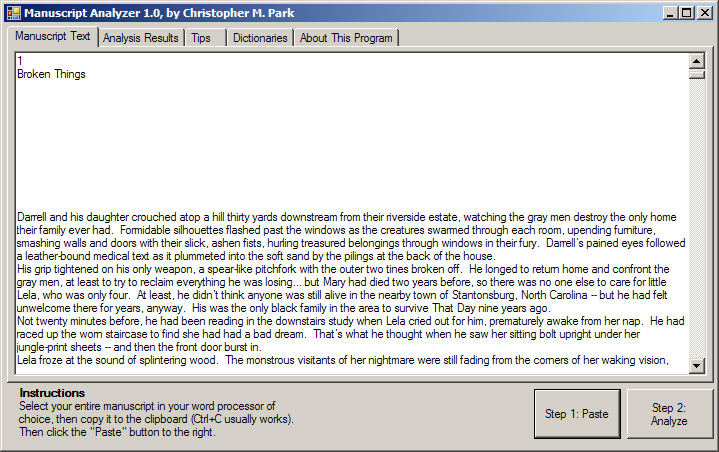
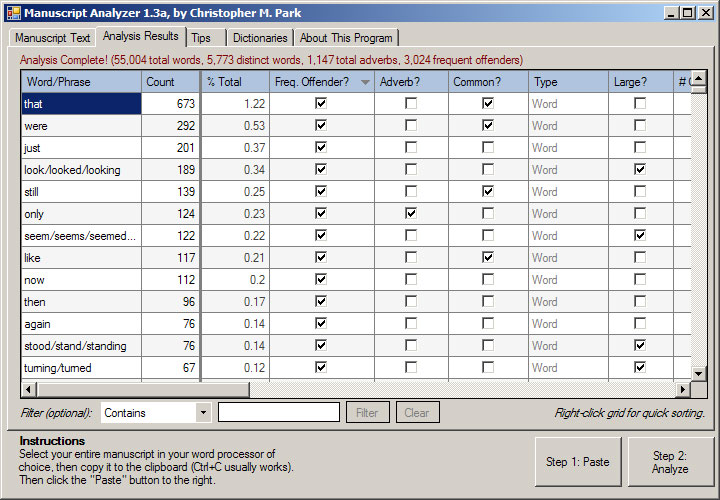
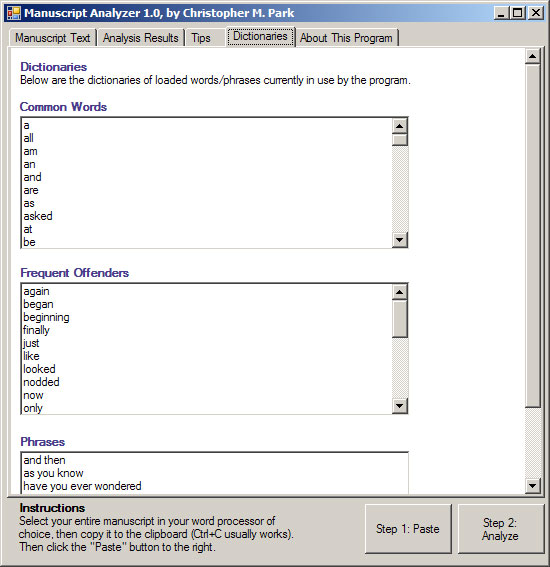
UPDATE: 1.3a is now the current version online, as that fixes a minor issue with sorting that was introduced in 1.3.
Friday, January 4, 2008
Holiday Roundup
I've been quiet lately, thanks to the holidays and then my return to work a couple of days ago. So this post is going to be a bit of catch-up for a lot of the things I've wanted to comment on in the last few weeks.
First off, thanks to a post by literary agent Jonathan Lyons, I read this very interesting piece by Dave Eggers. The part that is particularly interesting is his bit on selling out, which is a longish addendum to his response to the initial email. I've never had much concern over how avant garde anything was, but it was very interesting to read the rant of someone who once did, but no longer cares. I agree with Eggers' conclusion that tracking "sellouts" is just another form of fashion, and that might very well explain why I've never had any interest in it.
I saw an interesting post called Respecting Romance over at the BookEnds Literary Agency. This post was all about why some romance writers are embarrassed by their chosen genre, and why they shouldn't be. I don't read very much romance, and I definitely don't write it, but it recalled to mind the stigma that surrounds sci-fi and fantasy. I think most genres have some sort of stigma, actually, but here again -- it's all fashion. Write because you want to, and because your topic interests you. "Great art" can be formed in any genre -- any medium at all, in fact, as many artists have demonstrated.
Next I want to point out a post called Critters Vs. Betas (and the Dreaded Spouse Question) over at Dwight's Writing Manifesto -- and not just because he mentions me in the post. I recently posted some of my thinking on the topic, but Dwight has a new way of looking at it that I hadn't quite thought of before.
Literary agent Kristen Nelson recently made a post about the new Top Dealmaker feature at Publisher's Marketplace. I thought it was really useful information, and quite insightful (she usually is). It's good to have an agent's take on this sort of thing.
On an off-topic note, Stephen Parrish recently posted about Dinner For One, "a British one-act play [that] is a New Year's Eve tradition in Germany." Shortly after he mentioned this play (first time I'd ever heard of it), a German friend of my uncle brought it up. Go figure. Interestingly, the Wikipedia entry on the play notes that "although the sketch is most popular in non-English speaking countries, it is typically shown in the original English without dubbing or subtitles. Curiously, the film remains practically unknown to the English speaking world (except for Australia)." How very curious, indeed! Can you imagine a work of yours becoming a yearly tradition in some other country, but being utterly uncared-about in your native land?
I re-watched Terry Gilliam's cult classic Brazil the other day. It's a dystopian movie that made a big impression on me in high school, and which I've since counted as one of my top favorite movies even though I hadn't seen it for over eight years. My wife got it for me on DVD as a Christmas present, which was a really pleasant surprise. I was a little worried it might not seem as good now that I've grown up a lot more, but actually it was better than before. This movie is dense with symbolism, dark humor, and pointed social commentary. If you haven't seen this one, it's definitely worth a look -- the ending is probably my favorite movie ending of all time.
Have you ever heard of the (in)famous lexicographical term Mountweazel? I'm confident you'll find that trivia article both edifying and humorous.
Over the holiday break I read Stephen King's much-touted On Writing, and found it to be quite good. Most of you have probably read it already, but if not, it's definitely worth a read.
Another book that I'm finding even more helpful at present is Chris Roerden's Don't Murder Your Mystery. This is a very nuts-and-bolts book on writing, specifically aimed at Mystery writers. Don't let that fool you -- this gem is extremely applicable to all genres. The author has been a professional editor for over forty years, and she (yes, she's a female "Chris") really knows her stuff. For me, this book came at just the right time. I hope it finds you the same way.
And, I think that was about it!
First off, thanks to a post by literary agent Jonathan Lyons, I read this very interesting piece by Dave Eggers. The part that is particularly interesting is his bit on selling out, which is a longish addendum to his response to the initial email. I've never had much concern over how avant garde anything was, but it was very interesting to read the rant of someone who once did, but no longer cares. I agree with Eggers' conclusion that tracking "sellouts" is just another form of fashion, and that might very well explain why I've never had any interest in it.
I saw an interesting post called Respecting Romance over at the BookEnds Literary Agency. This post was all about why some romance writers are embarrassed by their chosen genre, and why they shouldn't be. I don't read very much romance, and I definitely don't write it, but it recalled to mind the stigma that surrounds sci-fi and fantasy. I think most genres have some sort of stigma, actually, but here again -- it's all fashion. Write because you want to, and because your topic interests you. "Great art" can be formed in any genre -- any medium at all, in fact, as many artists have demonstrated.
Next I want to point out a post called Critters Vs. Betas (and the Dreaded Spouse Question) over at Dwight's Writing Manifesto -- and not just because he mentions me in the post. I recently posted some of my thinking on the topic, but Dwight has a new way of looking at it that I hadn't quite thought of before.
Literary agent Kristen Nelson recently made a post about the new Top Dealmaker feature at Publisher's Marketplace. I thought it was really useful information, and quite insightful (she usually is). It's good to have an agent's take on this sort of thing.
On an off-topic note, Stephen Parrish recently posted about Dinner For One, "a British one-act play [that] is a New Year's Eve tradition in Germany." Shortly after he mentioned this play (first time I'd ever heard of it), a German friend of my uncle brought it up. Go figure. Interestingly, the Wikipedia entry on the play notes that "although the sketch is most popular in non-English speaking countries, it is typically shown in the original English without dubbing or subtitles. Curiously, the film remains practically unknown to the English speaking world (except for Australia)." How very curious, indeed! Can you imagine a work of yours becoming a yearly tradition in some other country, but being utterly uncared-about in your native land?
I re-watched Terry Gilliam's cult classic Brazil the other day. It's a dystopian movie that made a big impression on me in high school, and which I've since counted as one of my top favorite movies even though I hadn't seen it for over eight years. My wife got it for me on DVD as a Christmas present, which was a really pleasant surprise. I was a little worried it might not seem as good now that I've grown up a lot more, but actually it was better than before. This movie is dense with symbolism, dark humor, and pointed social commentary. If you haven't seen this one, it's definitely worth a look -- the ending is probably my favorite movie ending of all time.
Have you ever heard of the (in)famous lexicographical term Mountweazel? I'm confident you'll find that trivia article both edifying and humorous.
Over the holiday break I read Stephen King's much-touted On Writing, and found it to be quite good. Most of you have probably read it already, but if not, it's definitely worth a read.
Another book that I'm finding even more helpful at present is Chris Roerden's Don't Murder Your Mystery. This is a very nuts-and-bolts book on writing, specifically aimed at Mystery writers. Don't let that fool you -- this gem is extremely applicable to all genres. The author has been a professional editor for over forty years, and she (yes, she's a female "Chris") really knows her stuff. For me, this book came at just the right time. I hope it finds you the same way.
And, I think that was about it!
Subscribe to:
Posts (Atom)