It's only been a few months since I got Carrara, so I'm surprised to find myself already moving on. Vue is an even better program that recently came into my price range (it's still on sale, if you want to give it a look). This is one of the few rendering packages I've used that has made appearances in commercial special effects (Pirates of the Caribbean 2, most notably).
I'm sure I'll continue to use Carrara some, as I may use Bryce on occasion, but Vue is now the prime tool in my art milieu. All of the pieces from my latest gallery (still in progress) were done in Vue. Here are some of them:
This is an instant favorite for me -- and it's also one of the most realistic renderings I've ever done. I hope to be able to realize this level of fidelity in many more renderings.
My 300th rendering (not counting those in The Dregs or those that have never seen the light of day at all)! That seems fitting, because this was an instant favorite for me -- its a spiritual successor to one of my earlier works, Sky Castle, which was created nearly ten years before. 300 renderings in 10 years... that's not too shabby for something that is, after all, a hobby.
The building models are not by me, but rather came packaged with Vue 6.
This is my second remake of perhaps my most popular image ever, Loss. The original version was done in Bryce 2.0, way back in 1998 when I was first learning how to do renderings. The second version was done in Bryce 6.1 in 2007.
When I was heavily into Carrara rendering, I tried to make a version of this image using that program. However, I found that the fantastical nature of the image just didn't turn out very well in such a realism-minded program. I was afraid the same thing would be true with Vue (which is equally realism-minded), but the flexibility of the atmospherics model in Vue is such that I was able to achieve my unrealistic sunset with a modicum of tweaking.
It's been a really long time (almost a decade, I think) since I last rendered a low-lying landscape from this height and perspective. I love this sort of view, but the challenge of realistically managing the horizon has always kept me sticking with more mountainous terrains (which I also love, of course). Finally, with Vue, I'm able to achieve the sort of effect I've been looking for all these years. This is one of my few renderings that someone has mistaken for a photograph at first glance.
The sailboat is a stock item from Carrara 6, imported into Vue.
These are the first building models I've created myself in a while. Vue is able to import directly from Google SketchUp, and is able to do so in a manner that makes it easy for me to apply complex textures (which Carrara and Bryce both had trouble doing with SketchUp objects), so I imagine I'll be doing more such modeling from now on.
The twiggy brush in the foreground is also of my creation, based on a different solidgrowth tree in Vue. In general, I was very pleased with how dismally industrial I was able to make this scene.
"God rays" are a favorite subject of mine in landscapes, and this image marks my first foray into that territory in Vue. I was also particularly pleased with how the crags of the mountain came out, along with how the foreground grasses add realism and perspective.
I love this one. In some ways it reminds me of the opening chapters of the Prince of Persia: Sands of Time game, but I designed it as a 3D re-imagining of Subcon, from Super Mario Bros 2 (one of my favorite games). I love the look of this one in any case, though, with its multi-layered ecosystems.
This is also the first night scene I've done in some time, because I was having a hard time making those look right in Carrara. It's actually more complicated to make night scenes in Vue (in Carrara and Bryce there is a simple toggle), but the end result can be much better. I imagine I'll be doing more of them.
This was my second rendering in the full version of Vue. I wanted to see just how good the lighting and cloud effects could be -- the answer is "quite good," I think you'll agree.
One thing I really like here is how volumetric clouds are treated almost like meta blob objects (rather than simple bounding cubes). This allows for low-level clouds that look more organic, both by giving each component cloud a more realistic shape, but also by letting them "merge" together into larger clouds in a realistic manner. It's a little hard to explain if you aren't already familiar with this sort of thing, but let's just say that it lets artists model unusual natural phenomena more easily.
This is a re-envisioning of one of my favorite early renderings.
This one was unusually tricky to get right, and took me several more iterations than normal to get right. I'm pleased with the end result, except for the horizon line.
This is another one that took me forever to get right. In the end, the composition is completely different from what I had originally imagined, but I'm happy with it.
My first rendering in the full version of Vue. I was immediately floored by how realistic the "ecosystems" component is. These sorts of grasses and trees wouldn't be possible in any other rendering package.
One of my moodiest pieces ever. I was particularly pleased with how the ocean waves turned out.
Friday, April 11, 2008
Tuesday, April 1, 2008
Two Tone Range
Purely an experiment in lighting and atmosphere, the end result is something I really like. I enjoy the contrast of the ruddy darkness beneath the clouds with the grayish light above them. This sort of duality is the sort of thing that occurs all the time in nature, if you think about it, but it's the sort of thing we are rarely able to see from ground level.
Saturday, March 29, 2008
Hairy Spaceship
One of my stranger renderings of late, it's also one of my favorites. I wasn't really sure what I was going to create when I started with a blank slate in Hexagon, but the underlying structure of this model was what emerged. I thought it would make a good base for a translucent crystal of some sort, but when I started working with it in Carrara I quickly decided to go with something darker, opaque, and reflective.
The hair was the stroke of inspiration that tied this all together for me -- the weather, the water, and the patchy mist clinging to the ship all serve to refine and emphasize this one aspect of the scene.
Frankly, I find the end effect pretty menacing. Always a good thing.
Thursday, March 27, 2008
So Many Clocks!
I've never really thought about this before, but this world really is filling up with clocks. Doing a quick mental inventory of the clocks in my house, I come up with:
1 oven clock
1 microwave clock
2 wall clocks
3 alarm clocks
2 desk clocks
2 watches (at least -- probably more)
3 computer clocks
1 clock in answering machine
1 clock in VOIP phone
4 clocks in entertainment center equipment
3 clocks in miscellaneous other electronics
1 clock in wall thermostat
1 clock in bike odometer
That's 25 clocks right there, and I know I missed a good number of them. I also only counted those clocks that have some sort of visible display, whether on a monitor/screen readout or whatever. I'm sure various other electronics have some sort of internal clock of which I'm not even aware.
This is a pretty random thing to quantify, on the surface -- but on the other hand, it seems pretty descriptive of our society that we are perhaps more surrounded by timepieces than any other civilization on Earth has ever been.
Wednesday, March 26, 2008
Force Feedback In Managed DirectX
I recently wrote my first article for Code Project. It's on a pretty niche programming topic, specifically controlling the actuators in game controllers via C#. This is something that should be a pretty basic topic, but a longstanding bug in some Microsoft libraries prevent their examples from working with many game pads. My article outlines the basics of how to do that sort of code, and shows how to work around their bug.
Let go of my CD!
I recently discovered an online comic called xkcd, and I must say it is hilarious. A lot of the jokes are things that would only be funny to programmers, but I think anyone can appreciate this one. I enjoyed many others from that strip about turing tests, sysfaults, compiling, imaginary kilobyte denotations, and many other topics, but I doubt you'd be as interested in those if you're part of my normal readership (aka, other writers).
Monday, March 24, 2008
Island Chain
Another Carrara sunset, this time I was playing with light to see how dramatic I could make the effect. The result was quite pleasing, though I did have to massage the colors and contrast a bit in Photoshop to get the final effect.
The tower model was a freebie from Turbo Squid.
Saturday, March 22, 2008
Unintended Influences
Whenever my family gets together, we generally play games. Xactica, Turn the Tide, Five Crowns, Phase 10, and Coloretto are long-time favorites of the Card variety (though we also enjoy others such as Descent, Settlers of Catan, Princes of Florence, among dozens of others). Anyway, the point being that we have a very wide variety of games we play.
Recently, we've added Three Dragon Ante to the mix. It's a fun, semi-strategic, card game under the Dungeons & Dragons license. I've never played D&D much, though I have played some of the computer spin offs such as Unlimited Adventures and Neverwinter Nights. I have a reasonably thorough understanding of most D&D mechanics, though I've never been wholly invested in the property.
Imagine my surprise, then, to discover the names of two particular cards in Three Dragon Ante: Bahamut and Tiamat, the two dragon gods. These were names I had given to two of my seven Elder Dragons in THE GUARDIAN (which are also the only dragons in my series -- and there are no elves, dwarves or fairies/faeries, I swear).
I hadn't realized that these two names were used together in D&D, or I never would have chosen them to use in my own work (I picked them for their mythological significance). Fortunately it was something I caught on my own, well before the work was even sold -- how much more embarrassing would it have been to stand accused of plagiarism years later? At that stage of the game, it would have been very hard to convince anyone that the choice of name was unintentional. I hear the same sort of thing happened to Katherine Paterson with Bridge to Terebithia. I've been sympathetic to her on that issue since I first heard of it, but now I can really relate.
From now on I'll be googling every name I use if it seems at all familiar. A lot of the names I use have their roots in various world mythologies or classic works, but using names from modern writers/works isn't the same thing. I've renamed Bahamut and Tiamat to Deinderak and Tiarak, which are definitely unique. The characters were already quite unlike their (unintentional) counterparts in the D&D universe, so at least their monikers were all I had to change.
Writing a novel is an interesting endeavor in that you are simultaneously inspired by others' works and setting out to do something wholly original. The more original the better, of course, but there's no way to be original unless you know what else is out there (and, come on, good writers enjoy reading for pleasure, anyway). Sometimes a little too much of some other writer's influence sneaks into our works, and we have to guard against that. Even without the issue of plagiarism, reusing characters, names, ideas, or phrases from other works isn't going to make your own writing stand out. Where would we be if writers weren't out there inventing words like "hobbit" and "muggle" and "jedi?"
Wednesday, March 19, 2008
Doctrine of Insufficient Adulation
Via Slashdot, I found an interesting article called Why Apple fans hate tech reporters. The basic premise is that when people are really rabid about an idea -- the merits of a certain product, religion, or political stance -- they perceive even-handedness as an insult. In other words, if I think you're completely wrong/evil/whatever, and someone else comes along and doesn't immediately leap to my side, I'll feel like they're siding with you.
Interesting. Disturbing. This is apparently just part of human nature, because I've certainly seen it before in life, though I'd never thought much about it until WSJ columnist Walt Mossberg pointed it out. It's particularly troubling for me, because I tend to avoid political conflict by remaining neutral. Go ahead, ask me what I think about abortion or Israel or Global Warming -- I'm not going to debate those things with anybody, at least not at present.
There are many conflicts in the world, a great many of which affect me, but I am not enough of an expert on them to feel like I can take a meaningful stance. On those issues with which I do have first-hand experience (the need for helmets on bicyclists, issues with violence in schools) I'll definitely speak out. I know it's more popular for people to have ardent opinions on anything and everything, but that's never sat well with me. I've always been a moderate, only taking one side or the other when I feel particularly informed or knowledgeable about the issue.
And now I discover that even moderation is likely to drag me into ideological scuffles I want no part of. How the heck does Switzerland do it? Oh, well, life wouldn't be interesting without conflict.
Thursday, February 28, 2008
Oddest Book Titles
Reuters recently had an interesting short article on this year's finalists for the oddest book title. I can't decide whether I think "Are Women Human? And Other International Dialogues" or "Cheese Problems Solved" is funnier. Of course, "I was Tortured by the Pygmy Love Queen" is pretty good, too.
As the article points out, it's really nice to see that the publishing industry isn't homogenizing too much. There are still plenty of quirky oddities making it into print.
Wednesday, February 27, 2008
Why I Write
Literary agent Nathan Bransford posed this questions to his readers: why do you write? Here's my answer:
My own personal character has been heavily influenced by the works I read as a child and a young man. Books have a way of reflecting and crystallizing real life, and our favorite characters are often foils to ourselves. I write not so much to change the world (though that would be nice), but to hopefully help others shape themselves into the people they want to be -- as my favorite authors helped shape me into who I wanted to be.
On the other hand, one of the main reasons I write is simply to provoke a response. If I can make people laugh, or cry, or look at something in a new way, I've been successful. Novels are entertainment, education, and sometimes even catharsis. For the author as well as the reader. But mostly, I write because it's part of who I am.
PS - In other news, I am quite busy on a writing project, which is why I haven't been blogging much. I hope to be back soon!
Friday, February 8, 2008
Writing Status
Well. I am sick. Yesterday was the worst, with my temperature getting up to 101.8, among other unpleasantries (which I will spare you). Not sure if this is the flu or not, which is going around NC in a major way, but it's certainly cutting its way through the school where my wife works. At least the really bad phase seems to last only a day or two for most people.
Today I'm still home from work, and as you can tell I'm catching up on my blog posts a bit (to distract myself from how my body feels, mostly). But I'm way too out of it to get any actual writing done, and have been for a couple of days now. I did get maybe a page written on Wednesday, before things got too bad, and I've also been making prewriting notes so that I can hit the ground running once I'm better. Amazingly, I finally sat down and wrote the first half-page of my synopsis -- I think that's going pretty well, so far.
And... that's pretty much all the news.
Roads, versus their destinations
Yesterday, Dwight made an interesting post called What's a little sacrifice between friends. He brings up some very interesting points about happy endings, and predictable endings, and why he prefers works that are not formulaic in their resolutions. One interesting quote from Dwight's post, this one specifically referencing movies:
Well, I think it boils down to the fact that I don't read books or watch movies for their endings. I want to find myself captivated the whole way along, and if the ending is predictable -- so what? If I come away feeling good and happy about myself, what's the harm in that?
Granted, my own writing tends to be much darker, but that doesn't mean mean I can't enjoy the lighter side of things in others' works. In the case of the Pierce Brosnan Bond movies, it was all about the cleverness of the action and situations, and the interesting bad guys and their plots. Sure, it was lightweight fare, but it was pretty entertaining nonetheless. Those aren't among my favorite movies, to be sure, since they lack the depth to make me really connect with them, but every movie I enjoy can't be my favorite.
With the most recent Bond movie, Casino Royale, the writing is much more poignant and deeper, and Daniel Craig portrays a much more interesting Bond. Did I think there was a possibility that he might die in the end? Of course not. But there are a lot of things nearly as bad as death, in such movies. What about the heroine? She's fair game to die, and I didn't want her to. What about the other secondary characters that I was coming to care about -- would Bond be able to protect all of them? And, of course, there are other interesting subplots, such as his relations with M (who doesn't seem to like him very much), his growing finesse as a spy, and the ever present danger of betrayal. So, clearly, there was a lot to keep it suspenseful.
I think the same can be said of Batman Begins, which is another of my favorite movies. I was less interested in Batman before that movie, but I really connected with every aspect of that rendition. Harry Potter was the same way -- of course there was no possibility that Harry was going to die until the last book in the series, and even that seemed pretty unlikely. Yet those books drew me along like few others, as there was a whole world there that I cared about and didn't want to see ruined. There were plenty of characters that I cared about just as much as Harry, and was distraught when they did die (though I was artistically pleased with all of her choices as to who to kill).
I could give plenty of other examples of books I think fall under this category (The Dresden Files, which I just finished the first of and loved, for instance), but I think you get the point. The endings of books and movies should definitely not be telegraphed in advance -- that's bad writing -- but the central question of whether the protagonist(s) live or die is not always the most important one. Sometimes it's all about seeing what they do along the way (all unexpected events, hopefully), and sometimes it's about any collateral damage that might occur.
As a kid, I was the biggest James Bond nut. Somewhere in my teens (circa A View to a Kill with that awful Duran Duran soundtrack) I finally had the “He’s never going to die. What’s the point of all this? Why am I wasting my time here?” epiphany. I was done with Bond.Here's the original response I posted in the comments of his blog:
Very good post, Dwight. I have a lot of the same feelings. The intersting thing about tragedy is that it often goes well until the end, when everything falls to shit. I don't like to write tragedies any more than I like to write comedy, or happy endings, or whatever.I still stand by what I wrote there. However, as yesterday progressed I found myself wondering how I could think that, and still love Bond movies (or the latest Batman incarnation, which has much the same problem -- there's no way Batman will die, any more than Superman "died" in the mid-90's during that whole "Death and Return of Superman" publicity stunt). How is it that I can pride myself on writing the unexpected, often bittersweet endings, and then not be as judgmental with other works? What's the appeal of those other stories, if the ending is a relatively foregone conclusion?
As you say, write the story honestly. For me, this means bits of dark comedy throughout; moments of success for the hero and moments of abject failure (somewhere between page 1 and "the end"); and endings that are never all bad nor all good. Bittersweet? You could call it that.
But, more to the point, things are never wrapped up with a bow on top -- for good or for ill. Just like life.
Well, I think it boils down to the fact that I don't read books or watch movies for their endings. I want to find myself captivated the whole way along, and if the ending is predictable -- so what? If I come away feeling good and happy about myself, what's the harm in that?
Granted, my own writing tends to be much darker, but that doesn't mean mean I can't enjoy the lighter side of things in others' works. In the case of the Pierce Brosnan Bond movies, it was all about the cleverness of the action and situations, and the interesting bad guys and their plots. Sure, it was lightweight fare, but it was pretty entertaining nonetheless. Those aren't among my favorite movies, to be sure, since they lack the depth to make me really connect with them, but every movie I enjoy can't be my favorite.
With the most recent Bond movie, Casino Royale, the writing is much more poignant and deeper, and Daniel Craig portrays a much more interesting Bond. Did I think there was a possibility that he might die in the end? Of course not. But there are a lot of things nearly as bad as death, in such movies. What about the heroine? She's fair game to die, and I didn't want her to. What about the other secondary characters that I was coming to care about -- would Bond be able to protect all of them? And, of course, there are other interesting subplots, such as his relations with M (who doesn't seem to like him very much), his growing finesse as a spy, and the ever present danger of betrayal. So, clearly, there was a lot to keep it suspenseful.
I think the same can be said of Batman Begins, which is another of my favorite movies. I was less interested in Batman before that movie, but I really connected with every aspect of that rendition. Harry Potter was the same way -- of course there was no possibility that Harry was going to die until the last book in the series, and even that seemed pretty unlikely. Yet those books drew me along like few others, as there was a whole world there that I cared about and didn't want to see ruined. There were plenty of characters that I cared about just as much as Harry, and was distraught when they did die (though I was artistically pleased with all of her choices as to who to kill).
I could give plenty of other examples of books I think fall under this category (The Dresden Files, which I just finished the first of and loved, for instance), but I think you get the point. The endings of books and movies should definitely not be telegraphed in advance -- that's bad writing -- but the central question of whether the protagonist(s) live or die is not always the most important one. Sometimes it's all about seeing what they do along the way (all unexpected events, hopefully), and sometimes it's about any collateral damage that might occur.
Clearly, statistics aren't everything
This post at SF Signal shows which books supposedly are for the "dumb" kids, and which ones are for the smarties, as evidenced by the correlation between favorite books and SAT scores.
I highly recommend you read the original article, but here's the graph they include, for quick reference:

Hmm, interesting. I'm quite surprised to see that the average score (on the older 1600-point scale, rather than the new 2400-point one) does not go any higher than 1250. At any rate, I know loads of people who scored way higher than this entire range, and who loved many of the books on the lower end of the scale.
My favorite book is Ender's Game, but I'm also quite partial to Harry Potter and the Chronicles of Narnia (just to pick examples from this list). My score was about 1425 (790 in English, thank you very much). My wife is not nearly as partial to Ender's Game, but liked Eragon and loved Wicked and Harry Potter (though her favorite books, most by Connie Willis, aren't even on this list). She scored a 1590. I knew plenty of people who scored in the 1400-1600 range who loved Lord of the Rings above all else.
Of course, this might be skewed by the high school I went to -- Enloe was the top magnet high school in the country when my wife and I were there. I was actually a bit embarrassed by my 1425, and with a ~4.4 weighted GPA, I was only something like 125th in my class of about 500. My wife had a much, much higher weighted GPA, and a much better class rank in her year, but I think she'd rather I not publish those on the Internet.
The point is that I don't think that the books we read (within reason) are necessarily indicative of intelligence or SAT scores, and certainly that kids shouldn't be discouraged from reading certain books because it will "make them dumb." Obviously there are benefits to reading thought-provoking works with an advanced vocabulary, but reading works of value that inspire you is also important. Great books are about people, relationships, and ethics (Harry Potter and Ender's Game) as often as they are about deep ideas in an academic sense. Read higher-class literature if that's what moves you, but don't expect that to be a primary determinant of your academic success.
I highly recommend you read the original article, but here's the graph they include, for quick reference:
Hmm, interesting. I'm quite surprised to see that the average score (on the older 1600-point scale, rather than the new 2400-point one) does not go any higher than 1250. At any rate, I know loads of people who scored way higher than this entire range, and who loved many of the books on the lower end of the scale.
My favorite book is Ender's Game, but I'm also quite partial to Harry Potter and the Chronicles of Narnia (just to pick examples from this list). My score was about 1425 (790 in English, thank you very much). My wife is not nearly as partial to Ender's Game, but liked Eragon and loved Wicked and Harry Potter (though her favorite books, most by Connie Willis, aren't even on this list). She scored a 1590. I knew plenty of people who scored in the 1400-1600 range who loved Lord of the Rings above all else.
Of course, this might be skewed by the high school I went to -- Enloe was the top magnet high school in the country when my wife and I were there. I was actually a bit embarrassed by my 1425, and with a ~4.4 weighted GPA, I was only something like 125th in my class of about 500. My wife had a much, much higher weighted GPA, and a much better class rank in her year, but I think she'd rather I not publish those on the Internet.
The point is that I don't think that the books we read (within reason) are necessarily indicative of intelligence or SAT scores, and certainly that kids shouldn't be discouraged from reading certain books because it will "make them dumb." Obviously there are benefits to reading thought-provoking works with an advanced vocabulary, but reading works of value that inspire you is also important. Great books are about people, relationships, and ethics (Harry Potter and Ender's Game) as often as they are about deep ideas in an academic sense. Read higher-class literature if that's what moves you, but don't expect that to be a primary determinant of your academic success.
Tuesday, February 5, 2008
Progress is Progress
Wild Zontars had to drag the information out of me*, but I managed to write three and a half pages today. For whatever reason, the juices just weren't flowing -- but I persevered. I'd write more here, but it's late and I'm tired. I'll try to make a more interesting post very soon.
The stats as of today:
-52,625 estimated words.
-62,186 actual words.
-210.5 pages.
-Song(s) listened to while writing: Lacrymosa, by Evanescence; The Man Who Sold The World, by Nirvana; Monstrous Turtles!, by zircon
* Ten thousand points (**) if you catch the incredibly obscure reference I made above without googling it.
** One point if you can catch the much less obscure reference I made in the first footnote.
Monday, February 4, 2008
Blog Birthday
That's right, this blog turns one year old today. No fanfare, just business as usual. I've made some progress on my writing (actually, I've given in to the urge to do a bit of editing -- to good result, at least), but I don't have enough that's new to warrant a full progress report. I hope to complete an entire new scene tomorrow, but we'll see what else comes up in the meantime. I find myself with a lot of different things going these days...
Sunday, February 3, 2008
Manuscript Analyzer Online
The Windows version of Manuscript Analyzer has been getting some pretty good comments and use around the Internet, but one undercurrent that I've been encountering is that there are more writers who are Mac users than I had anticipated. To provide a solution for those users who can't use the Windows version, I've created Manuscript Analyzer Online.
This program is written entirely in JavaScript, and so works with Internet Explorer, Safari, Netscape, and FireFox without the need to install any software at all. The online edition contains all the features of the Windows edition, and is only very slightly slower to run.
The big concern that everyone is likely to have with this program, however, is its online nature. Is it stealing their manuscript, or transmitting it across the Internet where passing hackers might take advantage of it? The answer, of course, is no. Otherwise I wouldn't have put it up.
The program itself is about 24kb, and gets downloaded as a web page via your browser (like any other web page). Once it is downloaded, that's all that is transmitted: using JavaScript, the program analyzes the manuscript on your own computer, without any more interaction with my web server. This means that it also will work just as fast for dialup users as it does for users on cable or T1 (after that initial download), and that you don't have to keep an Internet connection open to use it.
Hopefully that alleviates any concerns that anyone has, but if there are other questions please do let me know and I'll be more than happy to address them. Also, I'm still quite interested in ideas for improvements/extensions to the program, so feel free to email me with those.
Exciting News
Well, this is certainly the most exciting news I've been able to post in a while. Remember how I've been admonishing you to read DON'T MURDER YOUR MYSTERY, the nonfiction book on writing by mystery editor Chris Roerden? Well, I promise you that my recommendations have not been skewed by the following news, which is a very recent development:
It turns out that the first line from my current WIP will be included in the next edition, DON'T SABOTAGE YOUR SUBMISSIONS. DSYS will be the expanded, cross-genre edition of the 2005 original, which won a 2007 Agatha award among many other honors. DSYS will be released later this year (I'll post a reminder as the time approaches).
This is very exciting for me not just because it's a great publication credit (hooray, query letters), but because I so wholeheartedly support this book. Amongst all the various writing books I own, this one has far and away been the most helpful on a practical, nuts-and-bolts level. It's really an honor to have my writing included with the many other examples of good writing that Roerden uses.
Friday, February 1, 2008
Chapter 13 Completed, And A New Process
Yes, I know I haven't been around much recently. Or, at least I haven't been making any blog posts or many comments elsewhere, though I have been reading the blogs on my list. I've been steadily working away for the last couple of weeks, though not directly on my manuscript for most of that time. I've got a new, secret project that I've been working on -- something that should prove rather useful and unique when it comes time to promote my book.
Yes, I know, that's getting ahead of myself -- the book isn't even done, and it's not definite that it will find an agent, let alone a publisher. But the promotional idea struck me a few weeks ago, and I knew I had to put it in motion. It's the sort of thing that will hopefully make me marginally more attractive to agents and publishers, anyway -- prepared marketing ideas, and all that. At any rate, my novel will still succeed or fail on its merit alone (I'd have it no other way), but every little bit helps in this business.
Moving on: I have made substantial progress on my novel itself. I've now passed 60,000 actual words, 50,000 estimated words, and 200 pages. And, best of all... (drum roll? no?)... I'm through with my revising-expanding work! Wow, that's only taken... um... has it really been four months? Well, the novel has doubled in length during that process, and definitely improved in quality. I plan on writing the last hundred or so pages in a lot less time than that, though.
That's the other thing I've been working on recently -- figuring out why I've been so blocked, albeit off and on, with my writing in the last year or so. There's one obvious answer: I didn't emotionally handle the rejections of The Guardian all that well. Well, granted. But there's another, deeper, reason: my writing process hasn't been matching my actual preferences. In fact, my writing process has never matched my preferences, but until The Guardian I was too blindly optimistic to care. Now that I'm less sure (but hopefully also wiser), my process has been smothering me.
What was my process? It basically boiled down to this:
- Plot in advance as much as possible.
- Figure out the rest as it is written, to keep things fresh.
- Write everything in order, and write the first draft as well as possible.
- Revise prior content before moving on with new writing.
- Try to hit a certain word count each session.
I think that's a pretty common process for writers, actually, but it just doesn't work for me. Or, I should say, it doesn't work well. It has, after all, helped me finish two and 2/3 books. But at the same time, I managed to not finish over twenty five (nineteen of which came before I finished my first book, though, so in retrospect those were really just learning projects more than anything else).
At any rate, my shiny new process is this:
- Plot in advance as much as possible.
- Figure out the rest as it is written, to keep things fresh.
-BUT don't ever go into a writing session thinking I'll figure it all out as I go.
That's a sure recipe for slow death during the session.
- Write things in the order they occur to me.
- This will be MOSTLY in chapter order, but definitely not in scene order.
And certainly not in paragraph order within the scene. Often it is easier
to jump ahead to some dialogue or action or description that I'm sure of,
and to then come back and fill in the gaps I was less sure about.
-Write the first draft as well as I can without going back and constantly revising.
- This also means not sitting at the keyboard for twenty or thirty minutes
trying to revise a single line (this was previously a common occurrence).
- Revising is much more effective, at least for me at this point in my career,
when done suitably after the initial writing. Also, wearing my editor's hat
scares the hell out of my writer's hat, and makes doing further writing that
much more difficult. Something many professional writers have said, but I
never listened. Well, I'm listening now.
- Ignore word count when trying to gauge progress in an individual session.
- The more important note is whether or not I finished the block of story
(usually a scene) that I wanted to finish. If I can finish one scene per writing
session, I'm doing good. Three scenes, like I wrote today, is doing awesome.
- Keep a to-do list of scenes that are ready to write, and scenes that need more plotting.
- Just being able to check items off my list, and to see the number of items on the
list as they dwindle is an inspiration to do more. I've used this trick with my
programming for half a decade, and it's just now occurring to me to do this with
my writing, too.
So far, my new process works. I'll let you know how it goes.
The stats as of today:
-51,500 estimated words.
-61,051 actual words.
-206 pages.
-Song(s) listened to while writing: Soundtracks to Meet the Robinsons, Superman Returns, Hook, and Brazil
Friday, January 18, 2008
Overcast Crags
This rendering is notable for several reasons. First, it's the first black and white scene I've ever done. I've always been one for color, but in this case I wanted to do something dramatic and new.
Secondly, this image represents the most accurate "brain dump" of a place from one of my novels. If you look through my art gallery archives, you'll find literally dozens of renderings that I've done to correspond with over eight books (all but two of them unfinished) that I worked on over the years. This one is the best.
This is the edge of the Deep, a sunken netherworld of demons in The Guardian. The chasm itself is miles deep and as wide as a small continent, shielded from the sun by a thick bank of clouds that swirl in an endless, unnatural cycle.
Golden Dunes
This is my first Carrara rendering to feature an actual image-based terrain texture, rather than the algorithm-based shaders that are so easy with that program. It turns out that using image-based textures are just as easy in Carrara (a lot more so to handle well than in Bryce). I was really pleased with the result on this one, which came from Mayang's Free Texture Library, a great resource for images to use as textures.
I learned a few other new techniques that went into the creation of this image, too -- more lighting tricks, as well as the way that distance haze is invoked. The end effect reminds me of the lands around Dalmasca in Final Fantasy XII (which was an unintended side-effect but seems pretty cool).
Thursday, January 17, 2008
Chapter 12 completed
Well, today was certainly a record -- though to be fair, it was third-draft revision, not first-draft writing. Still: thirteen and a half pages in one evening. I am very close to being done with my revising-expanding process, so that I can move on with writing the first draft of the rest of the book. This is very pleasing, to put it mildly.
The stats as of today:
-49,500 estimated words.
-58,704 actual words.
-Twelve and a portion fully-revised-and-expanded chapters (192.5 pages total).
-198 pages in all.
-Song(s) listened to while writing: Soundtrack to Jet Li's Fearless
The stats as of today:
-49,500 estimated words.
-58,704 actual words.
-Twelve and a portion fully-revised-and-expanded chapters (192.5 pages total).
-198 pages in all.
-Song(s) listened to while writing: Soundtrack to Jet Li's Fearless
Wednesday, January 16, 2008
Chapter 11 completed
Six and a half all-new pages today! Of course, I deleted just as much content, so my total word count dropped by about 200 words, but who cares. I'm finally done with my eleventh chapter, which is the last of the chapters that required wholesale rewriting.
My next chapter is the one that was best written prior to my last round of edits, so it should take the least amount of work. That's nine pages I should be able to fly through, relatively speaking. The shorter chapter that comes next isn't quite as good, but still doesn't require any wholesale replacement. Then I will be DONE with my revising-expanding process, and can move on with new content. I look forward to the point when the words I write will actually be added to my net wordcount. It seems like I've been working my tail off, and yet been hovering around 200 total pages for weeks.
At any rate, I'm feeling pretty jazzed. Hope your writing is going as well.
The stats as of today:
-49,500 estimated words.
-58,481 actual words.
-Eleven fully-revised-and-expanded chapters (179 pages total).
-198 pages in all.
-Song(s) listened to while writing: Remember, by Harry Nilsson
Tuesday, January 15, 2008
Autumn Storm (and progress)
Here's a new piece that I rendered today in Carrara.
As of the time of its creation, this is my favorite image that I've done in Carrara. I hope you can taste the crispness of the air, smell the tang of the storm rolling in towards you as the clouds scud across the sky. This is some of my favorite weather, and I'm really pleased to have captured it like this.
This was also my first Geocontrol terrain rendered at 4096 resolution -- makes a big difference in the realism factor, doesn't it?
Also, I managed to make four and a half pages of progress on my novel. All right!
The stats as of today:
-49,500 estimated words.
-58,647 actual words.
-Ten and a portion fully-revised-and-expanded chapters (172.5 pages total).
-198 pages in all.
-Song(s) listened to while writing: Soundtrack to Final Fantasy VII: Advent Children
The effect of expectations on percieved quality.
Here's an interesting article from Reuters about how higher wine prices boost drinking pleasure. Essentially, adults were given the same wine over and over, but told that each one cost different amounts. The adults preferred the higher priced versions, even though there was no difference. Anyone who has taken marketing knows that this effect exists -- it's the basis of all "luxury" items.
What was interesting to me in the article, however, was that they documented a physiological response in the brain. Since the people believed they were getting something better, their brain responded as if it was. Their subjective experience was very much a slave to their expectations.
This is very interesting, perhaps alarming. It might mean that the same manuscript, packaged differently, will seem better or worse to agents and editors. One version that smells of stale smoke, another that is printed on too-cheap paper, one in the wrong format, another with crazy fonts or styling or with home-made cover art included... the agent or editor is already thinking they are dealing with someone unprofessional. Your actual writing and story would have to be pretty amazing to surpass those sorts of hurdles. Especially since they are looking at your work as part of the larger slush pile, which they expect to reject almost all of, anyway.
Just something to think about next time someone like Anne Mini is talking about reasons for having your work in standard format. It's also a good reason to exercise restraint and patience when you approach the submissions process itself. Take the time to do your homework, to proofread carefully, and to do everything else in your power to make your submission perfect. Each error makes your work seem like a cheaper wine.
Of course, we all rush to submit our very first works, don't we? That's probably why most (but not all) people don't get published until their third or fourth completed novels. I think that's just a part of the learning curve, something you have to go through that no one can talk you out of. Still, once that lesson is learned, hopefully we're all a lot more thorough the second time around.
I imagine that I have at least one reader who thinks this post is aimed at them -- it's not! This is more about general wisdom; every situation is certainly different, and sometimes people do get their first works published. Joe Haldeman did. It just doesn't happen very often, is all. Most of the other greats got lots of rejections, and not because they were any less of writers than Haldeman. Sometimes the stars align, and sometimes they don't. So it's probably good that we throw ourselves out there on our first try, perhaps a bit recklessly. Then we have a frame of reference for how to do things the next time around (presuming the stars didn't happen to align).
Sunday, January 13, 2008
Red Desert Buttes
A couple of new pieces that I did last night. Also, I did get a page of writing done on my book, which was reasonable. Weekends are slow for me, writing-wise, I'm learning. But it's good to take some time to recharge every week.
Dramatic sunset lighting in a butte-filled desert. This is one of the first images with buttes that I've rendered since Bryce 2.0 back in 1998. How time flies. These terrains were mapped in Geocontrol, which is why they are so much more realistic than some of the recent terrains I created in Carrara alone.
My third version of the mountaintop range rendering. This time with snow instead of greenery, no trees or helicopter, and even more dramatic lighting. I think this is my favorite version of the three.
Saturday, January 12, 2008
Lighting up your writing
I had a bit of spare time the other day, and decided to do a bit of artwork. I haven't done any art since October or November, so it seemed about time. I've recently started using a tool called Carrara, which I find to be both more powerful and more difficult than Bryce, a tool I've used since 1998.
The switch should have been relatively smooth: Carrara has intuitive controls, a great deal many more features, and a lot more sophistication and realism than Bryce. However, there was a problem that I couldn't quite put my finger on. I was able to create images with content in forms I'd only ever dreamed of before, and it was indeed quite intuitive to do... but at the same time, something was missing in the finished products. The scenes often felt flat, dull, and less interesting than the ones I had been doing in Bryce.
This was a mystery to me for several months -- all the parts were seemingly there, so I couldn't see why everything didn't gel. I should point out at this point that I'm not a professional artist, and most of my technique is self-taught. To a professional artist, or even just someone trained in mid-level photography, the problem with my Carrara work should have been obvious: light. If you have any passing interest in art or photography, the link above is one of the best reads you may find.
Take a look at the two images below. The one on the left was rendered before I read that article, and the right-hand one was rendered after.
Pretty dramatic difference, right? The only thing changed between them is the lighting. The mountains, their "shaders," the clouds and mist -- none of that was changed one iota. Yet it looks like much of that is different, doesn't it? The mist is much more prominent in the second image, because it is caught in the path of a strong light from the left of the scene. The clouds look different (thicker and more brooding) because the sun is now positioned high in the sky, shedding a redder, more diffuse light as a counterpoint to the harsh white light from scene left. Even the mountains look different, as the deep contrast of light and shadow makes each crook and crag that much more prominent.
In every sense, light is art. Monet certainly knew this. Light is vision, after all -- at the most fundamental level, the only thing our eyes ever see is reflected light. From that perspective, of course changing the lighting of a scene will have a dramatic effect on the way that scene is viewed. Lighting effects everything from clarity to mood.
Here's where I tie this into writing -- perhaps you see the connection already. Light is to (visual) art as words are to writing, right? The wording of what we write is what separates the great writers from the merely good, and the merely good from the truly terrible. Cliches, passive voice, unneeded word repetition, awkward construction, and just plain unclear wording can kill any work -- fiction or nonfiction. It doesn't matter how brilliant or revolutionary your idea/plot/characterization is, unless you can transmit those concepts -- through your words -- to your readers.
This, of course, is old news. I presume I'm preaching to the choir, here, to pick an apt cliche. What may not be so obvious is this: poor wording problems can be remedied with editing. This is the part of the craft that has to be learned by most writers. Clear, original thinking and content -- that's the part that can't be taught. I'm not an art historian, but from what little I have read on the subject it seems that most famous artists attended some sort of art school, or studied under another artist in their time period. This was how they learned what they needed about technique, including everything that was known and relevant about light itself.
Even though these artists had presumably been walking around and "looking at stuff" their whole lives. Maybe even admiring the great art that came before them. My first point is this: a serious writer will take the time to learn the underlying craft it takes to become a true wordsmith. Practice makes perfect, but not unless you know what to practice.
But that's really my ancillary point. The true purpose of this post was that I realized something rather important with those two images of mine: in order to fix my "bland, dull" images, I just needed to put some vigor into the lighting. I have a good sense of form and composition, anyway, so that part was already pretty much set. It's the same with writing. If you have a good sense of plot and character, and have a good understanding of the basics of grammar, that's a pretty decent foundation to work from. It's like my first mountains -- deceptively empty if you're lacking the crucial elements of voice and style, but still quite recoverable. As long as you take the time to learn something about voice and style, as I finally did with regard to light.
Don't get me wrong, there are plenty of terrible writers with "great ideas" that aren't really great. That's not what I'm talking about. I'm talking about those writers with legitimately new concepts, with solid foundations, who nevertheless get rejected time and again because their work lacks pizazz, or agents just don't fall in love with it, or one of the many other euphemisms for "poor lighting." If you're one of those people, don't just keep beating your head on the wall -- practice probably won't help significantly, for the same reason that I'd have never figured out the underlying mechanisms behind lighting my mountain scene. Instead, go pick up some good writing books (I've mentioned On Writing and Don't Murder Your Mystery recently), and learn a few things you don't already know. Then come back and practice, practice, practice -- and I bet you'll see some progress.
I'll let you know if that worked for me once I find out.
Friday, January 11, 2008
Prewriting is Writing
Only two pages of writing -- well, prewriting -- today. When I'm finished writing that content, it should be about ten pages of actual prose. I'd have written more, but I have a family engagement. Tomorrow is looking promising, however.
Thursday, January 10, 2008
Progress
Four and a half pages (1,200 actual words) of all-new content today, even though it doesn't look it. I cut about four pages that were very old and not very good, so my totals didn't change much, but the new material is something I'm really pleased with. These last few sessions have been extremely good, actually.
I probably could have written more today, but I hit the end of what I had prepared, and so decided to stop. No sense burning myself out. I'll figure out the rest of this scene by the time I start writing tomorrow, and get it written then. The important thing is to be making meaningful , reasonably consistent progress.
At any rate, there is still a bit more old content that I need to do a wholesale replacement of, and then I'll be reaching the best of my old content -- that part should go extremely quickly, by comparison. Then I'll finally be done with my long "revising and expanding" phase, and can press on and write the last third of the book.
The stats as of today:
-49,000 estimated words.
-57,549 actual words.
-Ten and a portion fully-revised-and-expanded chapters (167 pages total).
-196 pages in all.
-Song(s) listened to while writing: Soundtrack to Final Fantasy VII: Advent Children
Wednesday, January 9, 2008
Chapter 10 is done
Today was a good day for writing. Eight pages good. My change in page count doesn't quite reflect all that I did, since a fair portion of my new content was replacing old content (about two pages' worth), but I'm very pleased. My new strategy of just getting my first draft down -- of not sweating the small stuff until a rewrite -- is going pretty well.
Of course, some self-editing must necessarily sneak in. When I first started chapter ten tonight, I wrote 3/4 of a page before stopping. This is all telling, I realized. I made myself go back and rewrite that content through showing instead of telling, and the result was about two pages of dialogue/exposition mix instead -- and it was vastly stronger. I may not be an expert yet, but I'm catching on!
Now, if only I can keep up a relatively fast pace and get through the dreaded first draft sometime in the next month or two, I can move on to the fun business of revisions. I believe this is the opposite attitude of most writers, who seem to prefer the first draft to revisions, but that's how it goes. Oddly, my backhand is much stronger than my forehand in tennis, too, which is also backwards.
Now that was a non sequitur.
The stats as of today:
-48,750 estimated words.
-57,356 actual words.
-Ten and a portion fully-revised-and-expanded chapters (163 pages total).
-195 pages in all.
-Song(s) listened to while writing: Soundtracks to all three Lord of the Rings movies, Meet The Robinsons, K-PAX, and the Bourne Supremacy.
Speeding up FireFox
True to my computer/gamer nerd status (see last post), here's an interesting post: Crazy like a FireFox. It shows you to get even more speed out of the FireFox Internet browser. Not that I thought it was particularly slow before, but it does seem to render a smidge faster now...
Nerd Type?
| What Be Your Nerd Type? Your Result: Gamer/Computer Nerd - You enjoy the visual stimulants of a video game, chatting on AIM, or reading online comics. Most of these types of nerds are considered dirty who lack hygeine, of course they always end up being the ones who make a crapload of money. And don't worry, that's just a stereotype; I'm not calling you dirty. ^_~ | |
| Literature Nerd | - |
| Social Nerd | - |
| Science/Math Nerd | - |
| Artistic Nerd | - |
| Anime Nerd | - |
| Musician | - |
| Drama Nerd | - |
| What Be Your Nerd Type? Quizzes for MySpace | |
These things are only so accurate, of course, but I found it interesting that Computer/Gamer beat out Literature. In reality, I'd say those are about neck-and-neck for me. I should blame someone for this digression (as everyone does), but I'm a little wary of blaming an agent who doesn't represent me (and whom I plan to query in the future, you know).
Tuesday, January 8, 2008
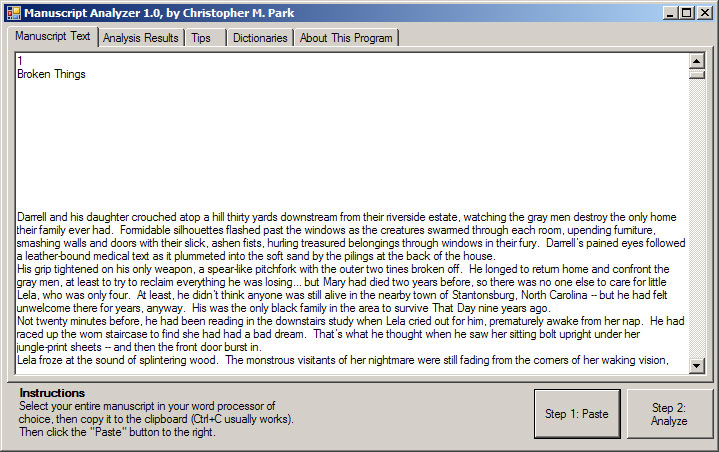
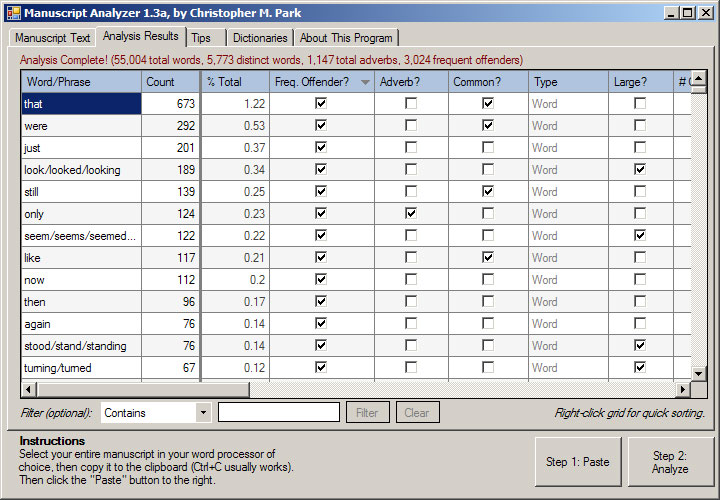
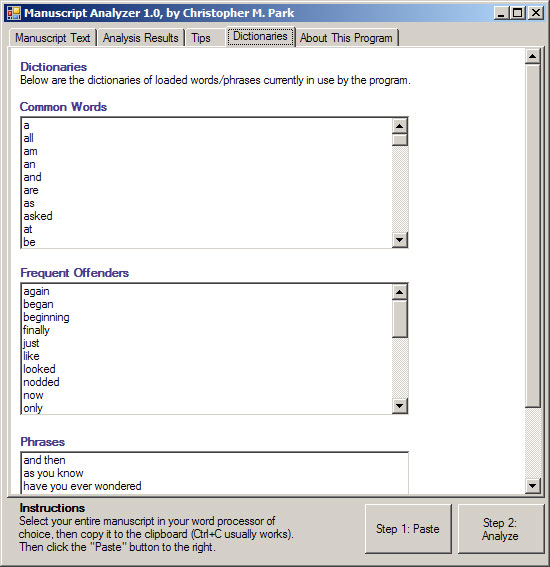
Manuscript Analyzer 1.3
A new version of Manuscript Analyzer is now available for download. This new version adds the following features:
- The dictionaries of Frequent Offenders and Phrases have been updated. Due to the self-updating nature of the dictionaries, a new release of the software was not actually required for this feature, but it bears mentioning.
- All dictionaries now support grouping of "like words" into single entries. For instance, "look/looked/looking" are all now shown as a single entry, rather than three separate entries. This gives a much more accurate view of the frequency with which frequent offenders are used.
- A filter feature has been added. This allows you to quickly filter out any entries that don't meet criteria of your choosing. At present, you can require that words contain/start with/end with a set of characters, or you can insist that a word or phrase "Equals" a specific value (for example, bring back only the word "and," without including other results like "andy," which the "Contains" filter would include).
I've recently added some screen shots to my tools page. You can also see them here:

UPDATE: 1.3a is now the current version online, as that fixes a minor issue with sorting that was introduced in 1.3.
- The dictionaries of Frequent Offenders and Phrases have been updated. Due to the self-updating nature of the dictionaries, a new release of the software was not actually required for this feature, but it bears mentioning.
- All dictionaries now support grouping of "like words" into single entries. For instance, "look/looked/looking" are all now shown as a single entry, rather than three separate entries. This gives a much more accurate view of the frequency with which frequent offenders are used.
- A filter feature has been added. This allows you to quickly filter out any entries that don't meet criteria of your choosing. At present, you can require that words contain/start with/end with a set of characters, or you can insist that a word or phrase "Equals" a specific value (for example, bring back only the word "and," without including other results like "andy," which the "Contains" filter would include).
I've recently added some screen shots to my tools page. You can also see them here:
UPDATE: 1.3a is now the current version online, as that fixes a minor issue with sorting that was introduced in 1.3.
Monday, January 7, 2008
Forward Motion
So I haven't posted a progress update since December 20th. I haven't actually written anything new since before that time, but as I have mentioned I read Stephen King's On Writing, and am currently still in progress with Chris Roerden's Don't Murder Your Mystery. I'm learning a lot from these two books, and naturally, the tendency is to want to go back and revise yet again with all the various new things that I've learned.
So that's what I did over the holiday break, in those few spare moments -- I worked over my first chapter again, and also worked on a couple of specific spots that came later on in. Tonight I realized what was happening, however, and decided to put those revisions on hold. If I keep revising as much as I have been so far, I'll never finish my first draft at all. So instead of revising Chapter 2, I jumped ahead to chapters 9 and 10, and revised both of them. This is in preparation for tomorrow, when I'll actually write new scenes for chapter 10 (I always have to do some revision of the preceding scene if there's been a gap of more than a few days in my writing, just so that I get back into the flow/mindset of that last scene I wrote).
In all, through this time I've managed to lose about 200 actual words, and no pages (so no estimated words, either). Still, I'm really pleased with those edits that I have made -- and also that there were so many things that were already "right," or at least close to it, that I didn't have to change.
The stats as of today:
-47,250 estimated words.
-55,302 actual words.
-Nine and a portion fully-revised-and-expanded chapters (155 pages total).
-189 pages in all.
-Song(s) listened to while writing: Meet the Robinsons soundtrack
Andrew Olmsted
Perhaps you have seen this blog post (or the many blog/news stories that surround it) already. If not, I suggest it as a good, significant -- if heavy -- read. One blogging soldier thought to write a post that should be posted by a friend in the event of his death. A few days ago, he died.
Friday, January 4, 2008
Holiday Roundup
I've been quiet lately, thanks to the holidays and then my return to work a couple of days ago. So this post is going to be a bit of catch-up for a lot of the things I've wanted to comment on in the last few weeks.
First off, thanks to a post by literary agent Jonathan Lyons, I read this very interesting piece by Dave Eggers. The part that is particularly interesting is his bit on selling out, which is a longish addendum to his response to the initial email. I've never had much concern over how avant garde anything was, but it was very interesting to read the rant of someone who once did, but no longer cares. I agree with Eggers' conclusion that tracking "sellouts" is just another form of fashion, and that might very well explain why I've never had any interest in it.
I saw an interesting post called Respecting Romance over at the BookEnds Literary Agency. This post was all about why some romance writers are embarrassed by their chosen genre, and why they shouldn't be. I don't read very much romance, and I definitely don't write it, but it recalled to mind the stigma that surrounds sci-fi and fantasy. I think most genres have some sort of stigma, actually, but here again -- it's all fashion. Write because you want to, and because your topic interests you. "Great art" can be formed in any genre -- any medium at all, in fact, as many artists have demonstrated.
Next I want to point out a post called Critters Vs. Betas (and the Dreaded Spouse Question) over at Dwight's Writing Manifesto -- and not just because he mentions me in the post. I recently posted some of my thinking on the topic, but Dwight has a new way of looking at it that I hadn't quite thought of before.
Literary agent Kristen Nelson recently made a post about the new Top Dealmaker feature at Publisher's Marketplace. I thought it was really useful information, and quite insightful (she usually is). It's good to have an agent's take on this sort of thing.
On an off-topic note, Stephen Parrish recently posted about Dinner For One, "a British one-act play [that] is a New Year's Eve tradition in Germany." Shortly after he mentioned this play (first time I'd ever heard of it), a German friend of my uncle brought it up. Go figure. Interestingly, the Wikipedia entry on the play notes that "although the sketch is most popular in non-English speaking countries, it is typically shown in the original English without dubbing or subtitles. Curiously, the film remains practically unknown to the English speaking world (except for Australia)." How very curious, indeed! Can you imagine a work of yours becoming a yearly tradition in some other country, but being utterly uncared-about in your native land?
I re-watched Terry Gilliam's cult classic Brazil the other day. It's a dystopian movie that made a big impression on me in high school, and which I've since counted as one of my top favorite movies even though I hadn't seen it for over eight years. My wife got it for me on DVD as a Christmas present, which was a really pleasant surprise. I was a little worried it might not seem as good now that I've grown up a lot more, but actually it was better than before. This movie is dense with symbolism, dark humor, and pointed social commentary. If you haven't seen this one, it's definitely worth a look -- the ending is probably my favorite movie ending of all time.
Have you ever heard of the (in)famous lexicographical term Mountweazel? I'm confident you'll find that trivia article both edifying and humorous.
Over the holiday break I read Stephen King's much-touted On Writing, and found it to be quite good. Most of you have probably read it already, but if not, it's definitely worth a read.
Another book that I'm finding even more helpful at present is Chris Roerden's Don't Murder Your Mystery. This is a very nuts-and-bolts book on writing, specifically aimed at Mystery writers. Don't let that fool you -- this gem is extremely applicable to all genres. The author has been a professional editor for over forty years, and she (yes, she's a female "Chris") really knows her stuff. For me, this book came at just the right time. I hope it finds you the same way.
And, I think that was about it!
Thursday, January 3, 2008
Manuscript Analyzer 1.0
Happy New Year, everyone! I had a very restful and recharging holiday season, and I hope you all had the same. To kick off the new year, I've finally gotten around to creating a Tools section on my website. This is a page for various little freeware programs that I create and want to publicly release, which I've been meaning to put up for ages.
As part of this new page, I'm also releasing the very first version of a new tool that I've created for writers . It's called Manuscript Analyzer, and is a pretty unique tool for aiding writers in doing some forms of analysis of their manuscripts. There are a number of programs that let you count the frequency of words in a document, but this takes it a step further and helps you identify junk phrases, "frequent offender" word patterns, and adverbs. It also lets you ignore common words that clutter up the high ranks of other word-counting programs, and allows you to focus on words by size.
Best of all, the dictionaries for all of the above can be extended by users via simple text files. This program auto-updates its dictionaries. As is noted in the "About" tab of the program itself, I'm very interested in ideas for how to extend this program even further. This is actually something that I just started coding this evening (seriously), so I'm sure there is a lot more that could be added. But I think that you'll find what's there to be quite robust and useful as it is.
Saturday, December 29, 2007
An Unusual Litmus Test
Anne Mini has recently been talking about who should and shouldn't be a valued feedback-giver to the aspiring writer (parts I and II). If you haven't read her posts yet, I highly recommend you do so before continuing reading this post of mine. I can wait!
...
Now that you have returned, let me first note I certainly agree that Anne's logic applies to almost every situation. However, most people tend to believe there are exceptions to every rule, and of course they tend to believe they fall into the minority that is the exception. Especially when it comes to issues like this.
Interestingly, I've read several published authors who noted their spouses were their first reader/editor. Stephen King, Orson Scott Card, and Bill Watterson (who wrote/drew the comic strip Calvin and Hobbes, and thus wasn't truly in this industry) all come to mind. I'm sure you could come up with many other examples.
There are two points I'd like to make on this score. First, readers would do well to remember that what a person says when publicly thanking his/her beloved is not necessarily the full truth. Secondly, most of these writers noted looking for general reaction from their spouse, usually on a chapter-by-chapter or realism basis, rather than on a line-by-line basis. But I'm sure it varies. At any rate, aspiring writers would do well to not just blandly take such comments of published writers at face value.
That said, I do believe my wife is an incredibly valuable first reader/editor to me, even on a line-by-line basis (and I believe I have a good litmus test for objectively determining she is -- more on that below). First of all, she has a degree in comparative literature, and is a voracious reader of the same genres I write in -- she's much wider read than me in general, actually. Secondly, she's done enough writing to know what she's doing. She hasn't written as much fiction as I have, but it's not a race.
All of that just gets her into the ball field of being a potential first reader, except for the pesky issue that she's my spouse -- and here's where my litmus test comes in. Ask yourself this: would you or your spouse be offended/upset/surprised/displeased by trading constructive critiques post-coitus? As in, “that wasn’t very good for me?” If you’re uncomfortable answering that to yourself (don’t tell me -- I really don’t want or need to know) then your spouse probably can’t be your editor regardless of his/her other qualifications.
But if you’re so uninhibited around each other that giving direct, un-couched feedback on your most intimate acts is a normal and accepted practice between the two of you (after all, the comments are only designed to help), then you can probably be reasonably certain they aren’t couching things when discussing your novel. Although, even then, be on guard at first -- it’s far too easy for your beloved to want to be supportive at the expense of not being constructively critical at first. Here’s a good law of editing (in the mathematical sense) I’d like to propose: if all your feedback from your first reader is unequivocally positive, it wasn’t helpful. Even if the person loves your book to death, he or she should find about ten thousand things wrong with it, and tell you just why each one is wrong (or say it just doesn’t rub them right if they can’t tell).
So that’s why I think my wife and I are one of the very few exceptions to this particular rule -- yet even then, she is my first reader, but certainly not my last before querying. I think my litmus test holds water, but I’m not aware of many people who seem likely to pass it (of course, it isn’t exactly a topic I ever discuss with anyone), so for most aspiring writers this is probably a moot point in the first place. When in doubt, follow the advice Anne has already laid out in her posts on this subject.
Friday, December 21, 2007
Overusing "That"
Yesterday I saw a very interesting post over at Dwight's Writing Manifesto called Drat That. It's a post about the perils of overusing/misusing the word "that," something I definitely tend to do. Thanks to his handy pointers, I'll definitely be looking out for that in my writing in the future. Thanks, Dwight!
Thursday, December 20, 2007
Prewriting
Tonight I decided that it was once again time to work on some prewriting. I needed to flush out a few more minor points about my major characters, and do a lot more flushing out of my minor characters. This exercise really helped, I think, and should make writing much easier in the future. I actually wrote 2,400 words worth of character bios today -- that would be ten standard pages! It's a shame that doesn't count towards my actual word count, but I have a great feeling that this will help with the fact that I keep getting stuck.
It's not that I haven't had motivation (though I haven't had much time). It's that things just haven't been feeling quite right. Things have seemed harder than they should, than they have in the past, and I haven't been able to shake the feeling that I just am not close enough to my characters. Hence tonight's earlier musings, as well as this character prewriting work. I don't think I'm fully there yet, but I am getting closer to the point at which the full weight of my momentum should hit, and I should be able to blaze through at least another substantial portion of this book.
Also, I did manage to revise my content from last time, and I actually wrote another two pages of new content. It came very easily tonight, after all my prewriting. All right! But that doesn't necessarily mean I have my momentum back. We'll see what the upcoming holidays do to that.
The stats as of today:
-47,250 estimated words.
-55,491 actual words.
-Nine and a portion fully-revised-and-expanded chapters (155 pages total).
-189 pages in all.
-Song(s) listened to while writing: Sick Cycle Carousel and Somebody Else's Song, both by Lifehouse
Thoughts on Writing
[The following is an essay that I wrote tonight for myself, in response to the things I am currently thinking about as I try to jump-start my writing after a relatively bad year productivity-wise. These thoughts are a bit unordered as times, as I'm working through a number of craft issues in my head at present, but I thought that they might be of outside interest.]
One of the critical things about writing well is to do the unexpected. This means if the next scene seems obvious, or little more than a bridge to the scene after that, you probably shouldn’t be writing the scene in question. This means that your characters have to be unique, and have enough interesting attributes to keep the reader following them. In my case, this also means there has to be enough to keep the reader sympathetic to the main character(s). If there isn’t something admirable or unique about the character, they just seem like another everyman, or a prop in a play.
One key aspect of this is that the character must be strong enough to make his or her own decisions, despite where you (the author) think the story is going. This might mean that some smaller scenes won’t work or can’t play, or even that some whole scenes might have to go -- a romantic scene with Ender would have been disastrous, and would have completely killed parts of his character.
This means that certain conversations, which the author might wish to have proceed in a certain fashion in order to disseminate information in the most efficient manner, will instead go in an entirely other direction. This is how depth and complexity is created. I have a tendency to feel frustrated or flustered in such cases, because I feel like I’m not writing tightly enough in terms of plot -- but in reality, not every scene is going to advance the plot by light years. The best books have plot and character development interwoven in every scene, but in many cases the plot development is so slow as to be almost unnoticeable. The novel is book-length because the main plot is doled out in little bits, after all.
One big issue with my own writing is that scenes which are just filler, or scenes in which the protagonist is passive, tend to crop up too much in early drafts. Identifying those sooner than later and killing them is a good idea. I’ve gotten a lot better about the filler issue, but the passivity issue is a big problem. After all, I tend to model the characters after myself, and my general strategy in life is to accumulate knowledge/power until I have an assured positioning for victory, and then to strike the finishing blow all at once. This strategy is actually very effective in practice, but it doesn’t exactly make for the most riveting writing, as the build-up period is comparatively dull.
This means I will always be slightly out of my element when writing, if I want to remain interesting to my readers. I will always have to use the strategy of taking smaller actions early and often, still with an eye to that big finish, but without the painful comfort of doing little in the meantime. This is something that I’ve been forcing myself to do with my last two works, but it still isn’t something that is entirely comfortable to me.
Interestingly, my older works were often much less cautious, but also much less practiced. I’ve changed since then. I’ve learned patience and caution, at times at a rather steep price to myself. What I have to learn is that these virtues are not necessarily virtuous when it comes to the body of my writing itself -- but they are certainly helpful in weathering the creation process itself.
Tuesday, December 18, 2007
Black Hole Blasts Neighboring Galaxy
Jet From Supermassive Black Hole Seen Blasting Neighboring Galaxy is an interesting article from the Washington Post. Apparently, astronomers have found a black hole that is sending a gigantic stream of deadly radiation into a neighboring galaxy -- good for birthing stars, but quite bad for any life that might have been in the path of that radiation.
Yet another thing for people to fear: intergalactic radiation that suddenly wipes out Earth's atmosphere and magnetic field. Apparently the researchers that saw this think that the same thing could actually happen to the Milky Way in about a billion years, when it starts merging with the Andromeda galaxy. Well, look on the bright side: maybe our sun will have imploded by then, anyway.
I have to say, this sort of thing really strikes me as interesting partial-premises for sci-fi novels. I know that a lot of the far-future dying-sun stories have already been done, but I still hunger to someday do something of the sort. There are just too many interesting ideas to write them all!
Friday, December 14, 2007
I Am Legend
My wife and I went to see I Am Legend tonight, and we both thought it was really great. It was a little bit less faithful to the book than I was expecting (the ending is completely changed), but that was probably necessary for modern moviegoer tastes. I was a bit surprised by some of the negative reviews that this movie garnered, which claimed everything from a lack of suspense, to wooden acting by Will Smith, to inept storytelling, to"too little gore."
Well. I think that "too little gore" is easily answered: it's just not that kind of movie. And frankly, I think the opposite advice can be given to most modern horrors, so it's obvious that I'm just not on the same wavelength with those reviewers. We'll chalk that up to taste.
Secondly, my wife and I both felt the movie was immensely suspenseful. The key word here is suspense -- this was more in the tradition of M. Night Shyamalan or Alfred Hitchcock (both of whose work I love), rather than George Romero. To note: I did enjoy the original Night of the Living Dead and Dawn of the Dead, but I was less than thrilled with Day of the Dead, and haven't wanted to see any of the more recent entries or remakes from that line. I also enjoyed 28 Days Later, though I felt it was overly bloody, and I quite enjoy Stephen King novels (the most obvious comparison being THE STAND, of course, which I believe must have been at least partly inspired by the original novella of I AM LEGEND -- King has noted that he is a fan of Richard Matheson).
So, given all of that, I must say that I thought that this was one of the most suspenseful movies I've seen in recent years. The use of silence, and of light and darkness, was masterful. The CG creatures weren't quite what I expected, but they didn't seem out of place at all to me. The largely solo acting by Smith was his best work, in my opinion -- he displays a fairly wide emotional range here, and does so subtly and convincingly. Those who complained of "wooden" acting, especially referring to the scene in which he recites from the movie Shrek, are simply missing the point. This is a moderately subtle movie that trusts the viewer to catch the emotional cues without the aid of music or extended dialogue. It's all about Smith's expressions, body language, tone -- and that's why I feel like it's his best work.
As for inept storytelling... there are flashbacks, as there are in the novel, and I think that was the main complaint. I thought those were well done, and provided some interesting contrast to the "present" events of the story. I suppose this is a matter of taste once again. Don't get the wrong impression, by the way. It isn't that the movie has done particularly bad with the critics -- it's middling on rotten tomatoes. I just felt that it should have done much better than middling.
The chief complaint that I could lodge against this movie is that it will probably make diehard fans of the book unhappy. The core twist is changed -- and thus the very meaning of the title is altered rather dramatically, actually -- and this will upset those who simply wanted to see the big-screen version of the Matheson novella. However, for those fans who understand what this movie is -- both a modernization and a retelling of the classic tale, with a weaker ending but a much more likable protagonist -- there's a lot to love here.
Changing The Spacing Of Your Manuscript
Anne Mini recently did a great post on why it's a good idea to have two spaces after each period. This was actually not a habit I ever picked up, as I don't believe my typing teachers ever advocated this (my wife learned this in her schools, but I didn't -- maybe I just missed the boat). At any rate, when I heard of this preference a few months ago, I decided to make the shift to using the two spaces, and in order to do that I had to reformat my entire WIP manuscript.
Hours of tedious work? Not hardly! Using nothing more sophisticated than the "Find and Replace" function in MS Word, here's how to reformat your manuscript to add two spaces instead of one. Just follow these steps in order, and you should be good to go. It also works on manuscripts that are half and half -- part of it formatted with the correct two spaces, part of it formatted with only one.
Of course, as with any large-scale change you make to your manuscript, make sure and save a copy first! If something should go awry for whatever reason, you don't want it to happen to your only recent copy.
Now, on to the steps:
1.) Open "Find and Replace" in MS Word by hitting Ctrl+H in windows, or by looking under the Edit menu and choosing "Replace" (the menu location may vary slightly by Office version, especially in the 2007 edition, which moved the location of a lot of things -- I'm using Office 2003).
1.a.) Step two and below will use the character "_" to represent a literal space (since you otherwise couldn't see it), and square brackets [] to indicate the boundaries of the text you should be finding and replacing. When entering these values into your textboxes, omit the square brackets, and use a literal space where I show the underscore.
2.) Search for [._] and replace it with the value [.__]
3.) Search for [."_] and replace it with the value [."__]
4.) Search for [?_] and replace it with the value [?__]
5.) Search for [?"_] and replace it with the value [?"__]
6.) Search for [!_] and replace it with the value [!__]
7.) Search for [!"_] and replace it with the value [!"__]
8.) Search for [:_] and replace it with the value [:__]
9.) Search for [._._.] and replace it with the value [...]
10.) Search for [...__] and replace it with the value [..._]
11.) Search for [___] (three spaces) and replace it with the value [__] (two spaces)
Unless you have strange formatting or other interesting punctuation, that's it! And I'm sure that you can see how you can apply these general principles to other types of punctuation, or strange types of speech-delineation, like the carrots (<>) that are used to identify thought-speech in Orson Scott Card's SPEAKER FOR THE DEAD.
The key is to run all your replaces that are like 2-8 first, so that you have at least the correct number of spaces after each sentence; then run numbers 9-11 to collapse any inappropriate extra spaces back down. If you're worried that things have gotten very out of whack, you can even run numbers 10 and 11 repeatedly, until they find nothing more to replace (that's actually not a bad idea to do, anyway, just to be sure).
I used this logic to successfully reformat my own manuscript several months ago, and I haven't found any problems with it in the interim. But I'm not the biggest expert on the rules of two spaces versus one, so if you see a hole in my logic, or if there's something I'm omitting, please let me know and I'll update the post. Happy formatting!
UPDATE 1: Someone pointed out on Anne's blog that this sort of logic incorrectly adds too many spaces after abbreviations. Since I didn't use any of those in my WIP, I didn't have that problem. But adding lines to search and replace things like [Mr.__] with [Mr._] would work, presuming you know, or can at least guess, all the abbreviations you used.
UPDATE 2: The list has been simplified a bit regarding quotes, thanks to a comment to this post.
UPDATE 3: Actually, that simplification was invalid, as another comment pointed out. In order to avoid adding extra spaces in cases like [what I think,"_said Tom.], the full steps above are necessary.
Wednesday, December 12, 2007
A winner is me!
Four pages today! And I started out with a really busy day at work, a lot of stress that resulted in a really bad headache, and other woes... but I wrote anyway. I was really only planning on making some notes and such, doing a little revising -- that sort of thing. But that turned into writing a page, which turned into two, which quickly turned into four at the last minute. Progress feels good, especially since it is so sparse during this time of year.
The stats as of today:
-46,750 estimated words.
-54,902 actual words.
-Nine and a portion fully-revised-and-expanded chapters (153 pages total).
-187 pages in all.
The stats as of today:
-46,750 estimated words.
-54,902 actual words.
-Nine and a portion fully-revised-and-expanded chapters (153 pages total).
-187 pages in all.
Thursday, December 6, 2007
Another Scene Down
Only a page and a half today, but that was a complete (brief!) scene. I also revised my content from last session. My day job bled into the night the last couple of days, which cut into my writing time in a major way, aside from sapping all my energy. Nothing bad, just lots of end-of-year stuff. Hopefully now I'm fairly caught up, though, and won't have to do that again in the coming weeks.
Today's scene was very brief, but I think that's a nice counterpoint to the longer ones I usually write. I also think it was a fitting length for this particular scene, which ends suddenly and surprisingly. I had been a little unsure how to write this one, but it turns out that I was thinking I was going to write it from one perspective, but really needed to write it from another character's pov. What would have been expected and relatively uninteresting the first way became something surprising and unexpected this way. And brief! Let's me move on to the next scene, which is more important anyway, which is good.
Now I just need to figure out exactly how I want to write that one. Sometimes having the right plan is well over half the battle. I don't expect to get much done on that tomorrow, though, since that's my birthday and I'll likely be otherwise occupied. The big twenty-five! I'm not sure if it seems stranger that I've lived a quarter of a century, or that I've only lived a quarter of a century.
The stats as of today:
-45,500 estimated words.
-53,639 actual words.
-Nine and a portion fully-revised-and-expanded chapters (149 pages total).
-182 pages in all.
Monday, December 3, 2007
More on Chapter Ten
Two and a half new pages today, and I revised all my content from Saturday. I managed to efficiently finish off a scene that I was worried would drag out, so that was a pleasure. Next writing session, I need to write one more scene, and then I'm up to replacing some preexisting content. I suppose I'll need to heavily-rewrite/replace about a chapter's worth of material that just doesn't fit anymore (and which was boring and fragmented to begin with, so needed a heavy rewrite regardless), and then I should have a couple of chapters of smooth sailing where my rewriting is fairly minimal. And then I'll finally be done with my rewriting/expanding efforts, and will be able to move on with the rest of the book. I'm hoping to hit that point by the end of December, if not sooner. I suppose we'll see if I hit that goal this time...
The stats as of today:
-45,250 estimated words.
-53,263 actual words.
-Nine and a portion fully-revised-and-expanded chapters (147.5 pages total).
-181 pages in all.
The stats as of today:
-45,250 estimated words.
-53,263 actual words.
-Nine and a portion fully-revised-and-expanded chapters (147.5 pages total).
-181 pages in all.
Attributes That Identify Your Writing
Nathan Bransford had an interesting post about cross-genre writing today. Essentially, he advocated that writers stick to one genre, in order to build their skills and their brand, until they are so famous that it no longer matters (think John Grisham). In response to questions in his comments, he further revealed that he felt that certain complementary genres, such as sci-fi and fantasy, or the various sub-genres of children's literature, were less of a problem. But in the case of the sci-fi / fantasy question, which was particularly relevant to me, he did mention that you still have to have some aspects to your writing that makes the stories obviously "you," and thus something that will have less risk of fragmenting your readership.
So that got me thinking: what aspects of my writing are distinctly "me," and present in all of my works? To date, I've written two Science-Fantasies (that's a real book category, not something I made up), and I'm working on one Dark Fantasy that's set in the future of our modern world, so in some senses is a bit like science fiction (just with magic). So here's what I came up with:
1. All my works have both magic and technology in them, to some greater or lesser degree.
2. All my works have characters with modern outlooks. Either my story is set in modern times, in the future, or in an alternate universe.
3. All of my books have a dark streak to them. Main characters are not safe from death, though I'm not cavalier about that.
4. Multiple cultures are always present in my works, and often multiple languages are present, as well.
5. I usually make use of some non-European mythology or folklore as the underpinnings of parts of my story or world.
6. There is usually a blend of locales in my stories that includes industrial/commercial locations as well as deep wilderness locations.
7. There is almost always some sort of Eastern influence in my works, usually Japanese, Korean, or Chinese (or all three).
8. Entropy is a theme (or at least a strong element) in every last work I write.
There are probably other things, too, but that's what I could come up with off the top of my head. In my biased, non-expert opinion, I think that this is enough to tie together a readership and build a fan base that can enjoy all my works. I don't plan to write any thrillers or horror or romance, though those elements may creep into my various works to greater or lesser degrees. But the core sci-fi / fantasy mix, and other elements that I mention above, are always part of my works, and should make a story recognizably mine once people have read a couple of my pieces. The main question is the ratio of sci-fi to fantasy, and that's something that varies work-to-work for me.
What about you? What attributes permeate every work that you write? Everyone has something, even if it's only one or two things. For instance, Orson Scott Card, who writes in something like four genres, is well known for always including interesting ethical dilemmas in every one of his works. Even if it's something as broad as that, or the fact that you always have strong female leads, or always write in a certain notable voice, you probably have something consistent in each of your works. So what is it?
Subscribe to:
Posts (Atom)