Just a brief note tonight. I've had several breakthroughs in my plotting, and finally have the next five or so chapters planned out to my satisfaction, which is a major relief. I haven't done much actual writing, but I've been going back through my existing content and have been making minor tweaks. I should be back on track with the actual writing soon, which will be something of a relief.
One thing I've been thinking about recently, however, is passivity. It's something endemic to much of my speech, unfortunately, so it's been a struggle to weed it out of my writing. I'm getting much better at that, and my most recent work is almost all active, both in a grammatical sense and a thematic sense. But going through even my earlier drafts of ALDEN RIDGE, it amazes me how much grammatical passivity was there.
One of the biggest ways in which I enact grammatical passivity is the phrase "there was" (or "there were" for plural). There was nothing there. There were only two cows within sight. There was only the sound of the crows in the trees. Searching for these little red flags has been a big help in weeding out grammatical passivity (though certainly many other forms were present as well). Many of those sentences can just be replaced one-to-one with more active forms, but some of them are also just too passive thematically as well, and so require a larger revision of the paragraph(s) surrounding the sentence at fault.
At any rate, it very much looks like I'm not going to be hitting even my revised goal of 140 revised pages by the end of October. Right now I'm hovering around 114, and I doubt I'll be writing 26 pages in the next six days. Hopefully I'll be able to hit 16 or 20, though, and I'll be pretty pleased with that.
Thursday, October 25, 2007

Thursday, October 18, 2007
Sunset Cove
I've been learning to use Carrara better, so here's a new image and an improved version of one of my older images. As I learn more about advanced shaders, I imagine I'll be revisiting Nightmare Wave, as well, to make the water in that one a lot more realistic.
My first sunset in Carrara. I wanted to do something with more dramatic lighting, and richer color than my last few Carrara images have had.
I rendered a new version of this image, now that I've learned a few new techniques. Radial waves have been added in the water, and the spray has become a lot more realistic. In all, it's a lot more apparent what sorts of force the tornado is exerting on the scene now, I think.
Sunset Cove
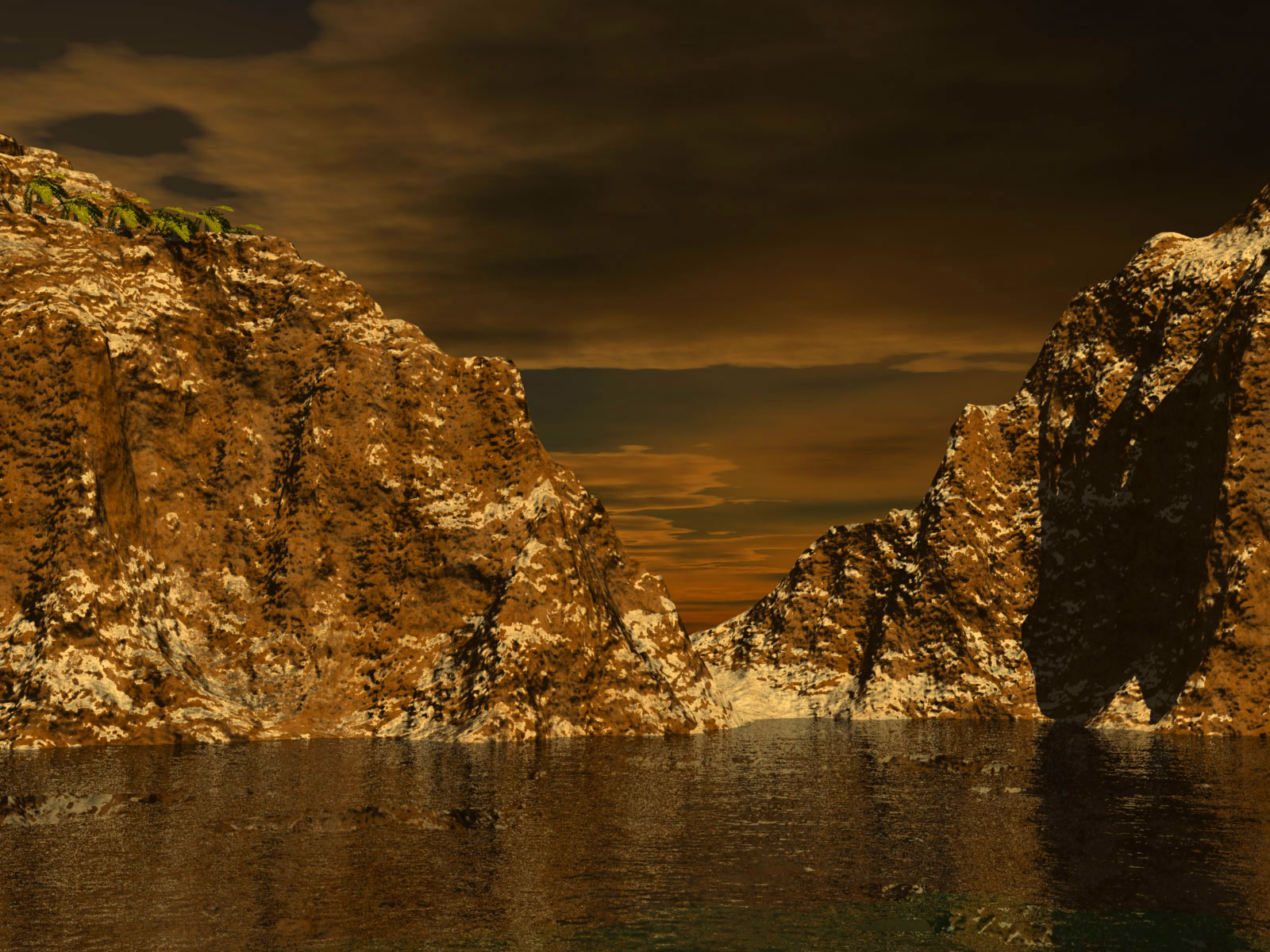

My first sunset in Carrara. I wanted to do something with more dramatic lighting, and richer color than my last few Carrara images have had.
Water Tornado
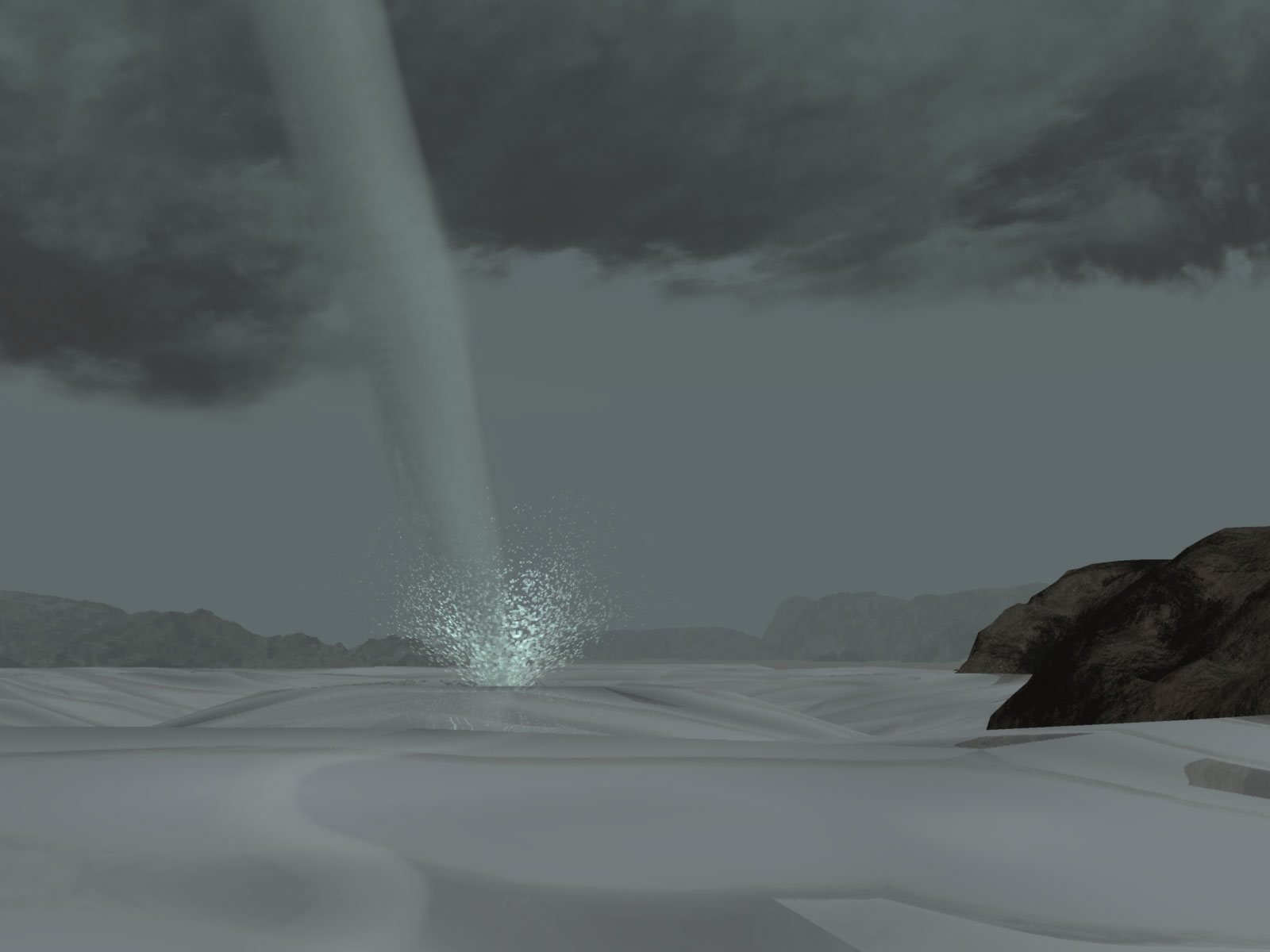

I rendered a new version of this image, now that I've learned a few new techniques. Radial waves have been added in the water, and the spray has become a lot more realistic. In all, it's a lot more apparent what sorts of force the tornado is exerting on the scene now, I think.
Wednesday, October 17, 2007
Carrara, and Four New Art Pieces
I've had my eye on Carrara for some time now, but never had any incentive to move away from Bryce, a lower-end product that is currently made by the same company. Bryce may be lower-end, but it has landscape-creation tools that are simply unrivaled. Since that's always been my primary focus with my 3D art, it was the natural choice.
However, in the most recent version of Carrara, they've added a lot of features that let artists do some spectacular effects that simply aren't possible in Bryce, or else are very, very, hard. If you want to know what I mean, see below. Not a single one of these images could have been rendered easily in Bryce.
That said, I'll still be using Bryce for years to come, I'm sure. Certain effects, particularly the ones that are more surreal, just can't be duplicated in Carrara. But when I need advanced effects or ultra-realism or fine control, Carrara is definitely going to be my tool of choice from now on.
If you're interested in checking out Carrara for yourself, there's a 30-day trial of the old version 5 here, and they're running a special on the express version of the new version 6 here. If you join DAZ's platinum club, you can get Carrara Express for only $20 through the end of October.
This was my second rendering in Carrara. There were a number of advanced effects in this program that I knew I just had to put to use, and a tornado seemed like the perfect outlet (I'm absolutely fascinated by tornadoes -- they've featured in my nightmares since I was a kid, and those were always some of my favorite dreams, though they are quite intense).
Of particular note is (obviously) the tornado itself, the dust around its base, the thickets of trees on the left and right of the screen, and the field of grass. None of those were effects that I've ever been able to accomplish with Bryce. It was this sort of thing, more than anything else, that led me to purchase Carrara.
This scene took me an unusually long amount of time to put together, because of all the complex elements, but I'm particularly pleased wit it. Seeing the tornado like that gives me chills, so I know I did it right.
This rendering is another product of my nightmares (which, as I noted before, are intense, but in some ways enjoyable). Tornadoes are the biggest star in my nightmares, but tidal waves are definitely number two. In my dreams, the waves are often as massive as this -- not sure if that's realistic for most tsunamis, but I don't care. Often I'm on a pier or bridge like this when they hit, and I'm left scrambling up steep banks or buildings or something as the wave destroys everything below. There are usually loads of people around right before the wave comes, but as soon as the tide sucks out (as happens before a wave hits, I'm told) I find myself completely alone. Somehow, it seems more intimidating that way. This scene would be my perspective in one of the dreams in which I don't make it away in time, and am sucked out to sea. Usually I make it away, though.
Once I did my first tornado in Carrara, I knew I had to try for another kind of tornado. In some ways, this tornado was much harder to design than the first, but I think it came out pretty well. I also did a lot of experimenting with water in this image. The spray effect around the tornado's base isn't as realistic as I would like, but it was my first try with particle effects like that. Again, something that is well beyond the reach of Bryce.
This was my first image in Carrara. I was mostly just playing around with the atmosphere, the water, the fog, the terrain shading, and the surface replicator tool (used for the forest). However, the end effect was pretty decent, so I decided to save it.
However, in the most recent version of Carrara, they've added a lot of features that let artists do some spectacular effects that simply aren't possible in Bryce, or else are very, very, hard. If you want to know what I mean, see below. Not a single one of these images could have been rendered easily in Bryce.
That said, I'll still be using Bryce for years to come, I'm sure. Certain effects, particularly the ones that are more surreal, just can't be duplicated in Carrara. But when I need advanced effects or ultra-realism or fine control, Carrara is definitely going to be my tool of choice from now on.
If you're interested in checking out Carrara for yourself, there's a 30-day trial of the old version 5 here, and they're running a special on the express version of the new version 6 here. If you join DAZ's platinum club, you can get Carrara Express for only $20 through the end of October.
Countryside Tornado
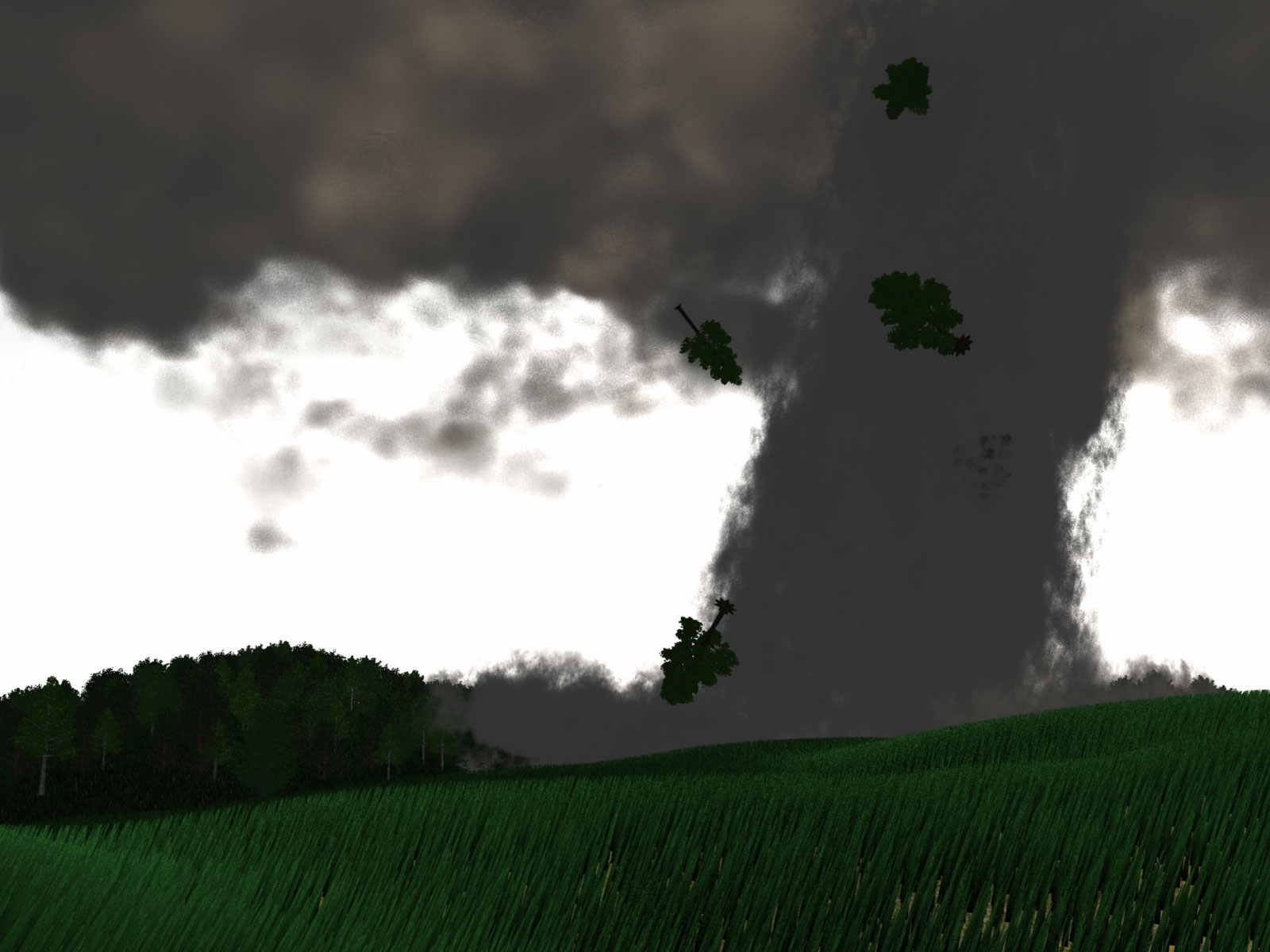

This was my second rendering in Carrara. There were a number of advanced effects in this program that I knew I just had to put to use, and a tornado seemed like the perfect outlet (I'm absolutely fascinated by tornadoes -- they've featured in my nightmares since I was a kid, and those were always some of my favorite dreams, though they are quite intense).
Of particular note is (obviously) the tornado itself, the dust around its base, the thickets of trees on the left and right of the screen, and the field of grass. None of those were effects that I've ever been able to accomplish with Bryce. It was this sort of thing, more than anything else, that led me to purchase Carrara.
This scene took me an unusually long amount of time to put together, because of all the complex elements, but I'm particularly pleased wit it. Seeing the tornado like that gives me chills, so I know I did it right.
Nightmare Wave
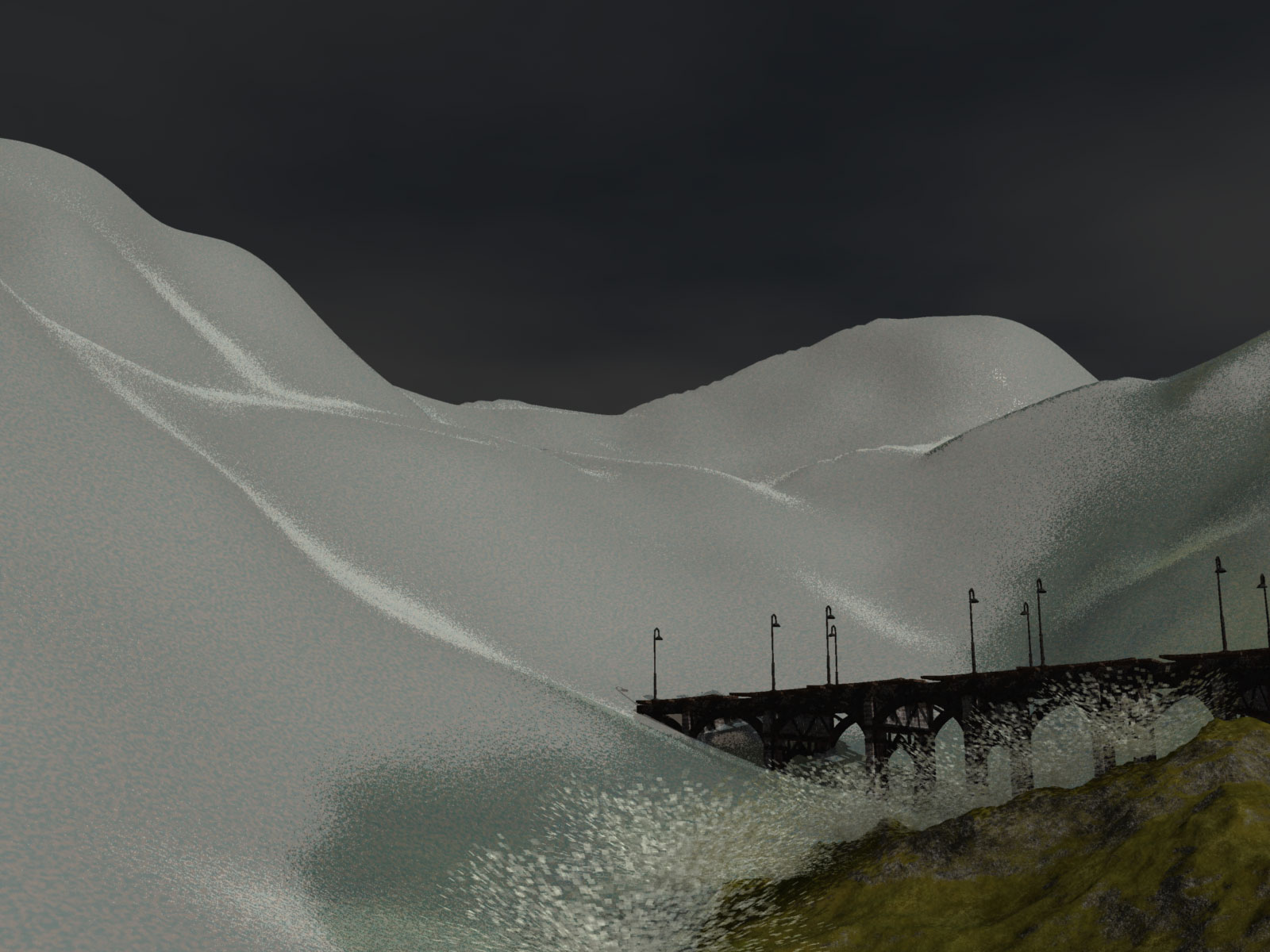

This rendering is another product of my nightmares (which, as I noted before, are intense, but in some ways enjoyable). Tornadoes are the biggest star in my nightmares, but tidal waves are definitely number two. In my dreams, the waves are often as massive as this -- not sure if that's realistic for most tsunamis, but I don't care. Often I'm on a pier or bridge like this when they hit, and I'm left scrambling up steep banks or buildings or something as the wave destroys everything below. There are usually loads of people around right before the wave comes, but as soon as the tide sucks out (as happens before a wave hits, I'm told) I find myself completely alone. Somehow, it seems more intimidating that way. This scene would be my perspective in one of the dreams in which I don't make it away in time, and am sucked out to sea. Usually I make it away, though.
Water Tornado
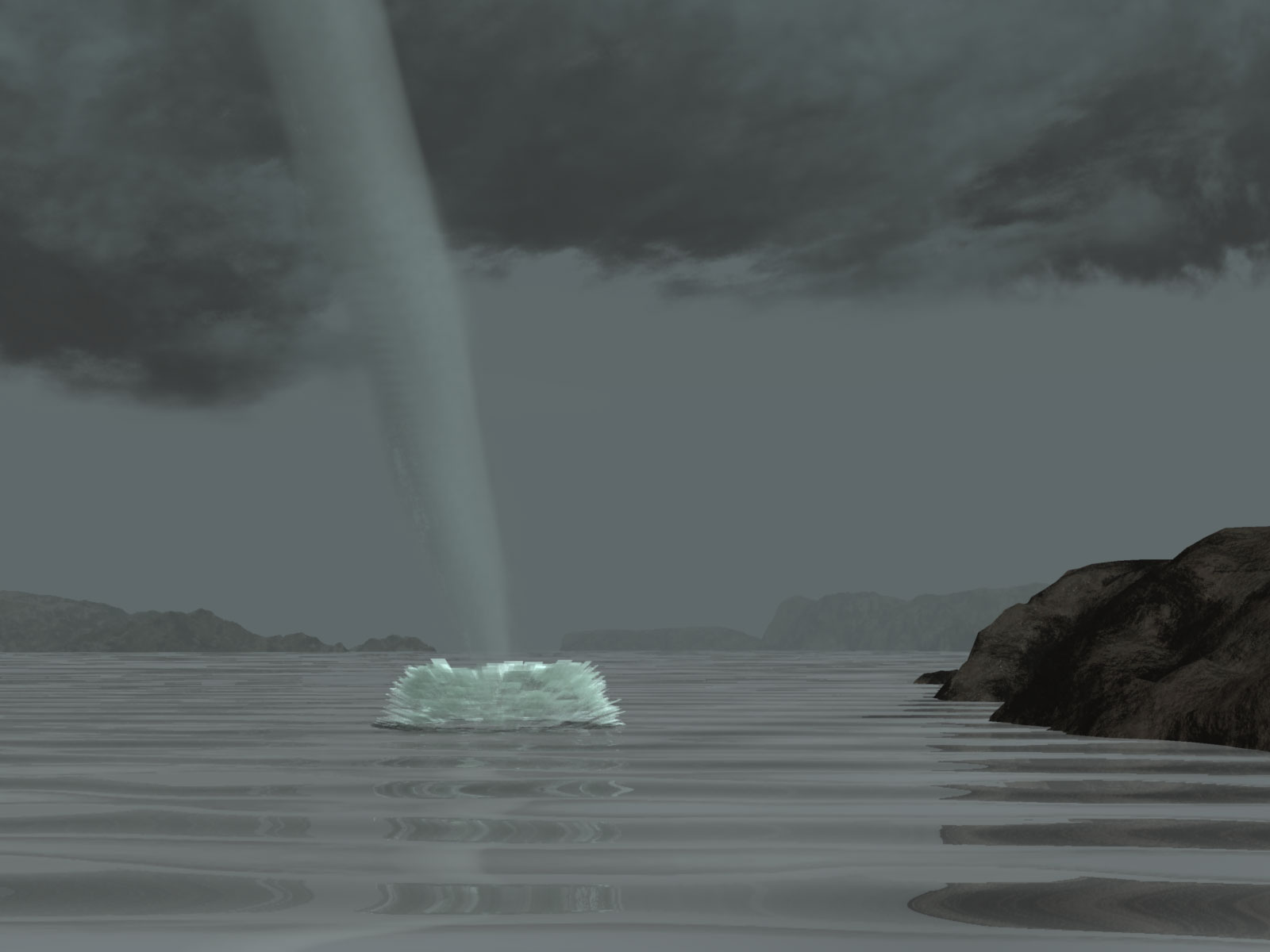

Once I did my first tornado in Carrara, I knew I had to try for another kind of tornado. In some ways, this tornado was much harder to design than the first, but I think it came out pretty well. I also did a lot of experimenting with water in this image. The spray effect around the tornado's base isn't as realistic as I would like, but it was my first try with particle effects like that. Again, something that is well beyond the reach of Bryce.
Foggy Cove


This was my first image in Carrara. I was mostly just playing around with the atmosphere, the water, the fog, the terrain shading, and the surface replicator tool (used for the forest). However, the end effect was pretty decent, so I decided to save it.
Revised Writing Goal
For the last month or so, my writing goal has been to complete 80 standard pages per month (20,000 words per month) at a rate not less than 4 pages per night on 20 nights out of the month. This rate served me well when I was doing a lot of revising/expanding, and I knew the scenes and material so well that there were few decision points -- every night, I could just sit down and write, and that would be it.
But now that I'm into my later chapters, there is more expanding/rewriting than there is revising, and that's really slowing me down. Moreover, it should slow me down. Some things just require a good amount of thought process. So, my new goal is going be to complete only 60 standard pages per month (15,000 words per month), at a rate not less than 4 pages per might on 15 nights out of the month. The rest of that time will be spent plotting, characterizing, mulling, and revising. It will be time well spent.
Also, some of it will be time spent on other things -- like relaxing, the holidays, that sort of thing. My stories are always in the back of my mind, being worked on, but really I can't spend every waking moment actively working on them. Hopefully that just makes me well-rounded, not a "bad" writer. I mean, I love writing, but that's not the only thing in my life. Some aspiring writers seem to have a rather limited way of looking at this particular subject.
I know that Stephen King reputedly used to write 3,000 words per day, and while I respect that he can do that, I don't think that will ever be my goal for several reasons. First, he's way more verbose than I am -- his books are long and include a lot of background detail that doesn't fit with my own writing style (though I enjoy reading him). Secondly, writing is his only job. Sure, if I someday make it big and can afford to quit my day job, then perhaps I'll write more like 8 pages every day. If my plotting and characterizing and musing can keep up.
If writing were my only job, I don't think it would be a stretch for me to finish two books a year. However, as it stands, my rate is more like a book every nine months (assuming I don't hit any snags). I've been trying to push it to four months, and that's just too aggressive. Since I'm so far in, I think I can still make it in five months total, but I'll just have to see how things go. I'm more concerned with doing things right than I am fast (and, come on, five months is still darn speedy, for most people).
On the plus side, I've been doing a lot of that musing and plotting and characterizing and revising for the past few days, and that's been going really well. I realized that I didn't like how one of my characters (Masa Uraya) was shaping up, so I've re-characterized him. I'm really happy with the result. Very soon, I should be ready to finish off chapter six, and move on with the next chapter. The next chapter is going to be all-new, and I have a feeling it's going to be a slow one because of its subject matter. At any rate, my prior goal served me well for the first part of this book, and my new goal should serve me well for the next leg of it.
But now that I'm into my later chapters, there is more expanding/rewriting than there is revising, and that's really slowing me down. Moreover, it should slow me down. Some things just require a good amount of thought process. So, my new goal is going be to complete only 60 standard pages per month (15,000 words per month), at a rate not less than 4 pages per might on 15 nights out of the month. The rest of that time will be spent plotting, characterizing, mulling, and revising. It will be time well spent.
Also, some of it will be time spent on other things -- like relaxing, the holidays, that sort of thing. My stories are always in the back of my mind, being worked on, but really I can't spend every waking moment actively working on them. Hopefully that just makes me well-rounded, not a "bad" writer. I mean, I love writing, but that's not the only thing in my life. Some aspiring writers seem to have a rather limited way of looking at this particular subject.
I know that Stephen King reputedly used to write 3,000 words per day, and while I respect that he can do that, I don't think that will ever be my goal for several reasons. First, he's way more verbose than I am -- his books are long and include a lot of background detail that doesn't fit with my own writing style (though I enjoy reading him). Secondly, writing is his only job. Sure, if I someday make it big and can afford to quit my day job, then perhaps I'll write more like 8 pages every day. If my plotting and characterizing and musing can keep up.
If writing were my only job, I don't think it would be a stretch for me to finish two books a year. However, as it stands, my rate is more like a book every nine months (assuming I don't hit any snags). I've been trying to push it to four months, and that's just too aggressive. Since I'm so far in, I think I can still make it in five months total, but I'll just have to see how things go. I'm more concerned with doing things right than I am fast (and, come on, five months is still darn speedy, for most people).
On the plus side, I've been doing a lot of that musing and plotting and characterizing and revising for the past few days, and that's been going really well. I realized that I didn't like how one of my characters (Masa Uraya) was shaping up, so I've re-characterized him. I'm really happy with the result. Very soon, I should be ready to finish off chapter six, and move on with the next chapter. The next chapter is going to be all-new, and I have a feeling it's going to be a slow one because of its subject matter. At any rate, my prior goal served me well for the first part of this book, and my new goal should serve me well for the next leg of it.
Saturday, October 13, 2007
More New Art
Two more pieces that I've been working on.
I've always had a fascination with the way that radio towers are placed atop hills and mountains in the Appalachian ranges, and this picture was an attempt to capture that. I think it turned out really well, especially with how the fog obscures the bases of the mountains.
This is a remake of perhaps my most popular image ever, Loss. The original version was done in Bryce 2.0, way back in 1998 when I was first learning how to do renderings. Unfortunately, since I lost the original scene file, I had to recreate this from scratch in order to get a higher-resolution version.
The original tree was pre-fab, which was why it was so low-resolution, but this one I created custom. Just getting the branches to look right took hours, and trying to come up with a comparable sunset in the newer version of Bryce also wasn't easy. In the end, I couldn't get the colors right in Bryce alone, so I had to do a lot of color correction in Photoshop (darkening the tree and its reflection, and increasing the saturation of the oranges and yellows). The effect of luminescence around the branches was also something that I needed Photoshop in order to accomplish.
Even with all this work, though, I'm not certain that I recaptured the feeling of the original. I think the clouds in the background still might not be as vivid, and the colors might not be quite right. But, in all, I think this was a successful revisit -- the water effects are particularly improved.
Mountain Antennae
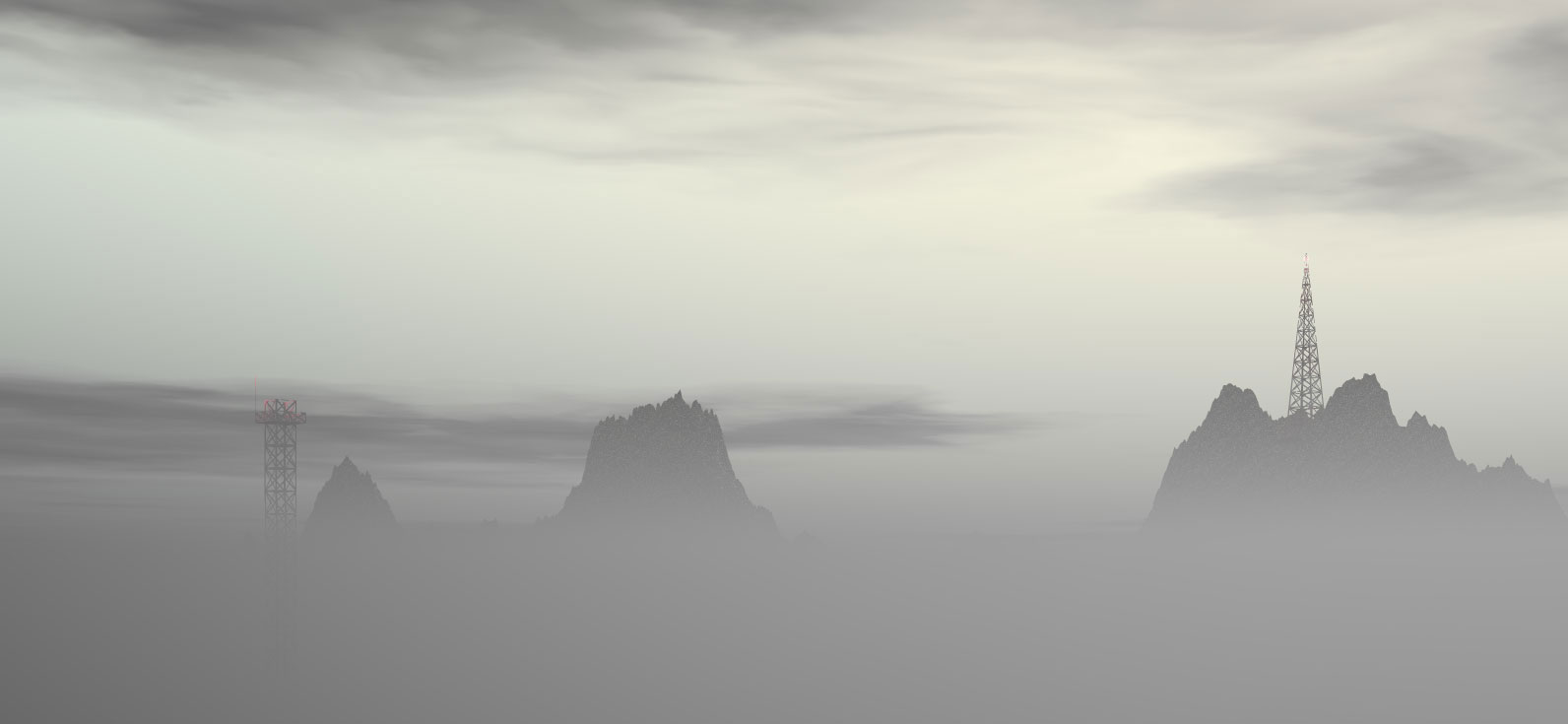

I've always had a fascination with the way that radio towers are placed atop hills and mountains in the Appalachian ranges, and this picture was an attempt to capture that. I think it turned out really well, especially with how the fog obscures the bases of the mountains.
Loss 2


This is a remake of perhaps my most popular image ever, Loss. The original version was done in Bryce 2.0, way back in 1998 when I was first learning how to do renderings. Unfortunately, since I lost the original scene file, I had to recreate this from scratch in order to get a higher-resolution version.

The original tree was pre-fab, which was why it was so low-resolution, but this one I created custom. Just getting the branches to look right took hours, and trying to come up with a comparable sunset in the newer version of Bryce also wasn't easy. In the end, I couldn't get the colors right in Bryce alone, so I had to do a lot of color correction in Photoshop (darkening the tree and its reflection, and increasing the saturation of the oranges and yellows). The effect of luminescence around the branches was also something that I needed Photoshop in order to accomplish.
Even with all this work, though, I'm not certain that I recaptured the feeling of the original. I think the clouds in the background still might not be as vivid, and the colors might not be quite right. But, in all, I think this was a successful revisit -- the water effects are particularly improved.
Friday, October 12, 2007
Steady Progress
Four pages again. I seem to be back in the swing of things, which is nice. I did my writing unusually early in the evening today, too.
The stats as of today:
-38,250 estimated words.
-45,255 actual words.
-Six-and-a-half fully-revised-and-expanded chapters (113.5 pages total).
-Eleven completed chapters in all (153 pages).
The stats as of today:
-38,250 estimated words.
-45,255 actual words.
-Six-and-a-half fully-revised-and-expanded chapters (113.5 pages total).
-Eleven completed chapters in all (153 pages).
Computer Art Methods and Terminology, Demystified
This has been bugging me for a while. Back in June, I made a post about an art piece that was my longest render time ever. I've also mentioned the term "render time" several times since -- but I realized that I never defined this term, and that to people who aren't 3D artists or CAD designers, it's probably pretty unclear. For that matter, probably a lot of the terms I use in conjunction with my art are unclear. So here's a primer:
"Render time" doesn't have anything to do with how long it takes me to create an image. That's not something I really keep track of. Instead, the render time is how long it takes for my computer to generate the final, full-effects "snapshot" of the scene I've created. In other words, while the computer is rendering my image, I'm off doing something else. So a 35 hour render time is 35 straight hours where my computer is unusable, or at least very slow, because it's busy cranking out the pixels. If I had a faster computer, or used multiple computers to do the rendering together, it would take less time.
My part of the work all happens before that, and I work off of smaller, lower-quality preview images and partial-renderings. Essentially, my job is to size, position, and texture the terrains and objects, set up lighting and atmospherics, and position the virtual camera. Once I'm reasonably happy with my results, given the little previews, I set the program to "render to disk," and walk away.
If I'm doing actual object-modeling work, as well, that generally occurs in a program like Sketchup or Hexagon or Poser. When I have my model done, I then import it (in grouped pieces) into Bryce, and I texture it and render it there. Object-modeling work is tedious and not something I'm especially good at, however, so often I just use pre-fab components. Even when I use models that I didn't originally create, however, I put a lot of work into tweaking parts of them, and I usually have to break the model into individual slices that I can separately texture.
"Texturing" refers to applying some sort of material to objects. Basic objects are just rendered as flat gray -- it's the process of texturing that makes things look like sand, water, glass, leaves, snow, weeds, etc. I don't do any of my own texture-creation -- most 3D modelers don't, actually, since that's a completely different skill set (it involves photographing real materials and then carefully cropping them to a repeatable pattern). I use base textures from Bryce, texture sets that I've purchased from third-party texture authors, and textures that are free on the Internet (Mayang's Free Texture Library is a great resource).
But texturing isn't as simple as choosing from a palette and then walking away. Often you need to blend multiple textures together, or resize them for the proper scale/orientation of your model (this is difficult to explain, but it can be tricky), and also certain things like reflectivity, transparency, diffusion, ambiance, etc, need to be adjusted (or changed all together). Plus, the process of just selecting the right textures that will complement each other, and/or blend well is difficult in itself. Scenes that have a lot of organic textures (like landscapes) can take a fair amount of work to make look realistic (or properly surreal, if that's your goal).
You might be surprised by how different the same scene can look with different textures applied -- the same is true when it comes to lighting and atmospherics, actually. The right levels/colors/distributions/positioning of fog, haze, clouds (cumulus and stratus), stars, sun/moon, etc, can make a huge difference. As can such effects like volumetric atmosphere (which simulates particles all throughout the air at the density and reflectivity of my choosing), and a variety of other atmospheric tools.
One more clarification about object-modeling: that doesn't refer to trees or terrains in my case (most of the time). Some of my trees are pre-fab, but most are generated using algorithms built into Bryce. I set a variety of parameters (trunk size/angle/style, branch density/angle, leaf type/texture/color/distribution, etc), and that's that. All of my terrains start out by being generated via fractal algorithms (in either Terragen or Bryce, depending on which I'm using) because fractals are great for realistic terrains. Once I have the general shape of the terrain in place, I use a height-mapping tool to "paint" and thus raise and lower the terrain, add cracks and rivults, that sort of thing. In Bryce, I can also apply terrain-wide effects such as smoothing, erosion, spikes, etc. When I'm done with all that, the terrain is ready to be sized, positioned, and textured.
Hopefully this provides some insight into the process via which I produce most of my art (my abstract works are a completely different process and skill set, mostly just using Photoshop by itself, or in conjunction with programs like Apophysis). Working in a wide array of programs helps keep it interesting, though -- and when I'm a bit stagnant in one program, I can always switch tack and do something completely different in another program.
"Render time" doesn't have anything to do with how long it takes me to create an image. That's not something I really keep track of. Instead, the render time is how long it takes for my computer to generate the final, full-effects "snapshot" of the scene I've created. In other words, while the computer is rendering my image, I'm off doing something else. So a 35 hour render time is 35 straight hours where my computer is unusable, or at least very slow, because it's busy cranking out the pixels. If I had a faster computer, or used multiple computers to do the rendering together, it would take less time.
My part of the work all happens before that, and I work off of smaller, lower-quality preview images and partial-renderings. Essentially, my job is to size, position, and texture the terrains and objects, set up lighting and atmospherics, and position the virtual camera. Once I'm reasonably happy with my results, given the little previews, I set the program to "render to disk," and walk away.
If I'm doing actual object-modeling work, as well, that generally occurs in a program like Sketchup or Hexagon or Poser. When I have my model done, I then import it (in grouped pieces) into Bryce, and I texture it and render it there. Object-modeling work is tedious and not something I'm especially good at, however, so often I just use pre-fab components. Even when I use models that I didn't originally create, however, I put a lot of work into tweaking parts of them, and I usually have to break the model into individual slices that I can separately texture.
"Texturing" refers to applying some sort of material to objects. Basic objects are just rendered as flat gray -- it's the process of texturing that makes things look like sand, water, glass, leaves, snow, weeds, etc. I don't do any of my own texture-creation -- most 3D modelers don't, actually, since that's a completely different skill set (it involves photographing real materials and then carefully cropping them to a repeatable pattern). I use base textures from Bryce, texture sets that I've purchased from third-party texture authors, and textures that are free on the Internet (Mayang's Free Texture Library is a great resource).
But texturing isn't as simple as choosing from a palette and then walking away. Often you need to blend multiple textures together, or resize them for the proper scale/orientation of your model (this is difficult to explain, but it can be tricky), and also certain things like reflectivity, transparency, diffusion, ambiance, etc, need to be adjusted (or changed all together). Plus, the process of just selecting the right textures that will complement each other, and/or blend well is difficult in itself. Scenes that have a lot of organic textures (like landscapes) can take a fair amount of work to make look realistic (or properly surreal, if that's your goal).
You might be surprised by how different the same scene can look with different textures applied -- the same is true when it comes to lighting and atmospherics, actually. The right levels/colors/distributions/positioning of fog, haze, clouds (cumulus and stratus), stars, sun/moon, etc, can make a huge difference. As can such effects like volumetric atmosphere (which simulates particles all throughout the air at the density and reflectivity of my choosing), and a variety of other atmospheric tools.
One more clarification about object-modeling: that doesn't refer to trees or terrains in my case (most of the time). Some of my trees are pre-fab, but most are generated using algorithms built into Bryce. I set a variety of parameters (trunk size/angle/style, branch density/angle, leaf type/texture/color/distribution, etc), and that's that. All of my terrains start out by being generated via fractal algorithms (in either Terragen or Bryce, depending on which I'm using) because fractals are great for realistic terrains. Once I have the general shape of the terrain in place, I use a height-mapping tool to "paint" and thus raise and lower the terrain, add cracks and rivults, that sort of thing. In Bryce, I can also apply terrain-wide effects such as smoothing, erosion, spikes, etc. When I'm done with all that, the terrain is ready to be sized, positioned, and textured.
Hopefully this provides some insight into the process via which I produce most of my art (my abstract works are a completely different process and skill set, mostly just using Photoshop by itself, or in conjunction with programs like Apophysis). Working in a wide array of programs helps keep it interesting, though -- and when I'm a bit stagnant in one program, I can always switch tack and do something completely different in another program.
New Pieces
For the last few days, I've been going through another artistic binge, and these are some of the results. I think I have a few more pieces in me for this round, too, so expect to see those in the coming days or weeks. Just so long as it doesn't interfere with my writing, I'm happy to indulge my artistic impulse when it deigns to come around!
This rendering came about when I realized that I hadn't done a close-up of a building in quite some time. And I don't think I've ever done a rendering from the roof of a building before. I started with these goals in mind, not sure what the rest of the landscape would look like, and then finally decided on desert. This provided an excellent opportunity to employ a volumetric sky, which is particularly vivid. I'm also rather pleased with the contrast between the different levels of sand throughout the background, and the plywood boards scattered throughout the wet sand in the lower left.
This rendering was actually a byproduct of working on my Desert Industry image. I was experimenting around with the top of the building, and wound up with this view of the striking tin knob that features in this image. Right away, I knew I had to make a rendering centered around that feature. This required a completely different sky from the other rendering, however, and I also needed to work in the fog effects (which I think came out particularly well on the lower-left). I also had to add the railing to this side of the building. The net effect is something that is more like a ship at sea than anything else, actually, which I really like.
This is only my third rendering in Apophysis. It's not as vibrant as Flame Belt was, but I think there is some interesting form here. I had to do a LOT of post-processing work in Photoshop to cut out ancillary clutter (and to remove the entire cyan hue, incidentally), but I think the result was quite interesting.
Desert Industry
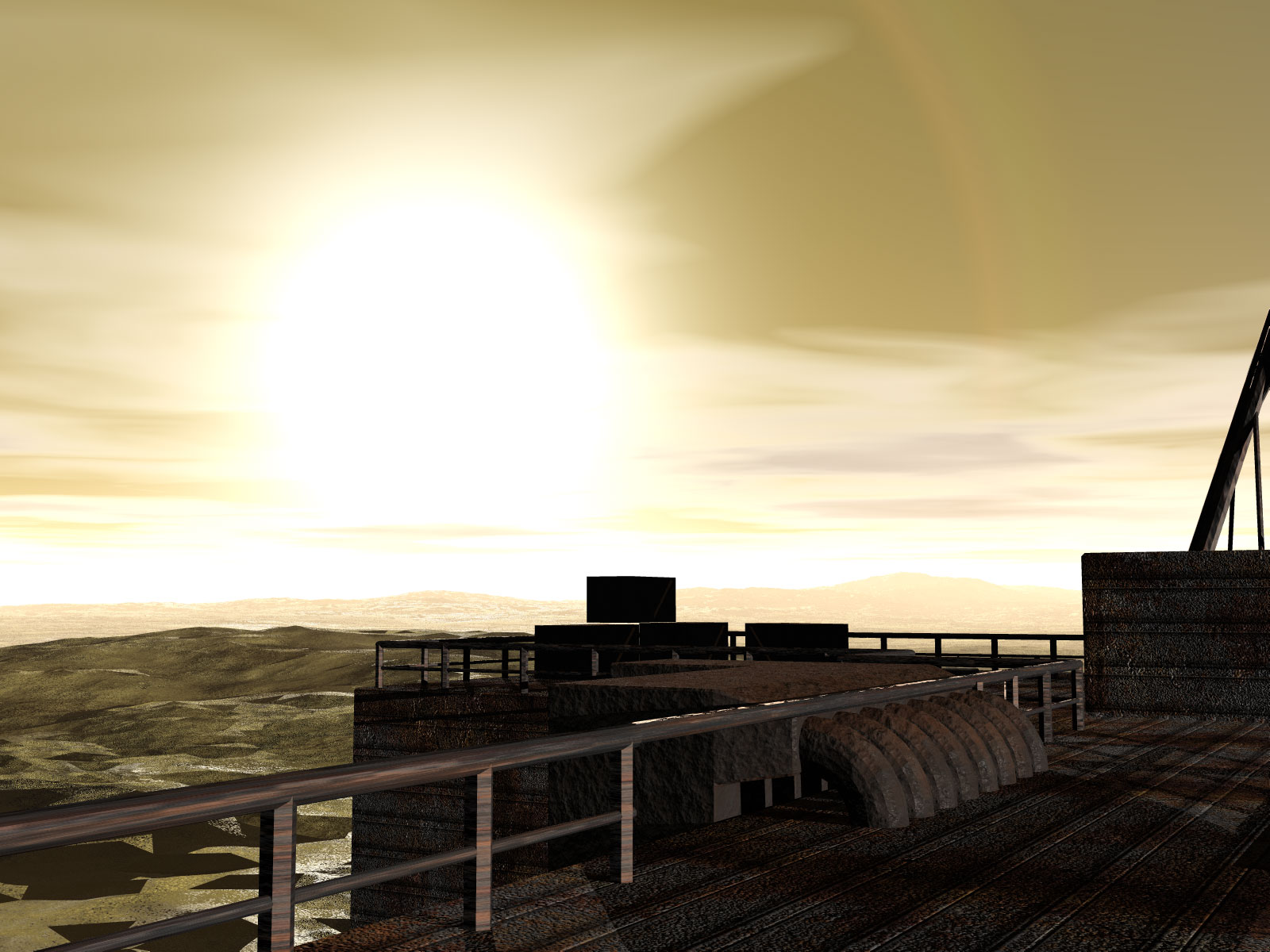

This rendering came about when I realized that I hadn't done a close-up of a building in quite some time. And I don't think I've ever done a rendering from the roof of a building before. I started with these goals in mind, not sure what the rest of the landscape would look like, and then finally decided on desert. This provided an excellent opportunity to employ a volumetric sky, which is particularly vivid. I'm also rather pleased with the contrast between the different levels of sand throughout the background, and the plywood boards scattered throughout the wet sand in the lower left.
Industrial Fog
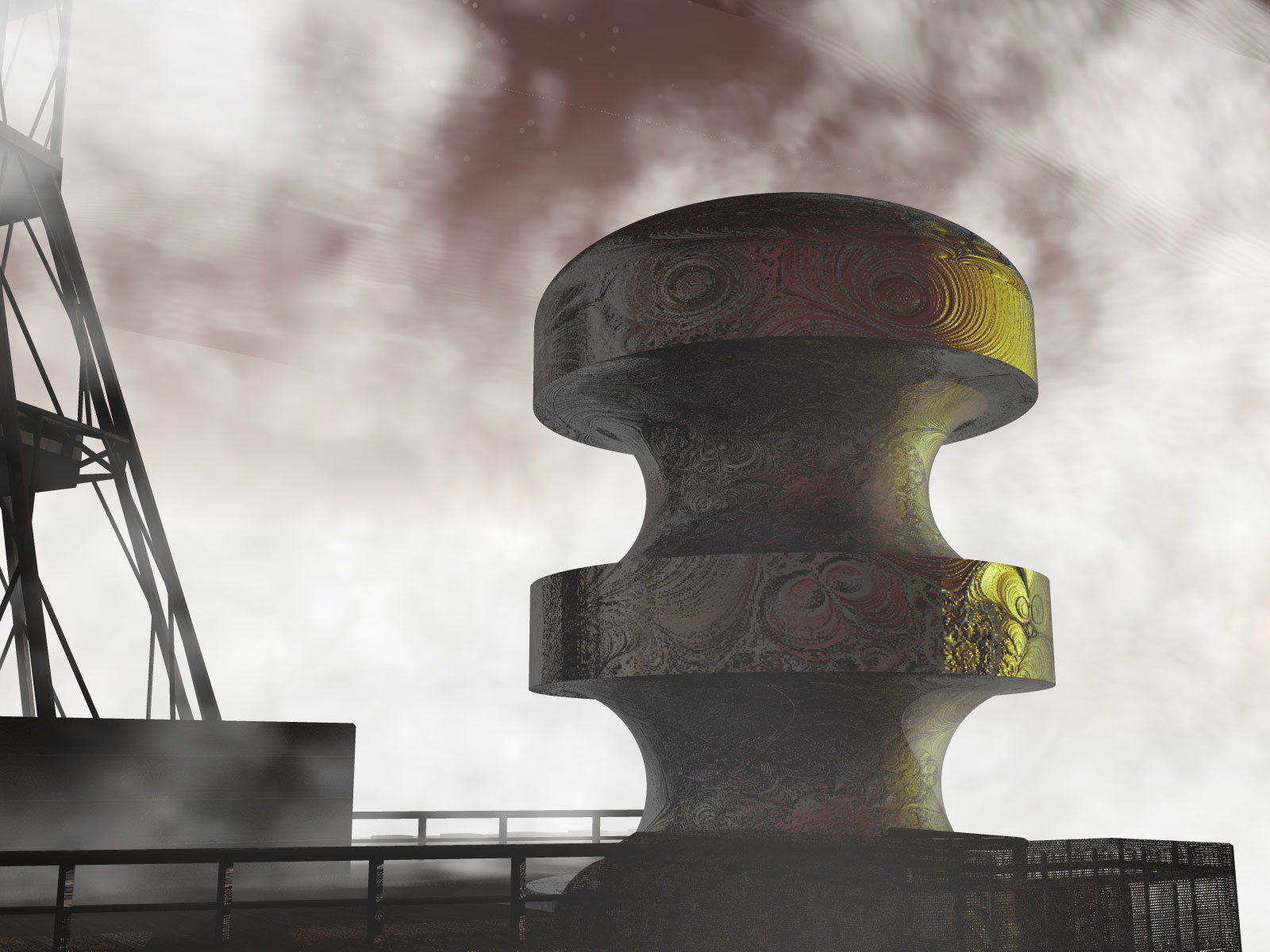

This rendering was actually a byproduct of working on my Desert Industry image. I was experimenting around with the top of the building, and wound up with this view of the striking tin knob that features in this image. Right away, I knew I had to make a rendering centered around that feature. This required a completely different sky from the other rendering, however, and I also needed to work in the fog effects (which I think came out particularly well on the lower-left). I also had to add the railing to this side of the building. The net effect is something that is more like a ship at sea than anything else, actually, which I really like.
Brain Stem
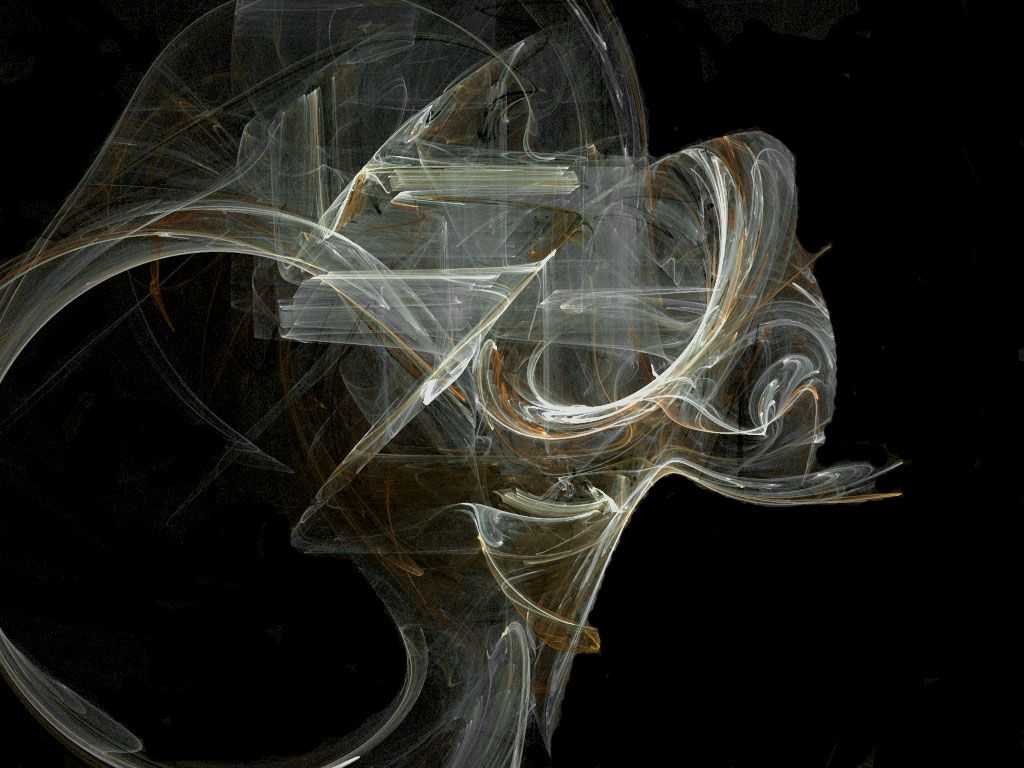

This is only my third rendering in Apophysis. It's not as vibrant as Flame Belt was, but I think there is some interesting form here. I had to do a LOT of post-processing work in Photoshop to cut out ancillary clutter (and to remove the entire cyan hue, incidentally), but I think the result was quite interesting.
Thursday, October 11, 2007
Progress continues
Four pages today. I'm still in a section that is rather tricky to expand/revise, but I thought it went rather well. I didn't revise my content from yesterday yet, though. I'll have to revise that, plus tonight's content, this weekend. I have high hopes for this weekend being especially productive for writing.
The stats as of today:
-38,000 estimated words.
-44,805 actual words.
-Six-and-a-half fully-revised-and-expanded chapters (109.5 pages total).
-Eleven completed chapters in all (152 pages).
The stats as of today:
-38,000 estimated words.
-44,805 actual words.
-Six-and-a-half fully-revised-and-expanded chapters (109.5 pages total).
-Eleven completed chapters in all (152 pages).
Chernobyl Countryside

My latest rendering. This is a rather dismal picture, but I enjoy a bit of desolation (in art) now and then. It seems fitting, with Halloween coming up. The towers pictured are actually all the #4 tower from Chernobyl. Also of note is the angle of the "camera" in this image. At least in the last four or five years, I haven't done many renderings that had the camera pointed upwards.
Art Show at Stephen Parrish's
The always-humorous Stephen Parrish (for some reason, I always have to give him some sort of title when I blog about him -- last time, it was "the indomitable." If you read his blog, perhaps you will see why he inspires this.) has taken it upon himself to do a showing of some of my art. Wow. I'm touched just that someone outside my immediate family would like my art that much, but some of his commentary is the sort of thing you don't expect to hear until your eulogy. I'm really blown away.
Wednesday, October 10, 2007
At last, progress.
Four and a half pages today. Two pages of that was all-new content, and the rest was unusually heavy edits. I also revised the five pages I wrote last Thursday. Last Thursday! How has it been six days since I last wrote anything? Well, sometimes life, trips, and all that, just gets in the way. I was also fearing the revisions/expansions that I knew I would have to make with this scene (they were pretty deep), and I think that also helped to keep me away. But I think it turned out pretty well -- I'll feel better about this scene once I have a chance to revise it once more in the coming days. Hopefully tomorrow, as long as I can make myself come back and do some work again.
The stats as of today:
-37,500 estimated words.
-44,243 actual words.
-Six-and-a-half fully-revised-and-expanded chapters (105.5 pages total).
-Eleven completed chapters in all (150 pages).
The stats as of today:
-37,500 estimated words.
-44,243 actual words.
-Six-and-a-half fully-revised-and-expanded chapters (105.5 pages total).
-Eleven completed chapters in all (150 pages).
Tuesday, October 9, 2007
Further Website Updates
Well, I've been too tired the last few days to do any writing, so I've been getting some other things accomplished that I've been putting off. A number of the posts out of yesterday's plethora were ones that I've been meaning to make for a while, for instance, and today I've been twiddling with the look of the blog/website yet again.
This is always how it is for me with websites. Ever since I put up my first site in 1998, I've had the bug of continual upgrades. Usually there's just something that isn't quite right with whatever design I've put together, and it bugs me until I finally do something about it. Gradually, the design congeals into something I'm happy with. I'm glad that the UI design aspect is only a secondary part of my day job, or I'd probably go insane. Modeling business practices in code is much easier and faster (most of the time).
At any rate, I think the site is gradually hitting the level where it will be hard to make changes without making something worse (which is what usually makes me settle on a given design). I think the addition of the new header helps bring the whole design together, and the new selection of colors is a lot more striking. Also, I've switched to sans-serif fonts, since those are easier to read on-screen (serif fonts are easier to read on paper).
Anyway, I've been tired because I went out of town over the weekend, and then I had to get up early today for a monthly meeting of technology executives that I attend. Tomorrow I should be fully-rested, and I expect to get back on a proper writing schedule.
This is always how it is for me with websites. Ever since I put up my first site in 1998, I've had the bug of continual upgrades. Usually there's just something that isn't quite right with whatever design I've put together, and it bugs me until I finally do something about it. Gradually, the design congeals into something I'm happy with. I'm glad that the UI design aspect is only a secondary part of my day job, or I'd probably go insane. Modeling business practices in code is much easier and faster (most of the time).
At any rate, I think the site is gradually hitting the level where it will be hard to make changes without making something worse (which is what usually makes me settle on a given design). I think the addition of the new header helps bring the whole design together, and the new selection of colors is a lot more striking. Also, I've switched to sans-serif fonts, since those are easier to read on-screen (serif fonts are easier to read on paper).
Anyway, I've been tired because I went out of town over the weekend, and then I had to get up early today for a monthly meeting of technology executives that I attend. Tomorrow I should be fully-rested, and I expect to get back on a proper writing schedule.
Robot Insurance
Useful for when that upcoming robotic insurrection finally happens. Any day now!
(As an aside, I've never seen Sam Waterston do humor before -- that makes it even funnier, for me. A couple of times, he almost smiles while delivering his lines.)
Monday, October 8, 2007
Write this... or that... or maybe...
I recently saw the link to this video over on Pub Rants, the blog of literary agent Kristen Nelson. I thought it was just too funny not to share.
Global Flag
The indomitable Stephen Parrish recently had an interesting post (originally by his brother) about the idea of a global flag. I had never really thought about this idea before, but since I'm more of a believer in globalism than nationalism, it is an idea that really resonates me. Evidently it also resonates with a number of other Americans. The basic idea seems to be that we would still display national pride, same as we display state pride in the US, but that we would place the global allegiance first -- same as we place the national allegiance first in the US.
I don't necessarily think that some sort of world hegemony is called for, but that's not really what this is about. You can't go to a university these days without hearing a lot about globalism, the global economy, et cetera, and I think that this rising global consciousness is a good thing. It isn't that we shouldn't have a sense of national identity, or be proud of where we come from (on a city, county, state, or national level) -- it's that we should also be conscious of our membership in the global community to which we belong, rather than thinking our hierarchy of citizenship ends at the federal level.
Also, this particular post of Stephen's included a link to this quiz that helps identify which American presidential candidates most match your views. I definitely learned something about many of the candidates from this quiz (I don't follow politics that closely), so I thought it was worth passing along.
I don't necessarily think that some sort of world hegemony is called for, but that's not really what this is about. You can't go to a university these days without hearing a lot about globalism, the global economy, et cetera, and I think that this rising global consciousness is a good thing. It isn't that we shouldn't have a sense of national identity, or be proud of where we come from (on a city, county, state, or national level) -- it's that we should also be conscious of our membership in the global community to which we belong, rather than thinking our hierarchy of citizenship ends at the federal level.
Also, this particular post of Stephen's included a link to this quiz that helps identify which American presidential candidates most match your views. I definitely learned something about many of the candidates from this quiz (I don't follow politics that closely), so I thought it was worth passing along.
Building an Elephant
Building an Elephant, by Sean Ferrell, has just recently come online at The Adirondack Review. This was the first piece of fiction I've read by Sean, though I have been keeping up with his blog for some time. Needless to say, I was really impressed by it -- hence this post.
First, my few small complaints. I felt like there was a pattern of occasional missing commas, which I suppose is a fairly minor grammatical quibble (and I have a tendency to use too many commas, so I have little room to talk). There were also a few cases where I would have liked to have a little more description of the emotion felt by the characters. "I felt happy about that" is perhaps the example that jumped out at me the most -- this really seems like a "show, don't tell" moment.
However, that's pretty much all I can say that is negative about this story, and that's really saying something (I'm very nit-picky, even with multi-published novelists). The ideas behind Building an Elephant are really what captured me most of all, though the voice is also quite strong, the writing is solid and efficient, and the descriptions are vivid. You can tell that this author knows what he is doing, in effect.
I don't want to spoil the plot, which is quite surprising given the opening, so I won't discuss the specifics here. Suffice it to say that Sean Ferrell isn't just bragging when he says that his work is cross-genre, and off the beaten path (in a good way). This is a science fiction story, but it doesn't really have the tone or feel of that genre (and I'm a fan of that genre, so I should know). The way that the science-fiction elements are described in this story felt more like magic realism to me, albeit with sci-fi elements in place of the magic.
I suppose my one other quibble would be that this story was rather guy-focused, with the girl next door being more the traditional "girl-next-door sex object" than a true character, but even this was handled in an adept, interesting way. This story is, at heart, a story about a teenage boy and his father, and I thought Sean very much captured the proper tone for that. The sci-fi elements are brilliantly woven in to this basic narrative fabric, and provide both world richness and interesting plot devices, while also raising a great many ancillary questions.
The greatest praise that I can give this or any story is that it made me think. I read this last night, and found myself thinking about the characters and world of this story as I went to sleep. Off and on today I've still been thinking about it, and thus was compelled to write this mini-review, which I don't normally do (actually, I don't think I've ever done this before). The sci-fi elements in some ways inhabit the edges of this story, but they were what made me think the most -- and the way in which they were presented (as just part of ordinary life, too "mundane" for much background explanation) is a big part of what made this such a compelling read. I wouldn't have ever thought of telling this story quite like this, but the story is definitely the better for it.
I don't feel there's any value in trying to give this some sort of arbitrary score or rating, so I'll just end on this note: go read it.
First, my few small complaints. I felt like there was a pattern of occasional missing commas, which I suppose is a fairly minor grammatical quibble (and I have a tendency to use too many commas, so I have little room to talk). There were also a few cases where I would have liked to have a little more description of the emotion felt by the characters. "I felt happy about that" is perhaps the example that jumped out at me the most -- this really seems like a "show, don't tell" moment.
However, that's pretty much all I can say that is negative about this story, and that's really saying something (I'm very nit-picky, even with multi-published novelists). The ideas behind Building an Elephant are really what captured me most of all, though the voice is also quite strong, the writing is solid and efficient, and the descriptions are vivid. You can tell that this author knows what he is doing, in effect.
I don't want to spoil the plot, which is quite surprising given the opening, so I won't discuss the specifics here. Suffice it to say that Sean Ferrell isn't just bragging when he says that his work is cross-genre, and off the beaten path (in a good way). This is a science fiction story, but it doesn't really have the tone or feel of that genre (and I'm a fan of that genre, so I should know). The way that the science-fiction elements are described in this story felt more like magic realism to me, albeit with sci-fi elements in place of the magic.
I suppose my one other quibble would be that this story was rather guy-focused, with the girl next door being more the traditional "girl-next-door sex object" than a true character, but even this was handled in an adept, interesting way. This story is, at heart, a story about a teenage boy and his father, and I thought Sean very much captured the proper tone for that. The sci-fi elements are brilliantly woven in to this basic narrative fabric, and provide both world richness and interesting plot devices, while also raising a great many ancillary questions.
The greatest praise that I can give this or any story is that it made me think. I read this last night, and found myself thinking about the characters and world of this story as I went to sleep. Off and on today I've still been thinking about it, and thus was compelled to write this mini-review, which I don't normally do (actually, I don't think I've ever done this before). The sci-fi elements in some ways inhabit the edges of this story, but they were what made me think the most -- and the way in which they were presented (as just part of ordinary life, too "mundane" for much background explanation) is a big part of what made this such a compelling read. I wouldn't have ever thought of telling this story quite like this, but the story is definitely the better for it.
I don't feel there's any value in trying to give this some sort of arbitrary score or rating, so I'll just end on this note: go read it.
My sister
This article was recently in the paper at the university of my sister, Catherine. I had to take this opportunity to brag on her just a bit -- she's one heck of a classical singer (not to mention pianist). She's at UNC on a music scholarship, and was recently in her first opera there. She's done quite well in many state and regional completions over the years.
I remember when my wife and I first went to see Catherine sing when she was still in high school. She was singing "Wishing You Were Somehow Here Again" from Phantom of the Opera, and we were blown away. She was already a really accomplished pianist by that point, but none of the family had any inkling that she was such a good singer until then.
After that, she starred as Lily in her high school's production of the Broadway version of The Secret Garden (she was at Enloe, a huge music/drama school, so this was a really big deal). She sang The Prayer as a solo at my wedding, and later sung it in an incredible duet at Enloe that I still think is better than either of the Josh Groban versions (and yes, I am biased toward my sister, but am also a Josh Groban fan, so that's still saying something).
She's working on a degree in music now, doing ecumenical singing for her scholarship, and always working on various performances and competitions and such. Suffice it to say, I am really proud of her.

I remember when my wife and I first went to see Catherine sing when she was still in high school. She was singing "Wishing You Were Somehow Here Again" from Phantom of the Opera, and we were blown away. She was already a really accomplished pianist by that point, but none of the family had any inkling that she was such a good singer until then.
After that, she starred as Lily in her high school's production of the Broadway version of The Secret Garden (she was at Enloe, a huge music/drama school, so this was a really big deal). She sang The Prayer as a solo at my wedding, and later sung it in an incredible duet at Enloe that I still think is better than either of the Josh Groban versions (and yes, I am biased toward my sister, but am also a Josh Groban fan, so that's still saying something).
She's working on a degree in music now, doing ecumenical singing for her scholarship, and always working on various performances and competitions and such. Suffice it to say, I am really proud of her.
Media Credit: DTH/Anthony Harris
Catherine Park, a Kenan Voice Scholar, signs the acoustical curtain I-beam on Friday at the topping-off ceremony of the new Kenan Music Building.
Amateur Lightsaber Duel
RVD2 is a 10-minute fan video of a light saber battle. Parts are a bit silly, others are a bit gritty, but overall I thought this was a really well-choreographed, well-thought-out action sequence. I'm surprised that some of the ideas presented here haven't been in the official Star Wars movies, actually. I don't generally go for this sort of thing, but someone showed me this one, and I thought it was too clever and good not to share.
Yankee or Dixie Quiz
I thought this was an interesting quiz, because it focuses on word and phrase usage in different parts of the US. See which parts of the country your own usage most agrees with -- most people are something of a mix. Personally, I was 63% Dixie, which sounds about right. How about you?
Sunday, October 7, 2007
Restarting page numbering in word
This question gets asked a lot, so I thought I'd answer it here: "How do I omit the page number from my title page (plus however many other Table of Contents / Epigraph pages, or whatever else you've stuck in up at the start), and then have it start at page 1 at the start of my first chapter?"
1. Start out with no page numbering at all.
2. At the top of the page that you want to start numbering from, do the following: under the Insert menu in Microsoft Word, choose Break, and then choose one of the "section break" types.
2.a. If you've already got a page break properly in place, choose "Continuous" to not mess that up.
2.b. If you want to insert a page break with your new section, choose "Next Page" to do so.
3. Make sure your cursor is still on that same page that you want to start the numbering from, and then once again go to the Insert menu. Choose Page Numbers, use whatever settings you like, and then choose Format on the Page Numbers popup. Under the Formatting popup, change the "Continue from previous section" radio button to say "Start at 1" instead.
This divides your document into two "sections," each of which can have independent page numbering. You can actually use this same technique to divide your document as many times as you want, and have all sorts of different page numbering schemes (such as no page numbering at the very start, then roman numerals for an Introduction, then regular Arabic numerals for the main content, and then lettering for appendixes).
But, for manuscripts, remember that you'll just want to keep it simple and just have the Arabic numerals for the main content, starting in your first chapter.
1. Start out with no page numbering at all.
2. At the top of the page that you want to start numbering from, do the following: under the Insert menu in Microsoft Word, choose Break, and then choose one of the "section break" types.
2.a. If you've already got a page break properly in place, choose "Continuous" to not mess that up.
2.b. If you want to insert a page break with your new section, choose "Next Page" to do so.
3. Make sure your cursor is still on that same page that you want to start the numbering from, and then once again go to the Insert menu. Choose Page Numbers, use whatever settings you like, and then choose Format on the Page Numbers popup. Under the Formatting popup, change the "Continue from previous section" radio button to say "Start at 1" instead.
This divides your document into two "sections," each of which can have independent page numbering. You can actually use this same technique to divide your document as many times as you want, and have all sorts of different page numbering schemes (such as no page numbering at the very start, then roman numerals for an Introduction, then regular Arabic numerals for the main content, and then lettering for appendixes).
But, for manuscripts, remember that you'll just want to keep it simple and just have the Arabic numerals for the main content, starting in your first chapter.
Thursday, October 4, 2007
Passing 100 Revised/Expanded Pages!
Five pages tonight! At first I mostly did a lot of revising of older content, because I was starting a new scene with Lela, who I hadn't written for in a week or so, and I needed to get back into her head. But once I got back into her head, it went very quickly. It was hard to write her perspective at first, but during my last sequence of scenes with her, I finally found the method for it, and now it's really enjoyable.
A lot of tonight's content was actually brand-new, but since I also outright deleted a two-page scene that is now redundant and which was crappy in the first place, my net word count actually didn't increase that much. And, I'm actually happy about that, since I'm still in the revising/expanding stage of things. My goal of 80,000 estimated words was seeming too far off a few months ago, before I started this process (I thought I might run out of storyat 60,000 words or so), but now I'm legitimately concerned that the entire story might not fit in just 80,000 words.
I'm confident that it will work out, though, and actually it's a good feeling to have too much content. It makes it easy to justify dumping any marginal content -- every scene must count, since I only get so many. As long as I end up between 80,000 and 100,000 estimated words, I'll be happy, but I'm still going to do my best to make sure that each and every scene really counts -- see my earlier post from today for what I mean by that. So far, so good on that score!
It also strikes me that it is now day 4 out of 31 for this month, and I'm already 25% of the way to my monthly goal. It's particularly good to be ahead because I'm not going to have much chance to write for the next three days -- and some of the other weekends from this month are looking pretty doubtful, too. Family events have to take precedence, of course, so that just means that I'll be getting fewer weekdays off from writing this month. As long as I keep ahead of things over the next couple of weeks, I should be in good shape for hitting my goal of 160 total pages, though.
The stats as of today:
-37,000 estimated words.
-43,585 actual words.
-Six-and-a-portion fully-revised-and-expanded chapters (101 pages total).
-Eleven completed chapters in all (148 pages).
A lot of tonight's content was actually brand-new, but since I also outright deleted a two-page scene that is now redundant and which was crappy in the first place, my net word count actually didn't increase that much. And, I'm actually happy about that, since I'm still in the revising/expanding stage of things. My goal of 80,000 estimated words was seeming too far off a few months ago, before I started this process (I thought I might run out of storyat 60,000 words or so), but now I'm legitimately concerned that the entire story might not fit in just 80,000 words.
I'm confident that it will work out, though, and actually it's a good feeling to have too much content. It makes it easy to justify dumping any marginal content -- every scene must count, since I only get so many. As long as I end up between 80,000 and 100,000 estimated words, I'll be happy, but I'm still going to do my best to make sure that each and every scene really counts -- see my earlier post from today for what I mean by that. So far, so good on that score!
It also strikes me that it is now day 4 out of 31 for this month, and I'm already 25% of the way to my monthly goal. It's particularly good to be ahead because I'm not going to have much chance to write for the next three days -- and some of the other weekends from this month are looking pretty doubtful, too. Family events have to take precedence, of course, so that just means that I'll be getting fewer weekdays off from writing this month. As long as I keep ahead of things over the next couple of weeks, I should be in good shape for hitting my goal of 160 total pages, though.
The stats as of today:
-37,000 estimated words.
-43,585 actual words.
-Six-and-a-portion fully-revised-and-expanded chapters (101 pages total).
-Eleven completed chapters in all (148 pages).
"Running Around"
I used to have a concept that I called "running around," which referred to scenes in books or movies that just had characters churning with no real purpose. The characters move from place A to B, or we see them do some activity, or they chat in a non-characterizing way -- something like that. At any rate, things are happening, but the story is not really progressing in any meaningful way.
I said I "used to have" this concept because I feel like it's a little bit too restrictive now. Sure, there are books and movies that have this problem, but they are comparably rare, because the conditions are rather specific. More recently, I've come up with a new way of thinking about the core issue to which I was reacting, and that is: to be really engaging, no scene can do just one thing.
In other words, a scene can't just be about plot movement and still be fascinating. Sure, if you watch a character working through a mystery or interviewing people, or going to lunch where a fateful event is going to happen, that moves the plot. But there has to be something else there, as well: characterization, "trenchant little insights" (as Anne Mini would say), some sort of ethical or emotional struggle, or tension feeding from sources other than just the current scene's activities. Or something else that intrigues the user or draws them along.
I don't think that every book has to use this approach to be publishable, an enjoyable read, a bestseller, or what have you. I'm simply pointing out that, to me, the very best books have a lot going on in pretty much every scene, multiple sources of tension and interest, and it's all woven together in an expert manner with solid writing. For example: THE DOOMSDAY BOOK has events going on in the past with Kivrin, the future with Mr. Dunworthy and the others, and multiple simultaneous mysteries; ENDER'S GAME has Ender's various struggles, many of which are co-mingled within the novel's timeline, and also has the related-but-separate storyline with Peter and Valentine; TWILIGHT has romance, supernatural events and revelations, as well as Bella's various ongoing life events; THE DARK IS RISING has Will's family and daily life alongside his quest for the signs, intermingled with the various things The Dark tries to do to thwart him, and the various things that Merriman and the others are doing to help him. And I presume I don't need to mention that the Harry Potter books are the same way.
All of these books are so significant, at least to me, partly because of how rich and varied they feel. There is always more than one thing going on, and always the tension of wanting to know about something else in the story while I'm reading whatever scene -- yet instead of distracting from the current scene, that desire enriches it. Somehow, books like this evoke the feeling that "anything can happen" better than any others.
I still thoroughly enjoy books like THE GOLDEN COMPASS, A THOUSAND WORDS FOR STRANGER, or I AM LEGEND which, to me, don't quite seem to have this level of interweaving, but their semi-linearity always leaves me wishing there had been a little more. Don't get me wrong -- each of the books I just mentioned are brilliant, have numerous surprises, and are among my favorites ever. However, none of these three reach the level of poignancy for me as the other books I mentioned, partly because all those twists and turns happen one at a time. Or, when events are happening in an interwoven manner, the interest-factor of one plot thread is overshadowing the others to the degree that the story feels more linear than it is.
Now, the qualifications (in the sense of limitations, not credentials), because, boy, does this post need them. If I haven't made this abundantly clear, this is all my opinion, and is also not meant to be taken as an insult to any of the books or writers on my second list. I picked from among my very favorite books for all the books mentioned in this post, and divided them into categories of those that can make my chest ache with simultaneous pain and pleasure to think of them (the first group), and those that I love, but which I didn't connect with on that same level (the second group).
If you disagree with me, or your list is reversed, don't let that detract from the core message here: this post is about writing, and I really do believe that having a very-interwoven plot, versus a slightly-more-linear one, is what differentiates the very best books from the "simply" great books. As a writer, moreso than as a reader, that's a very interesting prospect to ponder.
I said I "used to have" this concept because I feel like it's a little bit too restrictive now. Sure, there are books and movies that have this problem, but they are comparably rare, because the conditions are rather specific. More recently, I've come up with a new way of thinking about the core issue to which I was reacting, and that is: to be really engaging, no scene can do just one thing.
In other words, a scene can't just be about plot movement and still be fascinating. Sure, if you watch a character working through a mystery or interviewing people, or going to lunch where a fateful event is going to happen, that moves the plot. But there has to be something else there, as well: characterization, "trenchant little insights" (as Anne Mini would say), some sort of ethical or emotional struggle, or tension feeding from sources other than just the current scene's activities. Or something else that intrigues the user or draws them along.
I don't think that every book has to use this approach to be publishable, an enjoyable read, a bestseller, or what have you. I'm simply pointing out that, to me, the very best books have a lot going on in pretty much every scene, multiple sources of tension and interest, and it's all woven together in an expert manner with solid writing. For example: THE DOOMSDAY BOOK has events going on in the past with Kivrin, the future with Mr. Dunworthy and the others, and multiple simultaneous mysteries; ENDER'S GAME has Ender's various struggles, many of which are co-mingled within the novel's timeline, and also has the related-but-separate storyline with Peter and Valentine; TWILIGHT has romance, supernatural events and revelations, as well as Bella's various ongoing life events; THE DARK IS RISING has Will's family and daily life alongside his quest for the signs, intermingled with the various things The Dark tries to do to thwart him, and the various things that Merriman and the others are doing to help him. And I presume I don't need to mention that the Harry Potter books are the same way.
All of these books are so significant, at least to me, partly because of how rich and varied they feel. There is always more than one thing going on, and always the tension of wanting to know about something else in the story while I'm reading whatever scene -- yet instead of distracting from the current scene, that desire enriches it. Somehow, books like this evoke the feeling that "anything can happen" better than any others.
I still thoroughly enjoy books like THE GOLDEN COMPASS, A THOUSAND WORDS FOR STRANGER, or I AM LEGEND which, to me, don't quite seem to have this level of interweaving, but their semi-linearity always leaves me wishing there had been a little more. Don't get me wrong -- each of the books I just mentioned are brilliant, have numerous surprises, and are among my favorites ever. However, none of these three reach the level of poignancy for me as the other books I mentioned, partly because all those twists and turns happen one at a time. Or, when events are happening in an interwoven manner, the interest-factor of one plot thread is overshadowing the others to the degree that the story feels more linear than it is.
Now, the qualifications (in the sense of limitations, not credentials), because, boy, does this post need them. If I haven't made this abundantly clear, this is all my opinion, and is also not meant to be taken as an insult to any of the books or writers on my second list. I picked from among my very favorite books for all the books mentioned in this post, and divided them into categories of those that can make my chest ache with simultaneous pain and pleasure to think of them (the first group), and those that I love, but which I didn't connect with on that same level (the second group).
If you disagree with me, or your list is reversed, don't let that detract from the core message here: this post is about writing, and I really do believe that having a very-interwoven plot, versus a slightly-more-linear one, is what differentiates the very best books from the "simply" great books. As a writer, moreso than as a reader, that's a very interesting prospect to ponder.
Wednesday, October 3, 2007
Finished with chapter 6!
Whew! I thought this was going to take me two sessions, but I managed to get it completed in one. Five and a half pages today! Sorry that this post is so short (as most of my posts have been of late), but all my writing energy has been going into my manuscript. I imagine most of my readers understand, since most of them are writers themselves. I'll try to have a more insightful post sometime soon, to break up the continual status updates.
The stats as of today:
-36,750 estimated words.
-43,331 actual words.
-Six fully-revised-and-expanded chapters (96 pages total).
-Eleven completed chapters in all (147 pages).
The stats as of today:
-36,750 estimated words.
-43,331 actual words.
-Six fully-revised-and-expanded chapters (96 pages total).
-Eleven completed chapters in all (147 pages).
Tuesday, October 2, 2007
Still working on that sixth chapter
Five full pages, today. I didn't get anything done yesterday because I was caught up in day-job work stuff. This looks like one of those weeks where being a CTO is going to bleed over into my writing time, but I'm going to try to keep to my writing schedule as best I can, regardless. Honestly, there's always something, so if I don't make time when things are busy, I'll never have time. Tonight was a good night, though -- tough scene to revise, and a lot of expansion was included, but I'm happy with the result. I'm hoping to finish up chapter six in one or two more sessions.
The stats as of today:
-36,500 estimated words.
-42,750 actual words.
-Five-and-a-half fully-revised-and-expanded chapters (90.5 pages total).
-Eleven completed chapters in all (146 pages).
The stats as of today:
-36,500 estimated words.
-42,750 actual words.
-Five-and-a-half fully-revised-and-expanded chapters (90.5 pages total).
-Eleven completed chapters in all (146 pages).
Sunday, September 30, 2007
A little more on chapter 6.
Only two and a half pages today, but I'm all right with that. I got the content that I wrote last time edited, which was good, and I also figured out a minor plot point that had been holding me back with the rest of this chapter. I took yesterday and Friday off, and had intended to take today off as well, but just couldn't stay away that long at once. I've been feeling really tired, and fairly sick (just a cold or allergies, I think), so that's been putting a crimp in my writing. I slept for about 12 hours last night, which is extraordinarily rare for me.
Fortunately, I already had 84 total pages for September, and my goal was 80, so I had earned a couple of days off. Now I'm up to 86 pages, so that's even better for ending the month. Here's hoping I can reach 160 pages total by the end of October!
The stats as of today:
-36,000 estimated words.
-42,091 actual words.
-Five-and-a-portion fully-revised-and-expanded chapters (86 pages total).
-Eleven completed chapters in all (144 pages).
Fortunately, I already had 84 total pages for September, and my goal was 80, so I had earned a couple of days off. Now I'm up to 86 pages, so that's even better for ending the month. Here's hoping I can reach 160 pages total by the end of October!
The stats as of today:
-36,000 estimated words.
-42,091 actual words.
-Five-and-a-portion fully-revised-and-expanded chapters (86 pages total).
-Eleven completed chapters in all (144 pages).
Thursday, September 27, 2007
Solid Progress on Chapter 6
Five and a half pages today, and most of that was new content! And in only two hours, amazingly. Some scenes flow, some don't. Some days are good, others not so much. It's hard to find any root cause for why things go well or badly on any given day, but suffice it to say that I'm happy the writing went well today.
The stats as of today:
-36,000 estimated words.
-41,954 actual words.
-Five-and-a-portion fully-revised-and-expanded chapters (83 pages total).
-Eleven completed chapters in all (144 pages).
PS -- Finally my time is set correctly on the blog again. It was always an hour behind, and I couldn't figure out why. Most of the time I remembered to correct my post times, but sometimes I forgot. I'd looked through the blog settings multiple times in the past, and finally found the time zone setting tonight. Turns out I was on Cayman Islands time, of all places!
PPS -- Looks like the fix to the time zone as auto-set all of my old times ahead by an hour. Darn. Since I post right near midnight most nights, it's set most of my posts forward by a day. At least things will be correct from now on, though.
PPPS (Is that even a thing? I don't think that it is) -- So, I went back and fixed the dates/times for the entries from the last month, at least (I'm anal like that). However, I apologize for those of you who use RSS readers, because it likely marked a bunch of posts as new, when they really aren't. You can safely just hit "mark as read" for every post after this one in the reader (as if you're hanging on every post, anyway). That's all the P's and S's for tonight, I promise. Good night, all!
The stats as of today:
-36,000 estimated words.
-41,954 actual words.
-Five-and-a-portion fully-revised-and-expanded chapters (83 pages total).
-Eleven completed chapters in all (144 pages).
PS -- Finally my time is set correctly on the blog again. It was always an hour behind, and I couldn't figure out why. Most of the time I remembered to correct my post times, but sometimes I forgot. I'd looked through the blog settings multiple times in the past, and finally found the time zone setting tonight. Turns out I was on Cayman Islands time, of all places!
PPS -- Looks like the fix to the time zone as auto-set all of my old times ahead by an hour. Darn. Since I post right near midnight most nights, it's set most of my posts forward by a day. At least things will be correct from now on, though.
PPPS (Is that even a thing? I don't think that it is) -- So, I went back and fixed the dates/times for the entries from the last month, at least (I'm anal like that). However, I apologize for those of you who use RSS readers, because it likely marked a bunch of posts as new, when they really aren't. You can safely just hit "mark as read" for every post after this one in the reader (as if you're hanging on every post, anyway). That's all the P's and S's for tonight, I promise. Good night, all!
Wednesday, September 26, 2007
Website Updates, and Progress
Three pages today. I would have easily reached four or even six pages, had I not gotten side-tracked tweaking the code for my website/blog (ahem. For four hours). Well, there were a few different little glitches on the site in both FireFox and IE, and they've been bothering me for months now. For whatever reason, I chose tonight to be my night to make those updates. The result is that the glitches are gone, I made a few minor graphical enhancements, and I'm a bit more cross-browser compatible.
I guess that's worth sacrificing a few pages' worth of work, since the website/blog is, after all, most people's first impression of me. It's one of those marketing things that I've decided to get a jump on well before I even have an agent, let alone a publisher, because I don't want to get in a crunch (or hire somebody else) on account of the website later on. Plus, tweaking it gradually over time gives me a good chance to let the design gradually "settle."
Even so, this can't become a habit. I did finish with chapter 5 tonight, so I'm back to revising/expanding with chapter 6 tomorrow. It won't be until I get a fair ways into chapter 7 that I have another all-new scene to add.
The stats as of today:
-35,500 estimated words.
-41,126 actual words.
-Five fully-revised-and-expanded chapters (78 pages total).
-Eleven completed chapters in all (142 pages).
I guess that's worth sacrificing a few pages' worth of work, since the website/blog is, after all, most people's first impression of me. It's one of those marketing things that I've decided to get a jump on well before I even have an agent, let alone a publisher, because I don't want to get in a crunch (or hire somebody else) on account of the website later on. Plus, tweaking it gradually over time gives me a good chance to let the design gradually "settle."
Even so, this can't become a habit. I did finish with chapter 5 tonight, so I'm back to revising/expanding with chapter 6 tomorrow. It won't be until I get a fair ways into chapter 7 that I have another all-new scene to add.
The stats as of today:
-35,500 estimated words.
-41,126 actual words.
-Five fully-revised-and-expanded chapters (78 pages total).
-Eleven completed chapters in all (142 pages).
Tuesday, September 25, 2007
Made it... barely.
Just a quick post, today. I took yesterday off for a family event, so no progress then. Today was your typical Monday, but I managed to get a lot done today despite that. Tonight it took me four hours to write my four pages (two hours for the first, an hour for the second, and an hour for both the third and fourth together), and I also made minor revisions to my work from Saturday. I really didn't think I was going to make my goal, but somehow I managed to pull myself into the swing of things at long last, and I did.
That would be a rewarding feeling, if I wasn't so exhausted. But I know I'll appreciate it more tomorrow -- and even more so, I'll appreciate this sort of thing in aggregate, because if I let nights like tonight stop me, then I'm likely to get stuck for days. My hope is that by having pushed through a tough scene tonight, tomorrow's scene will flow easily. That's been the tentative pattern so far, but I don't necessarily trust it to hold up indefinitely.
Oh yes, and I broke 40,000 actual words today! Anyway, that's all for now. Time to get some rest...
The stats as of today:
-34,750 estimated words.
-40,376 actual words.
-Almost-six fully-revised-and-expanded chapters (75 pages total).
-Almost-eleven completed chapters in all (139 pages).
That would be a rewarding feeling, if I wasn't so exhausted. But I know I'll appreciate it more tomorrow -- and even more so, I'll appreciate this sort of thing in aggregate, because if I let nights like tonight stop me, then I'm likely to get stuck for days. My hope is that by having pushed through a tough scene tonight, tomorrow's scene will flow easily. That's been the tentative pattern so far, but I don't necessarily trust it to hold up indefinitely.
Oh yes, and I broke 40,000 actual words today! Anyway, that's all for now. Time to get some rest...
The stats as of today:
-34,750 estimated words.
-40,376 actual words.
-Almost-six fully-revised-and-expanded chapters (75 pages total).
-Almost-eleven completed chapters in all (139 pages).
Monday, September 24, 2007
Plotting and Brainstorming
I didn't make my writing goal today. I revised my content from last night, and made perhaps a half-page's progress on the rest of the scene. I was having a lot of trouble determining how to wrap up this scene and ultimately end it, and that was really stopping me cold. The initial ideas that I had had when first planning this scene now seemed insufficient, but I couldn't figure out anything better.
Well, after an hour or two of flogging myself with this, trying to come up with something brilliant, I finally realized I could talk it over with my wife, who is also a writer (and a terrific editor). In the past, we haven't talked much about works in progress because we like to give the other one a chance to read the finished product (or at least a mid-level draft) with fresh eyes. But lately we've been breaking that habit, and that's definitely for the better. Brainstorming works so much better with two people than with one. Ten minutes of talking with my wife, and we had eliminated several possibilities and established the general parameters for what could happen in the next part of the scene -- being able to set some boundaries is really important when you have writer's block, or at least it is for me. With that all settled, a really great idea for ending the scene occurred to me straightaway.
Sometimes it's my wife that comes up with the great idea for my writing, sometimes it's me who comes up with the great idea for hers, but often just being able to talk to someone else about a troubling scene makes the writer come up with something all by himself/herself. Certainly, it varies, but the point is that having that second person can be really invaluable. I'm sure I would have come upon a solution eventually, but with my part-time writing schedule, it could have taken days or weeks of misery and blockage. Instead, though today was shot for writing, I'm all set for tomorrow. Tomorrow should be a good day for writing, easy to hit my goal, because I know just what I want to do with the upcoming sections (even though I'm sure that some in-the-moment details will surprise me).
Writers are often rather solitary, as writing is considered a solitary art, but if you find yourself frequently blocked, getting a friend/spouse/family member to be your sounding board might just be the ticket to breaking through. I think a lot of people use their critique partners this way, actually. But even if you don't have a full-out critique partner, having an idea-partner might be a really great way to help keep your writing on track. After all, just having someone to poke holes in your logic is a huge value in itself. Much better that happen during the ideation stage, rather than after everything is done (or worse, after publication).
I'm really glad that I finally realized this. It gives me a lot more confidence that I'll be able to maintain my pace of progress after I run out of content that needs to be revised/expanded.
Well, after an hour or two of flogging myself with this, trying to come up with something brilliant, I finally realized I could talk it over with my wife, who is also a writer (and a terrific editor). In the past, we haven't talked much about works in progress because we like to give the other one a chance to read the finished product (or at least a mid-level draft) with fresh eyes. But lately we've been breaking that habit, and that's definitely for the better. Brainstorming works so much better with two people than with one. Ten minutes of talking with my wife, and we had eliminated several possibilities and established the general parameters for what could happen in the next part of the scene -- being able to set some boundaries is really important when you have writer's block, or at least it is for me. With that all settled, a really great idea for ending the scene occurred to me straightaway.
Sometimes it's my wife that comes up with the great idea for my writing, sometimes it's me who comes up with the great idea for hers, but often just being able to talk to someone else about a troubling scene makes the writer come up with something all by himself/herself. Certainly, it varies, but the point is that having that second person can be really invaluable. I'm sure I would have come upon a solution eventually, but with my part-time writing schedule, it could have taken days or weeks of misery and blockage. Instead, though today was shot for writing, I'm all set for tomorrow. Tomorrow should be a good day for writing, easy to hit my goal, because I know just what I want to do with the upcoming sections (even though I'm sure that some in-the-moment details will surprise me).
Writers are often rather solitary, as writing is considered a solitary art, but if you find yourself frequently blocked, getting a friend/spouse/family member to be your sounding board might just be the ticket to breaking through. I think a lot of people use their critique partners this way, actually. But even if you don't have a full-out critique partner, having an idea-partner might be a really great way to help keep your writing on track. After all, just having someone to poke holes in your logic is a huge value in itself. Much better that happen during the ideation stage, rather than after everything is done (or worse, after publication).
I'm really glad that I finally realized this. It gives me a lot more confidence that I'll be able to maintain my pace of progress after I run out of content that needs to be revised/expanded.
Saturday, September 22, 2007
Met my goal again.
Four pages, yet again! And I also made some minor revisions to the six pages from last night, so those are fully ready to go, now. This content was almost completely new, but it replaced another scene that was preexisting, so my total page count didn't rise as much as my revised page count. I had been planning to write another all-new scene to go with the one from last night, but the pacing just didn't feel right with what I was planning. So instead, I archived that idea, and will probably re-insert that scene (and actually write it) sometime later in the book. I suspect somewhere in chapter 7 or 8, unless something even better strikes me before then.
The stats as of today:
-33,750 estimated words.
-38,959 actual words.
-Five-and-a-portion fully-revised-and-expanded chapters (71 pages total).
-Ten-and-a-portion completed chapters in all (135 pages).
The stats as of today:
-33,750 estimated words.
-38,959 actual words.
-Five-and-a-portion fully-revised-and-expanded chapters (71 pages total).
-Ten-and-a-portion completed chapters in all (135 pages).
Friday, September 21, 2007
Well into chapter 5.
Six pages of all-new content today! And it only took me two and a half hours, amazingly. I was really flying through this content, which is surprising, because I hadn't planned it out as well as I usually need to. This scene was a flashback, and a key one at that, but since I knew the characters well enough, it came pretty easily. It actually surprised me three times with twists on how the scene developed, but I love it when scenes do that to me. It gives me the same sense of surprise that the reader gets.
Anyway, I can't say much about the specifics of the scene, as usual, but I'm now about a third of the way through chapter five. I hadn't intended on writing this entire scene tonight, but, like I said, things were just flowing. I'm happy to see that this can happen when I'm writing new content, and on a Friday to boot. If I keep this up, I'm going to finish ahead of my goal, which was ambitious to begin with. I guess we'll see if I can maintain my momentum that long. I hope so!
The stats as of today:
-33,500 estimated words.
-38,628 actual words.
-Five-and-a-portion fully-revised-and-expanded chapters (67 pages total).
-Ten-and-a-portion completed chapters in all (134 pages).
Anyway, I can't say much about the specifics of the scene, as usual, but I'm now about a third of the way through chapter five. I hadn't intended on writing this entire scene tonight, but, like I said, things were just flowing. I'm happy to see that this can happen when I'm writing new content, and on a Friday to boot. If I keep this up, I'm going to finish ahead of my goal, which was ambitious to begin with. I guess we'll see if I can maintain my momentum that long. I hope so!
The stats as of today:
-33,500 estimated words.
-38,628 actual words.
-Five-and-a-portion fully-revised-and-expanded chapters (67 pages total).
-Ten-and-a-portion completed chapters in all (134 pages).
Thursday, September 20, 2007
Finishing Chapter 4
Man, today was one of those days that makes me love being a writer. I was really feeling stuck yesterday on what to do with the next scene. I knew that I was going to have to rewrite it pretty completely, and it's a scene that is pretty emotionally loaded, so I was really concerned about doing it right. Well, today I spent a good amount of time after work just thinking about what I could do with that scene. My wife went to a movie with some of her friends, so this was an ideal time for me to just try and figure this out.
It took about two hours of driving, running on the elliptical trainer (nothing like endorphins to help the writing process), and zoning out looking at the rain -- but I finally figured it out. The scene had been awkward before partly because of its content, partly because of its brevity, and partly because of how it touched on important issues without really explaining them properly (because there were certain things I didn't want to give away yet). Well, I figured out how to fix all that, and I did it without giving away more than I wanted to at this stage of the novel.
Additionally, it actually gave a whole new level to one of my long-planned sub-plots, so that was an even bigger bonus. The ultimate result was some new content that I'm really proud of, five solid pages for my daily total, as well as a finished chapter four. All right!
Of course, tomorrow I'm going to have to do it all over again, because I have another emotionally-charged scene that I have to write, and which I haven't fully thought through just yet. So we'll see how that goes, but I'm hopeful. It will be a good test of the speed at which I'll be able to work once my current revision/expansion phase is finished with this book.
The stats as of today:
-32,000 estimated words.
-36,814 actual words.
-Four fully-revised-and-expanded chapters (61 pages total).
-Ten-and-a-portion completed chapters in all (128 pages).
It took about two hours of driving, running on the elliptical trainer (nothing like endorphins to help the writing process), and zoning out looking at the rain -- but I finally figured it out. The scene had been awkward before partly because of its content, partly because of its brevity, and partly because of how it touched on important issues without really explaining them properly (because there were certain things I didn't want to give away yet). Well, I figured out how to fix all that, and I did it without giving away more than I wanted to at this stage of the novel.
Additionally, it actually gave a whole new level to one of my long-planned sub-plots, so that was an even bigger bonus. The ultimate result was some new content that I'm really proud of, five solid pages for my daily total, as well as a finished chapter four. All right!
Of course, tomorrow I'm going to have to do it all over again, because I have another emotionally-charged scene that I have to write, and which I haven't fully thought through just yet. So we'll see how that goes, but I'm hopeful. It will be a good test of the speed at which I'll be able to work once my current revision/expansion phase is finished with this book.
The stats as of today:
-32,000 estimated words.
-36,814 actual words.
-Four fully-revised-and-expanded chapters (61 pages total).
-Ten-and-a-portion completed chapters in all (128 pages).
Wednesday, September 19, 2007
Some days you win...
Some days you win the battle with yourself, some days you don't. Today I only completed two pages of work, though I did spend an hour making some slight adjustments to yesterday's work (that shouldn't have taken an hour, but it speaks to the state of mind I was in). Today was exhausting, and I was just too distracted to get as much done as I would have liked. I also wasn't quite sure what I wanted to do with the scene I'm rewriting, and that never helps. I'll be better prepared next time. Tomorrow will be better, I'll make sure of it. Publicly airing both my successes and failures is a help, actually.
The stats as of today:
-31,000 estimated words.
-35,751 actual words.
-Almost-four fully-revised-and-expanded chapters (57 pages total).
-Ten completed chapters in all (124 pages).
The stats as of today:
-31,000 estimated words.
-35,751 actual words.
-Almost-four fully-revised-and-expanded chapters (57 pages total).
-Ten completed chapters in all (124 pages).
Books vs. Movies
So I recently saw Stardust, a movie adaptation of a Neil Gaiman novel. From the early trailers, I wasn't interested in this movie, and from the jacket blurb and the description on Amazon, I wasn't interested in the novel. It really just didn't seem like my type of thing -- even though I write fantasy, I really am not a fan of most traditional "high fantasy," which is pretty much what this seemed to be (albeit with many strange twists, such as an odd-looking pirate played by Robert De Niro -- though I like De Niro very much, he's not exactly what jumps to mind for fantasy, right?).
Well, I guess by now you've probably heard similar sentiments all around the Internet, in papers, and from family and friends. In my case, my sister was dragged into it with low expectations, and came out talking about how great the movie was. She convinced me and my wife to go, but even still, we went in fairly reluctantly. And then, of course, like everyone else, we came out talking about how great it was. De Niro was perfect for the role he played, and I can't imagine that pirate being played by anyone else.
Well, I suppose I could launch into a discussion of bad trailers and/or bad jacket blurbs, or even a discussion of how new and/or humorous twists on old formulas don't synopsize well -- but that isn't what I really want to talk about today. This post is titled what it is because I'm now reading the original novel of STARDUST, and so far I'm really loving it -- and I'm realizing that I really prefer to read the novels after I see the movies. Otherwise, I get irritated by everything that's missing in the movie version, and everything that they changed or "messed up" for reasons of time, or visual splendor, or whatever. This was how I felt about the last few Harry Potter movies, having read and loved the books long before.
It's interesting how it only seems to work one way, most of the time. I read Stephen King's THE SHINING earlier this year, really enjoyed it, and then saw the Kubrick film -- which, of course, Kubrick really made his own, and so was completely different from the book. If I'd seen the movie before reading the book, I wonder how I would have felt? It seems to me that when I read a book after the movie, it's like finding a treasure trove of new detail to flush out what I already liked in the movie, whereas when I see a movie version of a book, it's often a popularized, lobotomized version of the book.
The upcoming movie adaptation of THE DARK IS RISING does not look promising in that regard, but I'll be going to see it regardless, because that's one of my favorite books of all time and I'd like to see how it translates to film (even though I suspect it will not fare well -- they renamed it "The Seeker," for crying out loud, and gave Will more powers and a girl crush -- that's not the story that first captivated me in fourth grade). But there's always hope, right? Fans of the Lord of the Rings books (which I am not) largely seemed pleased by the movie trilogy, and I thought the most recent movie version of THE LION, THE WITCH, AND THE WARDROBE was exquisite. I suspect that I AM LEGEND will be an excellent adaptation of the Richard Matheson classic (which I only recently read), despite how much it has obviously changed from the original, given the trailer.
So it's not that I don't think that adaptations of books make for good movies, but it's just that so often the movies are an entirely new entity. Sometimes the movie keeps the spirit of the book, sometimes it keeps the plot and/or characterization details, sometimes it keeps little of anything. In an abstract sense, I don't really even see anything wrong with that -- film and fiction are two totally different mediums. I'd think it acceptable for a writer to hear a song, or see a painting, and be inspired into writing a novelization. That's acceptable partly because the book and the painting would so obviously be two different things -- no one would try to claim that the book was the "book version" of the painting. That wouldn't even make sense.
But since movies and books do have so many elements in common -- though novels lack the visual component of movies, and movies lack the internal life of novels, they otherwise have many shared components -- I think the tendency is for people to think that they can see the movie or read the book, and one is just as good as the other. That's where I disagree. If you saw the movie Stardust and loved it, wonderful -- now go and buy the book. If you've read the book, you might well like this particular movie adaptation, as well -- though I will warn you that many details have been changed, the spirit remains intact.
Film adaptations generally say "based on the novel," but it seems like that generally isn't something that people take too literally. Perhaps it would be more clear if we said that most movies were "inspired by" the book. Interestingly, people often have the same problem understanding what "based on a true story" means. As if memoirists just jotted down the facts of their life as they happened. A lot goes into making a successful, interesting memoir, even if the memoirist's life was inherently fascinating. I think that the same thing is true of book-to-movie adaptations.
If only more people would realize the differences inherent between the mediums, and how much is missed by seeing just the one "version" in the theaters, then perhaps the recent upsurge in novel-based movies would cause a corresponding upsurge in readership. If only.
Well, I guess by now you've probably heard similar sentiments all around the Internet, in papers, and from family and friends. In my case, my sister was dragged into it with low expectations, and came out talking about how great the movie was. She convinced me and my wife to go, but even still, we went in fairly reluctantly. And then, of course, like everyone else, we came out talking about how great it was. De Niro was perfect for the role he played, and I can't imagine that pirate being played by anyone else.
Well, I suppose I could launch into a discussion of bad trailers and/or bad jacket blurbs, or even a discussion of how new and/or humorous twists on old formulas don't synopsize well -- but that isn't what I really want to talk about today. This post is titled what it is because I'm now reading the original novel of STARDUST, and so far I'm really loving it -- and I'm realizing that I really prefer to read the novels after I see the movies. Otherwise, I get irritated by everything that's missing in the movie version, and everything that they changed or "messed up" for reasons of time, or visual splendor, or whatever. This was how I felt about the last few Harry Potter movies, having read and loved the books long before.
It's interesting how it only seems to work one way, most of the time. I read Stephen King's THE SHINING earlier this year, really enjoyed it, and then saw the Kubrick film -- which, of course, Kubrick really made his own, and so was completely different from the book. If I'd seen the movie before reading the book, I wonder how I would have felt? It seems to me that when I read a book after the movie, it's like finding a treasure trove of new detail to flush out what I already liked in the movie, whereas when I see a movie version of a book, it's often a popularized, lobotomized version of the book.
The upcoming movie adaptation of THE DARK IS RISING does not look promising in that regard, but I'll be going to see it regardless, because that's one of my favorite books of all time and I'd like to see how it translates to film (even though I suspect it will not fare well -- they renamed it "The Seeker," for crying out loud, and gave Will more powers and a girl crush -- that's not the story that first captivated me in fourth grade). But there's always hope, right? Fans of the Lord of the Rings books (which I am not) largely seemed pleased by the movie trilogy, and I thought the most recent movie version of THE LION, THE WITCH, AND THE WARDROBE was exquisite. I suspect that I AM LEGEND will be an excellent adaptation of the Richard Matheson classic (which I only recently read), despite how much it has obviously changed from the original, given the trailer.
So it's not that I don't think that adaptations of books make for good movies, but it's just that so often the movies are an entirely new entity. Sometimes the movie keeps the spirit of the book, sometimes it keeps the plot and/or characterization details, sometimes it keeps little of anything. In an abstract sense, I don't really even see anything wrong with that -- film and fiction are two totally different mediums. I'd think it acceptable for a writer to hear a song, or see a painting, and be inspired into writing a novelization. That's acceptable partly because the book and the painting would so obviously be two different things -- no one would try to claim that the book was the "book version" of the painting. That wouldn't even make sense.
But since movies and books do have so many elements in common -- though novels lack the visual component of movies, and movies lack the internal life of novels, they otherwise have many shared components -- I think the tendency is for people to think that they can see the movie or read the book, and one is just as good as the other. That's where I disagree. If you saw the movie Stardust and loved it, wonderful -- now go and buy the book. If you've read the book, you might well like this particular movie adaptation, as well -- though I will warn you that many details have been changed, the spirit remains intact.
Film adaptations generally say "based on the novel," but it seems like that generally isn't something that people take too literally. Perhaps it would be more clear if we said that most movies were "inspired by" the book. Interestingly, people often have the same problem understanding what "based on a true story" means. As if memoirists just jotted down the facts of their life as they happened. A lot goes into making a successful, interesting memoir, even if the memoirist's life was inherently fascinating. I think that the same thing is true of book-to-movie adaptations.
If only more people would realize the differences inherent between the mediums, and how much is missed by seeing just the one "version" in the theaters, then perhaps the recent upsurge in novel-based movies would cause a corresponding upsurge in readership. If only.
Tuesday, September 18, 2007
More Progress
Nothing insightful today, just a progress report. I was feeling pretty sick this morning, so I didn't think I would be writing much, but by this evening I was feeling much better, and so managed to surpass my daily goal by a page in only a little over two hours. I had a longish meeting this afternoon, and oddly that seemed to clear up most of my cold symptoms. That's probably not one anyone's heard before. Meetings have never been a cold remedy for me before, but whatever works...
The stats as of today:
-30,750 estimated words.
-35,285 actual words.
-Almost-four fully-revised-and-expanded chapters (55 pages total).
-Ten completed chapters in all (123 pages).
The stats as of today:
-30,750 estimated words.
-35,285 actual words.
-Almost-four fully-revised-and-expanded chapters (55 pages total).
-Ten completed chapters in all (123 pages).
Monday, September 17, 2007
Conflict vs. Anger
I made my goal of four pages again today -- four and a half pages, actually. I had to almost completely rewrite the opening two scenes of chapter four. In one scene, nothing really happened, and in the other my two characters (Elaine and Darrell) were passive and a jerk, respectively. Not exactly my best work -- my weakest writing in ALDEN RIDGE came in this particular chapter, actually, because I was trying too hard to write in a style that is not my own.
I was intentionally trying to create external conflict between the characters, in keeping with some of the writerly advice that I was reading around that time. I had read that a modern debut has to have conflict on every page, and I took that a little bit too literally in the case of Darrell needlessly acting like a jerk. In my rewrites, I was able to maintain the conflict -- he and Elaine are disagreeing about something important, and ultimately he doesn't get what he wants -- but I did so in a way that doesn't even make him come across as rude.
I suppose it may seem a subtle distinction, but essentially I just made it so that the conflict was implicit to the scene, rather than something that I was artificially manufacturing by characterizing Darrell in a way I hadn't originally intended. Based on the original version of the scene, I actually had one reader who started wondering if Darrell was going to actually turn out to be the bad guy. Suffice it to say, this was not what I was intending to convey. But I do feel like my reworked version is firing on all cylinders.
So that's what I did with the second scene -- the first scene, which was largely between Darrell and Lela, was just empty before. He told Lela some things, she said okay to each thing, there was some internal conflict on his part, and the scene ended. Fairly true to life in representing how a parent might give instructions to a child, but not exactly riveting to read about. In the original version of this scene, instead of having conflict that was manufactured, I just didn't have any conflict at all.
Fortunately, I was able to solve this problem during my rewrite. I introduced some new issues by showing more of both Darrell and Lela's thoughts (one of the beautiful things about my choice to write in third omniscient), and I rewrote their dialogue so that it was a lot more active and involved some real back-and-forth between the two of them. That way it wasn't just his monologue with her brief acknowledgments inserted in the middle. Much, much better this way.
At any rate, tonight's work takes me about a third of the way through my original chapter four, and then chapter five is going to be my first all-new chapter during these rewrites. I'm very much looking forward to that -- I guess I'll be reaching that point in three days at the most if I keep to my schedule. Oh, and also: today I hit 30,000 estimated words. All right!
The stats as of today:
-30,000 estimated words.
-34,684 actual words.
-Three-and-a-portion fully-revised-and-expanded chapters (50 pages total).
-Ten completed chapters in all (120 pages).
I was intentionally trying to create external conflict between the characters, in keeping with some of the writerly advice that I was reading around that time. I had read that a modern debut has to have conflict on every page, and I took that a little bit too literally in the case of Darrell needlessly acting like a jerk. In my rewrites, I was able to maintain the conflict -- he and Elaine are disagreeing about something important, and ultimately he doesn't get what he wants -- but I did so in a way that doesn't even make him come across as rude.
I suppose it may seem a subtle distinction, but essentially I just made it so that the conflict was implicit to the scene, rather than something that I was artificially manufacturing by characterizing Darrell in a way I hadn't originally intended. Based on the original version of the scene, I actually had one reader who started wondering if Darrell was going to actually turn out to be the bad guy. Suffice it to say, this was not what I was intending to convey. But I do feel like my reworked version is firing on all cylinders.
So that's what I did with the second scene -- the first scene, which was largely between Darrell and Lela, was just empty before. He told Lela some things, she said okay to each thing, there was some internal conflict on his part, and the scene ended. Fairly true to life in representing how a parent might give instructions to a child, but not exactly riveting to read about. In the original version of this scene, instead of having conflict that was manufactured, I just didn't have any conflict at all.
Fortunately, I was able to solve this problem during my rewrite. I introduced some new issues by showing more of both Darrell and Lela's thoughts (one of the beautiful things about my choice to write in third omniscient), and I rewrote their dialogue so that it was a lot more active and involved some real back-and-forth between the two of them. That way it wasn't just his monologue with her brief acknowledgments inserted in the middle. Much, much better this way.
At any rate, tonight's work takes me about a third of the way through my original chapter four, and then chapter five is going to be my first all-new chapter during these rewrites. I'm very much looking forward to that -- I guess I'll be reaching that point in three days at the most if I keep to my schedule. Oh, and also: today I hit 30,000 estimated words. All right!
The stats as of today:
-30,000 estimated words.
-34,684 actual words.
-Three-and-a-portion fully-revised-and-expanded chapters (50 pages total).
-Ten completed chapters in all (120 pages).
Sunday, September 16, 2007
Excerpt, and a new rendering.
Today was one of my ten days off for this month, so I did very little revising/writing. Most of my spare time was spent working on a new rendering, this one depicting the factory from the opening chapters of ALDEN RIDGE, as it sits on the river. I've posted a full-height version below, as well as a version that has been cropped to be easily displayed on standard computer monitor dimensions.
Additionally, I've finally gotten around to posting my new excerpt from ALDEN RIDGE. You can read that here. This excerpt only contains one chapter, but the amount of content is just about the same as the two chapters that comprised my (most recent) old version. The new version of chapter one largely takes place just before where the old chapter one started, so most of it is all-new, but it catches up to the content of the old chapter one in the last two or three pages (out of what is a total of twelve and a half standard pages).
In general, I think that this new version is much better written, and contains a lot more to grab the reader's interest. It's written as dark fantasy now, remember, and so no longer exhibits the terseness or extreme pacing of a thriller. And yes, this is written in omniscient third -- please don't complain to me about that. I'm mostly posting this so that this website showcases my best work; I'm really not looking for feedback on this content at this time. I wrote it too recently to be able to make good use out of any good constructive criticism just yet.
 |  |
Additionally, I've finally gotten around to posting my new excerpt from ALDEN RIDGE. You can read that here. This excerpt only contains one chapter, but the amount of content is just about the same as the two chapters that comprised my (most recent) old version. The new version of chapter one largely takes place just before where the old chapter one started, so most of it is all-new, but it catches up to the content of the old chapter one in the last two or three pages (out of what is a total of twelve and a half standard pages).
In general, I think that this new version is much better written, and contains a lot more to grab the reader's interest. It's written as dark fantasy now, remember, and so no longer exhibits the terseness or extreme pacing of a thriller. And yes, this is written in omniscient third -- please don't complain to me about that. I'm mostly posting this so that this website showcases my best work; I'm really not looking for feedback on this content at this time. I wrote it too recently to be able to make good use out of any good constructive criticism just yet.
Saturday, September 15, 2007
Inspiration Strikes
Woohoo! I had suspected that today might be a productive day, for whatever reason, and I was right. This morning I woke up with the edits for the next lines of chapter three fixed in my head. When I went to make them, I wound up sitting down and working for two hours to finish off the rest of that chapter -- and I easily hit my daily goal of four completed pages. Much better than last night!
The stats as of today:
-29,750 estimated words.
-34,222 actual words.
-Three fully-revised-and-expanded chapters (45 pages total).
-Ten completed chapters in all (119 pages).
The stats as of today:
-29,750 estimated words.
-34,222 actual words.
-Three fully-revised-and-expanded chapters (45 pages total).
-Ten completed chapters in all (119 pages).
Friday, September 14, 2007
One of those days...
Bleh. Today was one of those days where I just didn't want to write at first, for a variety of reasons. It had been a fairly tiring day of programming work, and besides, it was Friday. Also, there was a really severe thunderstorm and several tornadoes touched down in the area -- I don't care about lightning, but tornadoes have been the primary actor in my worst nightmares since I was a kid. Lastly, I was kind of sore, and finding it hard to get comfortable in my chair. Oh, and I was a bit too hot.
Ahem. Presumably you see where I'm going with this. All of the above was quite true, and would previously have been enough to dissuade me from trying to write unless I was already excited about writing that day -- but if I was excited about writing that day, I most likely wouldn't have noticed any of the other stuff. As I said, previously I would have let this sort of mood, the cumulative effect of all those little excuses, trip me up. But not today!
Granted, the first hour I sat at my computer was almost completely wasted. I did just about everything but write -- and then I finally managed to get control of the situation, and made myself start working. It was difficult going for another hour or so, and then I really got into it and the last two hours of the session weren't bad at all.
In all, I did make my goal of completing four pages of work, though a lot more time and effort was required for that result than I would have liked. But that's just part of being a writer. I've decided that I can't afford to always wait until the muses are smiling. If writing is going to be my career, I have to learn to press on even without my muses, when I am utterly and completely alone in the productivity-generating department.
Some days, writing is more an act of willpower than it is inspiration. I very much hope that those days remain in the minority, but I've decided that I have a job to do regardless. Even if it isn't always a romp in the park, I can't escape the fact that I can't not be a writer. So today I wrote my four pages, even though I didn't really want to, and even if tomorrow is one of the good days I'll still be glad I pushed through those four pages today. That sort of determination on an ongoing basis is the only way I'm going to reach the goals I've set for myself. I'll be interested to see if I can do it. I've never written a novel in less than a year and a half before.
The stats as of today:
-29,250 estimated words.
-33,730 actual words.
-Nearly three fully-revised-and-expanded chapters (40 pages total).
-Ten completed chapters in all (117 pages).
Ahem. Presumably you see where I'm going with this. All of the above was quite true, and would previously have been enough to dissuade me from trying to write unless I was already excited about writing that day -- but if I was excited about writing that day, I most likely wouldn't have noticed any of the other stuff. As I said, previously I would have let this sort of mood, the cumulative effect of all those little excuses, trip me up. But not today!
Granted, the first hour I sat at my computer was almost completely wasted. I did just about everything but write -- and then I finally managed to get control of the situation, and made myself start working. It was difficult going for another hour or so, and then I really got into it and the last two hours of the session weren't bad at all.
In all, I did make my goal of completing four pages of work, though a lot more time and effort was required for that result than I would have liked. But that's just part of being a writer. I've decided that I can't afford to always wait until the muses are smiling. If writing is going to be my career, I have to learn to press on even without my muses, when I am utterly and completely alone in the productivity-generating department.
Some days, writing is more an act of willpower than it is inspiration. I very much hope that those days remain in the minority, but I've decided that I have a job to do regardless. Even if it isn't always a romp in the park, I can't escape the fact that I can't not be a writer. So today I wrote my four pages, even though I didn't really want to, and even if tomorrow is one of the good days I'll still be glad I pushed through those four pages today. That sort of determination on an ongoing basis is the only way I'm going to reach the goals I've set for myself. I'll be interested to see if I can do it. I've never written a novel in less than a year and a half before.
The stats as of today:
-29,250 estimated words.
-33,730 actual words.
-Nearly three fully-revised-and-expanded chapters (40 pages total).
-Ten completed chapters in all (117 pages).
Thursday, September 13, 2007
Rewriting and expanding.
Okay, time for a writing progress update. I've been working on rewriting and expanding all the content that I've previously created for ALDEN RIDGE. Planning work for LUCIEN'S STORY has been on hold for a while, because I've just been so energized about my work in progress.
I have basically three reasons for undertaking this rewriting effort. First, I realized that I was underwriting in a major way in my earlier chapters. My later chapters naturally changed back into my normal, proper style, but my earlier chapters were written and paced like a thriller rather than like fantasy. You may recall that I initially thought I was writing a supernatural thriller, but now that I know I'm writing dark fantasy I had to go back and make some changes. Part of it was also just a knee-jerk reaction to being told by professional readers that I was overwriting in THE GUARDIAN. Even though I fixed that problem by my final draft, that fear of overwriting persisted into my work on ALDEN RIDGE, and the effect of that was not beneficial.
Secondly, and this is perhaps the most controversial reason for my rewrite, I'm switching from third limited to third omniscient. Oh, how decidedly un-trendy, right? Well, I have too many interlocking perspectives to be able to fit them all into isolated scenes. To properly show all the points of view that I want to show, in third limited I would have to make characters do a lot of thinking back and talking to each other about past events. This is obviously undesirable, while the nuances of the relationships are brought out especially well by having the interlocking perspectives that are possible with third omniscient. And if that style choice makes my book a little bit harder to market to agents and editors, well, then I'll just have to make the every other aspect of the writing that much more attractive. I've talked this idea over with an editor I know, and we've agreed that this is probably the best course of action for this specific book.
Lastly, I'm rewriting to add in a new sub-plot that I've recently come up with. It resolves my issues of not being entirely certain what to have Lela doing during the early parts of the book, which is important because she's always been vital to the later parts. Now I've finally figured out how to balance everything out so that she plays a continuously important role, just the same as Darrell and Elaine do.
Sometime soon, whenever I have a chance, I'll put the new version of my first chapter up on the website. I think it's one of the best things I've ever written, and I'll be very interested to see what you all think.
I have basically three reasons for undertaking this rewriting effort. First, I realized that I was underwriting in a major way in my earlier chapters. My later chapters naturally changed back into my normal, proper style, but my earlier chapters were written and paced like a thriller rather than like fantasy. You may recall that I initially thought I was writing a supernatural thriller, but now that I know I'm writing dark fantasy I had to go back and make some changes. Part of it was also just a knee-jerk reaction to being told by professional readers that I was overwriting in THE GUARDIAN. Even though I fixed that problem by my final draft, that fear of overwriting persisted into my work on ALDEN RIDGE, and the effect of that was not beneficial.
Secondly, and this is perhaps the most controversial reason for my rewrite, I'm switching from third limited to third omniscient. Oh, how decidedly un-trendy, right? Well, I have too many interlocking perspectives to be able to fit them all into isolated scenes. To properly show all the points of view that I want to show, in third limited I would have to make characters do a lot of thinking back and talking to each other about past events. This is obviously undesirable, while the nuances of the relationships are brought out especially well by having the interlocking perspectives that are possible with third omniscient. And if that style choice makes my book a little bit harder to market to agents and editors, well, then I'll just have to make the every other aspect of the writing that much more attractive. I've talked this idea over with an editor I know, and we've agreed that this is probably the best course of action for this specific book.
Lastly, I'm rewriting to add in a new sub-plot that I've recently come up with. It resolves my issues of not being entirely certain what to have Lela doing during the early parts of the book, which is important because she's always been vital to the later parts. Now I've finally figured out how to balance everything out so that she plays a continuously important role, just the same as Darrell and Elaine do.
Sometime soon, whenever I have a chance, I'll put the new version of my first chapter up on the website. I think it's one of the best things I've ever written, and I'll be very interested to see what you all think.
I have a new goal.
I decided to make this two posts, because these really are two topics. My last post was about how I am now rewriting and expanding what I've already accomplished on ALDEN RIDGE. Well, this post is about the new goal that I have set for myself in this regard.
Things are moving along with the story now; all my prior writers' block has been un-stuck, and I have every hope that this will remain the case now that I've figured out the true way that I want to tell this story. There was always something ever so slightly off with the writing style before, but now it really feels just like me again.
So, given this positive turn of events, I've decided to make the most of my new productivity, and apply some real discipline. I'm going to try to keep to a schedule of completing work on at least four pages of the book every day, for at least twenty days each month. If I can manage that, that will mean I'm completing 1,000 (estimated) words per day of writing, and 20,000 estimated words per month. That would mean a completed novel in four months.
I've never maintained such a consistent pace before, so we'll see how that goes. But when I was really going strong on THE GUARDIAN, I was writing more like 2,000 words per session. So hopefully I can keep to the proper average per month, if nothing else. I'll keep you updated on how it goes!
So far, my results are thus:
-Yesterday, I completed nine and a half pages of rewriting/expanding (2,375 estimated words!)
-Today, I completed five and a half pages of rewriting/expanding (1,375 estimated words!)
And it wasn't that I felt some compulsion to keep working, either. Writing has suddenly become fun again, and I've remembered all over again why I love doing this. For a while there I was so shaken by uncertainty that it was hard to remember the good things, but I'm well and truly through that slump, which was the worst I've ever experienced, now.
So, after today's work, my statistics for the manuscript are:
-29,000 estimated words.
-33,209 actual words.
-Two fully-revised-and-expanded chapters, plus a few pages into the third (36 pages total).
-Ten completed chapters in all (116 pages).
Things are moving along with the story now; all my prior writers' block has been un-stuck, and I have every hope that this will remain the case now that I've figured out the true way that I want to tell this story. There was always something ever so slightly off with the writing style before, but now it really feels just like me again.
So, given this positive turn of events, I've decided to make the most of my new productivity, and apply some real discipline. I'm going to try to keep to a schedule of completing work on at least four pages of the book every day, for at least twenty days each month. If I can manage that, that will mean I'm completing 1,000 (estimated) words per day of writing, and 20,000 estimated words per month. That would mean a completed novel in four months.
I've never maintained such a consistent pace before, so we'll see how that goes. But when I was really going strong on THE GUARDIAN, I was writing more like 2,000 words per session. So hopefully I can keep to the proper average per month, if nothing else. I'll keep you updated on how it goes!
So far, my results are thus:
-Yesterday, I completed nine and a half pages of rewriting/expanding (2,375 estimated words!)
-Today, I completed five and a half pages of rewriting/expanding (1,375 estimated words!)
And it wasn't that I felt some compulsion to keep working, either. Writing has suddenly become fun again, and I've remembered all over again why I love doing this. For a while there I was so shaken by uncertainty that it was hard to remember the good things, but I'm well and truly through that slump, which was the worst I've ever experienced, now.
So, after today's work, my statistics for the manuscript are:
-29,000 estimated words.
-33,209 actual words.
-Two fully-revised-and-expanded chapters, plus a few pages into the third (36 pages total).
-Ten completed chapters in all (116 pages).
Wednesday, September 12, 2007
Take off work to... what?
It's really sad when the government has to tell people to take off work and have sex. Apparently that's just what's happening in a province in central Russia, though, where there's a low birth rate. Women who give birth on June 12 next year will even be eligible for prizes like appliances or even a new house. I guess it's good to see that the government is taking action on an important issue like the birth rate, but it's odd that people need incentives like that. I wonder if it's a factor of economic depression, or some other sort of social phenomenon?
Introverts
I've always known that I have introvert-like tendencies, but I've never thought I was a true introvert because I don't have any fear of public speaking. I'm not shy at all, in fact, and quite enjoy lecturing on technical topics in particular. I gave an hour-long presentation on Trends in Rich Client Development at a local council for technology executives just this Tuesday, in fact.
Therefore, it was with great surprise that I discovered this article from The Altantic, and this follow-up interview from several years after the article's original publication (thanks to Shrinking Violet Promotions). It turns out that I'm apparently an introvert after all, even though I have an affinity for the limelight much of the time, and am quite good at relating to people. Often I unconsciously make myself the center of gatherings (oops) by keeping up with everyone present and providing a lot of casual banter (as I've gotten older, this attention-grabbing habit has lessened steadily from its peak during my teenage years).
There are many different degrees of introverts, but I fit what are apparently the most salient factors in determining one's introvert/extrovert orientation: I don't seek out parties or the company of other people in most cases, I have no problem being alone for extended periods, and I tend to be drained, rather than energized, with extended social contact with others. Workplace contact is fine, and I've been known to run multi-day all-day meetings with large groups of clients, while retaining more stamina than any of the other attendees... but put me in a party with a group of non-family acquaintances for a couple of hours, and I'm bushed by the time I leave.
As the writer notes, this is largely because I have to consciously work to keep up the conversation when its not someone extremely familiar (family or my very best friends) or a topic with a very specific agenda (work, for the most part). I don't have to pause to think overly much when I'm talking about work things, but if you just want to chat with me about random inanities, I'm really going to have to work to hold up my own end unless we slip into anecdote-sharing mode. Then the storyteller in me takes over, and I'll be just fine until I run out of relevant anecdotes or the topic shifts again. And if it's a topic I don't have any real knowledge about, like professional sports, you're going to find me just smiling and nodding a lot (with the occasional grunts of agreement or commiseration).
Reading the interview, I was surprised to discover that my wife is not just an introvert, but also shy. I'm an introvert only, and one with an affinity for positive attention, so that's a pretty big difference in outlook. We've both always known this about ourselves and each other, but we never really had the words to put to it before. It's somehow reassuring to discover that there are a lot of others out there just like us. In college, all our friends thought we were crazy for never going to their parties. We thought they were a little crazy for being amused by the endless routine of empty socializing and drinking. Now that everyone is older, and more focused on careers and apartments/houses and serious relationships, it's a lot easier for us all to relate.
Still, it's nice to see it written in a major publication that we weren't the crazy ones. We were simply introverts, and we still are. Perhaps that's why I so very much look forward to (hopefully) someday going on book tour, even though I know how exhausting it will be for me. I imagine the majority of writers are introverts, and that those who aren't also shy probably know exactly what I'm talking about.
Therefore, it was with great surprise that I discovered this article from The Altantic, and this follow-up interview from several years after the article's original publication (thanks to Shrinking Violet Promotions). It turns out that I'm apparently an introvert after all, even though I have an affinity for the limelight much of the time, and am quite good at relating to people. Often I unconsciously make myself the center of gatherings (oops) by keeping up with everyone present and providing a lot of casual banter (as I've gotten older, this attention-grabbing habit has lessened steadily from its peak during my teenage years).
There are many different degrees of introverts, but I fit what are apparently the most salient factors in determining one's introvert/extrovert orientation: I don't seek out parties or the company of other people in most cases, I have no problem being alone for extended periods, and I tend to be drained, rather than energized, with extended social contact with others. Workplace contact is fine, and I've been known to run multi-day all-day meetings with large groups of clients, while retaining more stamina than any of the other attendees... but put me in a party with a group of non-family acquaintances for a couple of hours, and I'm bushed by the time I leave.
As the writer notes, this is largely because I have to consciously work to keep up the conversation when its not someone extremely familiar (family or my very best friends) or a topic with a very specific agenda (work, for the most part). I don't have to pause to think overly much when I'm talking about work things, but if you just want to chat with me about random inanities, I'm really going to have to work to hold up my own end unless we slip into anecdote-sharing mode. Then the storyteller in me takes over, and I'll be just fine until I run out of relevant anecdotes or the topic shifts again. And if it's a topic I don't have any real knowledge about, like professional sports, you're going to find me just smiling and nodding a lot (with the occasional grunts of agreement or commiseration).
Reading the interview, I was surprised to discover that my wife is not just an introvert, but also shy. I'm an introvert only, and one with an affinity for positive attention, so that's a pretty big difference in outlook. We've both always known this about ourselves and each other, but we never really had the words to put to it before. It's somehow reassuring to discover that there are a lot of others out there just like us. In college, all our friends thought we were crazy for never going to their parties. We thought they were a little crazy for being amused by the endless routine of empty socializing and drinking. Now that everyone is older, and more focused on careers and apartments/houses and serious relationships, it's a lot easier for us all to relate.
Still, it's nice to see it written in a major publication that we weren't the crazy ones. We were simply introverts, and we still are. Perhaps that's why I so very much look forward to (hopefully) someday going on book tour, even though I know how exhausting it will be for me. I imagine the majority of writers are introverts, and that those who aren't also shy probably know exactly what I'm talking about.
Tuesday, September 11, 2007
Estimated vs. Actual Word Count
This is something that I've been meaning to write about for the better part of a month now, but I've been putting it off because it seemed too difficult to explain. I think that this is partly what has been holding me up from posting more updates on how my writing/editing is going, also, since I need to make this post before I can properly inform you of my progress.
The issue is how word count is reported. I've always just been one to hit the "Word Count" option under the Tools menu in Word, and leave it at that. Seems simple enough, right? That's the actual word count.
Well, I've recently learned that most of the publishing industry still doesn't think in those terms -- they want to know the estimated word count, which is 250 words x number of pages in standard format (12 pt. Times New Roman, double spacing, 1" margins all around, et cetera). See Anne Mini's Word Count category for her detailed first-hand explanations of why that is, and how this works. Suffice it to say that, based on the acceptable word counts that many agents mention on websites and blog posts, and then the corresponding page counts that they mention on occasion, you'll see that Anne is right, and that there is still an overt expectation that you use estimated word count instead of actual.
This means that, when I initially queried THE GUARDIAN with 145,000 words, the agents were probably thinking the equivalent of what you would consider 162,000 "actual" words, when really I should have told them something closer to 118,900 words. When I shrunk my novel to 96,000 words, it was actually more like 84,000 words in their parlance. 80,000 words is what they would consider 320 pages, so that's right in the sweet spot of the range for most debut fiction (80,000-100,000 estimated words).
Please note that there is not absolute conversion factor between estimated and actual word count, even if your manuscript is already in perfect standard format (hence the conversion factor discrepancies between my numbers above). It's all about how many pages you wind up with, which can obviously vary a lot if most of your chapters happen to end with a page that only has one or two lines of text, versus if your chapters largely happen to end right at the bottom of each page. Depending on how many chapters you have, this could throw you off by several thousand words one way or the other.
Right now, however, my actual word count for ALDEN RIDGE is 31,287, and my estimated word count is 27,750. Previously my target was about 95,000 actual words. From now on, however, I'm going to ignore the actual word count, and just shoot for about 80,000-85,000 estimated words. That will probably work out to about the same thing.
At any rate, I figured this estimated-word-count expectation was a little-known fact in the aspiring author crowd. It's certainly not something I had ever encountered before Anne started talking about it on her blog. Hope this was useful!
The issue is how word count is reported. I've always just been one to hit the "Word Count" option under the Tools menu in Word, and leave it at that. Seems simple enough, right? That's the actual word count.
Well, I've recently learned that most of the publishing industry still doesn't think in those terms -- they want to know the estimated word count, which is 250 words x number of pages in standard format (12 pt. Times New Roman, double spacing, 1" margins all around, et cetera). See Anne Mini's Word Count category for her detailed first-hand explanations of why that is, and how this works. Suffice it to say that, based on the acceptable word counts that many agents mention on websites and blog posts, and then the corresponding page counts that they mention on occasion, you'll see that Anne is right, and that there is still an overt expectation that you use estimated word count instead of actual.
This means that, when I initially queried THE GUARDIAN with 145,000 words, the agents were probably thinking the equivalent of what you would consider 162,000 "actual" words, when really I should have told them something closer to 118,900 words. When I shrunk my novel to 96,000 words, it was actually more like 84,000 words in their parlance. 80,000 words is what they would consider 320 pages, so that's right in the sweet spot of the range for most debut fiction (80,000-100,000 estimated words).
Please note that there is not absolute conversion factor between estimated and actual word count, even if your manuscript is already in perfect standard format (hence the conversion factor discrepancies between my numbers above). It's all about how many pages you wind up with, which can obviously vary a lot if most of your chapters happen to end with a page that only has one or two lines of text, versus if your chapters largely happen to end right at the bottom of each page. Depending on how many chapters you have, this could throw you off by several thousand words one way or the other.
Right now, however, my actual word count for ALDEN RIDGE is 31,287, and my estimated word count is 27,750. Previously my target was about 95,000 actual words. From now on, however, I'm going to ignore the actual word count, and just shoot for about 80,000-85,000 estimated words. That will probably work out to about the same thing.
At any rate, I figured this estimated-word-count expectation was a little-known fact in the aspiring author crowd. It's certainly not something I had ever encountered before Anne started talking about it on her blog. Hope this was useful!
Talent or Learning
Okay, this will be my last cross-post for today. If you haven't seen today's post over on the BookEnds Literary Agency blog, you should definitely check it out. It's called "Talent or Learning: What Makes a Writer an Author." This is not only a sterling example of why the BookEnds blog such a great read, it's also a really well thought-out examination of the broad ingredients for a good author (or football player, as it happens). I've seen similar discussions of this topic many times before, but this particular salvo in the ongoing debate really surprised me (in a good way), and helped me to think about the whole issue in a new light. Highly recommended.
Marie Brennan on Writing
While I'm posting links to content by others, I thought I'd point out this essay by author Marie Brennan (thanks to Chandra Rooney for pointing me to this). Marie's essay discusses the perception by non-writers that writing is easy and that it can be done by anyone. I think that Marie's response is not surprising when you think of how professional writers are likely to react to such (even indirect) aspersions on their craft, but her response is better put than any I've previously seen. Definitely an essay to bookmark and look back at whenever philistines have got you down.
Stupendously Ultimate First Line Challenge
If you're a writer and haven't yet seen Nathan Bransford's Stupendously Ultimate First Line Challenge, you should drop by and submit your first line(s), and then get ready to vote on your favorite from the finalists list later this week. There are lots of entries already, but I'm sure he'd love more. Contest closes tomorrow evening.
Thursday, August 30, 2007
My initial Mozy backup is finally complete
About a month ago I wrote a post on Mozy, a new backup tool that I had been using for a few weeks at the time. Well, I thought I'd post an update, since as of 5 hours ago, my initial backup set is finally complete.
Perhaps it seems egregious for an initial backup set to take a month and a half, but I was backing up 59.3 GB of data. About ten years worth of my computer art materials, (legal) music, home video clips, numberless digital photos taken by my wife, and of course my writing. The whole process took longer than it otherwise would have because I throttled it down to about 30 Kbps between 8:30 AM and 10:00 PM, so it was only able to run at a full (for my cable connection) ~390 Kbps during the night hours.
I must say, it's been a bit interesting checking in each day to see how much progress had been made. But still, I'm looking forward to having this just kick off at 2AM every night, and quickly back up whatever changes I've made during the day. That's what I got this for, after all.
If I had one main suggestion for Mozy regarding initial backup sets, it would be this: how about creating a service by which clients can email you DVDs for you to upload straight from your data center? The indexes would certainly be a problem since you normally map everything to the hard disks, but if you made it so that Mozy had the option to do an initial backup set to a set of DVDs, then you could embed the indexes right on the DVDs and easily read them when the clients send them in.
This, of course, would take development time away from your main efforts, and would also require ongoing man hours for staff to handle the DVDs as they arrive. So I wouldn't expect this service to be free -- perhaps $5 per DVD would work for all parties. Whatever covers your costs while making it easier/faster for clients to do that initial backup set. Although, I can see where that added service might cause capacity planning problems in your data center, because your volume of data could quickly jump upwards when a lot of DVDs come in, whereas right now every individual client stream arrives at a fairly predictable trickle.
There are always so many different concerns when you have a centrally hosted software service like this. Part of what professionally interests me in that model, I guess.
Perhaps it seems egregious for an initial backup set to take a month and a half, but I was backing up 59.3 GB of data. About ten years worth of my computer art materials, (legal) music, home video clips, numberless digital photos taken by my wife, and of course my writing. The whole process took longer than it otherwise would have because I throttled it down to about 30 Kbps between 8:30 AM and 10:00 PM, so it was only able to run at a full (for my cable connection) ~390 Kbps during the night hours.
I must say, it's been a bit interesting checking in each day to see how much progress had been made. But still, I'm looking forward to having this just kick off at 2AM every night, and quickly back up whatever changes I've made during the day. That's what I got this for, after all.
If I had one main suggestion for Mozy regarding initial backup sets, it would be this: how about creating a service by which clients can email you DVDs for you to upload straight from your data center? The indexes would certainly be a problem since you normally map everything to the hard disks, but if you made it so that Mozy had the option to do an initial backup set to a set of DVDs, then you could embed the indexes right on the DVDs and easily read them when the clients send them in.
This, of course, would take development time away from your main efforts, and would also require ongoing man hours for staff to handle the DVDs as they arrive. So I wouldn't expect this service to be free -- perhaps $5 per DVD would work for all parties. Whatever covers your costs while making it easier/faster for clients to do that initial backup set. Although, I can see where that added service might cause capacity planning problems in your data center, because your volume of data could quickly jump upwards when a lot of DVDs come in, whereas right now every individual client stream arrives at a fairly predictable trickle.
There are always so many different concerns when you have a centrally hosted software service like this. Part of what professionally interests me in that model, I guess.
Saturday, August 25, 2007
Baby talk is perhaps biological?
Yesterday, there was a very interesting article on baby talk from macaque monkeys in the Chicago Tribune. Evidently, researchers have discovered that the monkeys have a special voice that they use only for talking to infants. This voice is higher-pitched, too, just like humans when they do baby talk. From the article:
Evidently, this tail wagging is extremely rare when they aren't in the presence of infants. The article vaguely suggests that this behavior in macaques might be indicative that baby talk in humans might have a biological imperative behind it. That seems plausible to me, given the ubiquitousness of baby talk amongst all human cultures.
The interesting thing is that this could fly in the face of modern critics of baby talk, who believe that using nonsense words and such stunts the baby's ability to learn real words. Of course, my argument would be that the nonsense words don't necessarily have to be a part of baby talk; it seems like the tone, facial expression, and intent alone would qualify.
My wife and I have both had an aversion to using nonsensical baby talk, even before the studies that show that might be harmful (or at least not helpful), but we still do the tone and facial expressions and such with kids. I'm no expert, but it seems like that would both satiate any biological imperatives that exist (plus fulfilling whatever role they play in the baby's development or at least mood), while also not confusing the baby with gibberish. Who knows for sure, anyway? But it is quite interesting...
The intent seemed simply to get the infant to look over and make eye contact with the caller, she said, then to amuse the infant, much as a human might try to get a baby to smile.
A rhesus macaque wanting to charm a tot has an advantage over a human: Besides babbling in baby tongues, it can wag its tail. The monkeys often wag their tails in the presence of a monkey infant, like a human using a rattle to entertain the little one.
Evidently, this tail wagging is extremely rare when they aren't in the presence of infants. The article vaguely suggests that this behavior in macaques might be indicative that baby talk in humans might have a biological imperative behind it. That seems plausible to me, given the ubiquitousness of baby talk amongst all human cultures.
The interesting thing is that this could fly in the face of modern critics of baby talk, who believe that using nonsense words and such stunts the baby's ability to learn real words. Of course, my argument would be that the nonsense words don't necessarily have to be a part of baby talk; it seems like the tone, facial expression, and intent alone would qualify.
My wife and I have both had an aversion to using nonsensical baby talk, even before the studies that show that might be harmful (or at least not helpful), but we still do the tone and facial expressions and such with kids. I'm no expert, but it seems like that would both satiate any biological imperatives that exist (plus fulfilling whatever role they play in the baby's development or at least mood), while also not confusing the baby with gibberish. Who knows for sure, anyway? But it is quite interesting...
Friday, August 24, 2007
Talk about a wate of paper
Check out this article on the bills that AT&T sends to iPhone customers. Apparently some of these monthly bills were as large as "small novels." That sounds like gross exaggeration, but, looking at the pictures, it doesn't seem like that is the case at all. Makes you feel a little bit better about the volume of paper used for manuscripts in the publishing industry, doesn't it? At least all that paper actually has a point...
Wednesday, August 22, 2007
Author Bio Updated
Anne Mini recently did a series on how to construct proper author bios (Parts 1, 2, 3, 4, 5), and this inspired me to redo my own author bio. The old version was much longer, and in some senses more informative, but the problem with it was that it was just too long. There was just too much information that I was trying to convey at once, so the important points were lost in the shuffle. It was really styled more like an encyclopedia entry than a marketing tool, anyway, so I doubt it would have been very effective with professional readers.
As Anne points out, one of the primary purposes of the author bio is to make the author sound interesting. I think my new version does that a lot better (and more concisely) than the old version did. For those of you with websites and/or blogs -- do you have an author bio online, yet? It might be a good thing to do, both as a great thing to have on hand for when agents request it, and to have readily available online in case someone from the industry stops by (you never know, right?).
If you post one, drop me a comment and let me know; I always like finding out more about the people who stop by my blog!
As Anne points out, one of the primary purposes of the author bio is to make the author sound interesting. I think my new version does that a lot better (and more concisely) than the old version did. For those of you with websites and/or blogs -- do you have an author bio online, yet? It might be a good thing to do, both as a great thing to have on hand for when agents request it, and to have readily available online in case someone from the industry stops by (you never know, right?).
If you post one, drop me a comment and let me know; I always like finding out more about the people who stop by my blog!
Tuesday, August 21, 2007
Forging New Habits Is Hard
I've recently started trying to adopt the habit of putting two spaces after every period. This was not something that I ever learned, and it's something that still seems very foreign to me to do. I've of course seen plenty of other people who do this, but it's not been anything I've ever wanted to do myself; I always thought it was an antiquated practice. But recently I've learned that it throws off page counts in Standard Format, so I'm trying to learn this as a new habit.
I'm getting pretty good at automatically remembering to add that extra space most of the time, but fairly often I look back at my text and notice a string of places that I missed. Ah well, I've taught myself to put spaces on either side of em dashes, to put spaces between my ellipses -- and then to take them out again once I learned that was wrong -- and to put spaces between parentheses and their contents in programming but not in fiction. Ah well, I'll have this latest change down soon enough, despite years of conditioning to the contrary. It's just a bit amusing to see my subconscious struggle with it for the time being. How hard or easy do you find changing habits like this to be?
I'm getting pretty good at automatically remembering to add that extra space most of the time, but fairly often I look back at my text and notice a string of places that I missed. Ah well, I've taught myself to put spaces on either side of em dashes, to put spaces between my ellipses -- and then to take them out again once I learned that was wrong -- and to put spaces between parentheses and their contents in programming but not in fiction. Ah well, I'll have this latest change down soon enough, despite years of conditioning to the contrary. It's just a bit amusing to see my subconscious struggle with it for the time being. How hard or easy do you find changing habits like this to be?
Monday, August 20, 2007
Writing Update
Been a while since I've logged one of these, unfortunately, but that's just the way it goes when planning and editing. I've partly been working on the worldbuilding, etc, for LUCIEN'S STORY, and that's not something I can really share much about, since I'd rather you learned of all that by actually reading the novel someday. The decision-making and discovery processes for that sort of thing are not all that scintillating, anyway.
The other part of what I've been doing is working on ALDEN RIDGE again. I showed the manuscript to an editor I know, to get some outside feedback, and this has resulted in some very good new ideas on how to handle certain aspects of the structure of the story. So I've been working on planning those changes, as well, and am just now getting to the point where I'll be working on them in earnest.
I'll post more updates as they become relevant, and try to keep you up to date on what's going on. I hope you're using my RSS feed and Google Reader (or whatever RSS program), and not relying on just checking back every few days.
The other part of what I've been doing is working on ALDEN RIDGE again. I showed the manuscript to an editor I know, to get some outside feedback, and this has resulted in some very good new ideas on how to handle certain aspects of the structure of the story. So I've been working on planning those changes, as well, and am just now getting to the point where I'll be working on them in earnest.
I'll post more updates as they become relevant, and try to keep you up to date on what's going on. I hope you're using my RSS feed and Google Reader (or whatever RSS program), and not relying on just checking back every few days.
Monday, August 13, 2007
Subscribe to:
Posts (Atom)